MICHAEL's EMAIL

WELCOME TO THE MICHAEL J MORRIS REPORT!!!!

EMAIL mj.morris@live.ca

WRITE ME WITH COMMENTS, STORY IDEAS, SUGGESTIONS, INFORMATION REQUESTS. IF YOU CAN'T FIND A STORY, DO NOT HESITATE TO EMAIL ME

Saturday, August 13, 2016

Good old days for obtaining passenger train information in Chapleau ended by Via Rail in 1987

In the good old days, prior to 1987, passenger train users in Chapleau simply called or stopped by the Canadian Pacific Railway yard office, and asked, "When is the train coming in?"

Railway employees knew that "the train"  was either Via Rail's Number 1 or Number 2, the daily passenger trains on the CPR's main transcontinental line. In earlier years of course, more trains were running, especially in the summer months.

Everyone in Chapleau who used passenger train service knew the yard office phone number, and the information would be forthcoming immediately from an employee on duty. It was a service the community took for granted since telephones were first installed in 1924 -- if you didn't have a phone, you simply stopped by the yard office.

Well, those were the good old days. Via Rail, which operated the passenger train service changed its policies. The train traveller was no longer able to contact the station for train information, and tickets were no longer available from the railway company office which became an added inconvenience to the travelling public.

For years, anyone wishing to travel from Chapleau by train simply went to the office to buy a ticket It was a service that the historic railway town took for granted. But, change was in the air, and by January 1990, Bobby Fortin, Mark Mizuguchi, Ray Brunette, Walter Telik and Shane Black were part of the last Chapleau crew on the Via Rail passenger train on the CPR main line. It was cancelled.

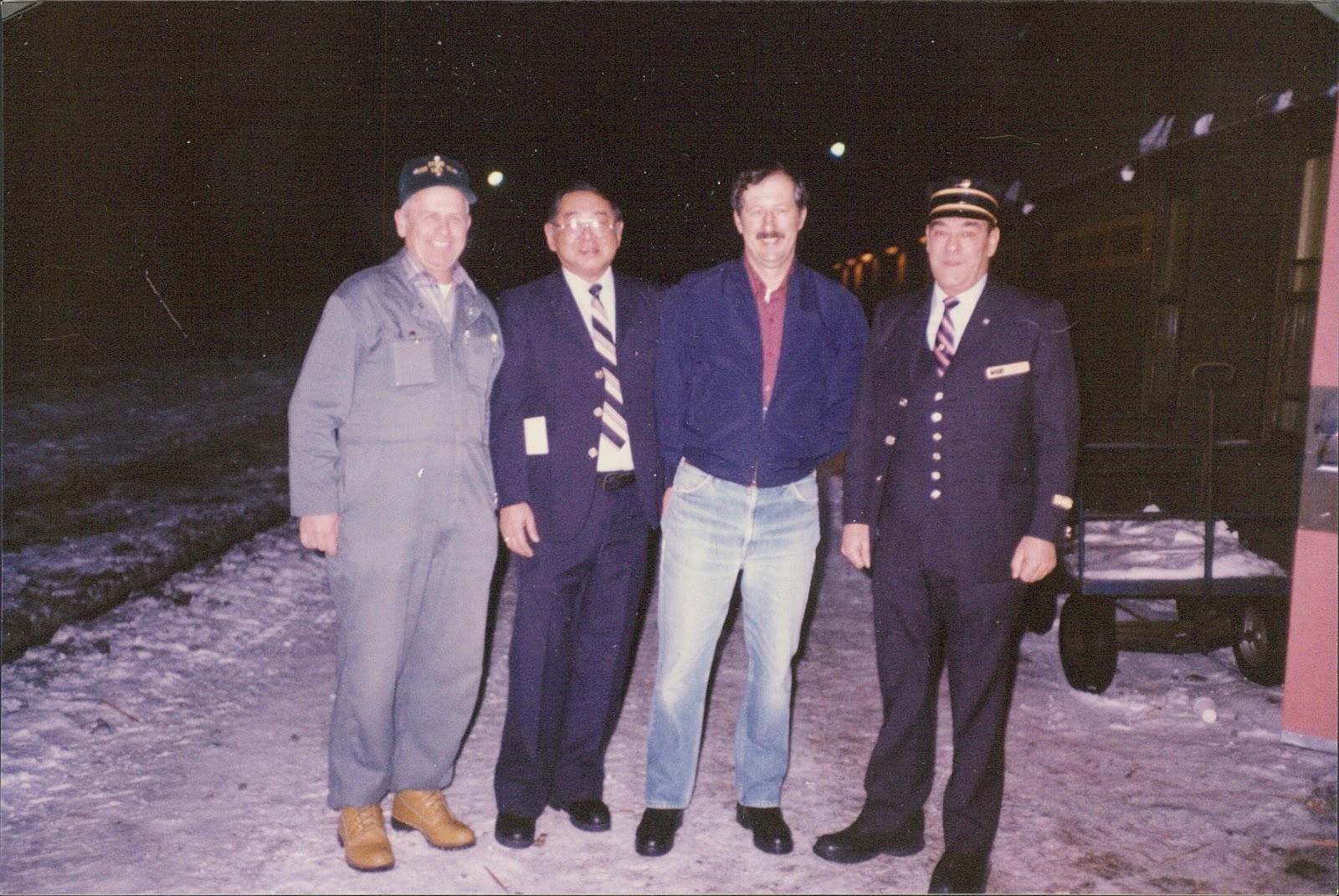
However, in 1987, let's assume it was 11:05 p.m. and you have received news that makes it imperative you are in Toronto the following day. Under the new service, you call Via Rail's toll free number to obtain a reservation. You would be advised that the Via Rail reservation office is closed from 11 p.m. to 7 a.m. but if you want Toronto arrival times you are to call another toll free number.

It is now about eight hours before the train's scheduled arrival in Chapleau, never mind Toronto. If, on time, the train is somewhere around Thunder Bay, and any railroader would tell you that lot can happen before the train ever reaches  Chapleau.

You decide to call the yard office for train information only to be advised that it no longer deals with Via Rail and the local Via Rail representative will be available at the station one hour before the train'a arrival. No longer will CPR provide information  as Via Rail has its own employee. 

This may sound like a simple matter, but in a railway community, this signified a change going back to the 1880s when CPR passenger service was first established. This policy change obviously affected train travellers in communities across Canada.

The CPR employee tells you that he/she is sorry  but "we are no longer able to provide that information", and you are advised to call the Via Rail toll free number. A recording tells you the train is on time.

So, based on the information provided from the recording, you arrive at the station around 7 a.m. only to find that the Via agent is not there. No wonder as the train is about four hours late and the agent is not on duty until one hour before the train's arrival.

The Via agent does arrive one hour before the train's late arrival but you have been waiting all this time simply because a recording from a closed office told you the train was on time --- obviously it had been updated during the night.

When this change happened I was writing a general interest column for The Daily Press in Timmins from Chapleau. As an aside I started my career as a daily newspaper career as a reporter with the Timmins newspaper 52 years ago in 1964 on September 1.

I came across a copy of the column I wrote about the Change at Via recently and decided to share it as an example of declining service at a time when technology was evolving rapidly towards instant communications. Never mind the cancellation of passenger train service on the CPR line three years later.

While working on the column in 1987, I chatted with a CPR employee who commented: "Train service was not the greatest before they took the business away from CP Rail but did Via ever think of asking people for their opinion."

And although this person did not know it at the time, this comment kind of summed it all up: "I am truly beginning to believe that we do live in the back woods now without even an escape route to the cities by train. Yes, we all know that Via, our government run railway is very much in debt, but must Via cut costs by cutting service too". 

In the past few years, there has been an effort by a group in Northeastern Ontario to have regular passenger train service re-introduced on the CPR main line, but so far, no success. My email is mj.morris@live.ca


Saturday, August 6, 2016

George Fife managed Chapleau Electric Light and Power Company from 'humble beginnings' to 'efficient public utility'


For 46 years the Chapleau Electric Light and Power Company, had been an "important and intimate part of both private and business life in Chapleau" but at midnight on August 31, 1955, an era came to a close, according to Vince Crichton in "Pioneering in Northern Ontario'.

From 68 homes in 1909 when J. McNiece Austin bought the Mageau and Leblanc power plant and holdings, to the 826 homes plus businesses in 1955. the company had provided the community's electricity needs.

Mageau and Leblanc had built a sawmill on the east bank of the Nebskwashi River (near what is now commonly referred to as the Memegos Property) in 1899, and by 1909 were replacing its first power plant.

Vince wrote: "Coal oil lamps were hazardous to the operation of sawmills, so the owners built the first hydro plant in Chapleau at their mill site in 1905. The purpose was to provide adequate lighting for the mill and its allied establishments as well as to provide hydro for the growing town of Chapleau".

Mr. Austin needed someone to manage the operation of the plant and company, and persuaded George Fife to take the position. Mr, Fife arrived in Chapleau in 1910 from Renfrew.  His duties included those of manager, technician, electrician, line and installation man and bill collector, Vince noted.

As an aside, Mr. Fife is the grandfather of Robert Fife, one of Canada's most distinguished journalists, currently Ottawa Bureau Chief of The Globe and Mail.

Until 1916, the company only provided night service from one half hour before sunset to one half hour after sunrise.

Vince noted that in 1914, there was a building boom in Chapleau as 50 new homes were built plus the Town Hall, Lady Minto Hospital and Fire Hall.

By December 1915, meters has been installed, and rates beginning on January 1, 1916 were 10 cents a killowat hour with a service charge of 25 cents per month. minimum rate of $1.00 per month and a power rate of $45.00 per horsepower per year with 24 hour service now provided.

By 1918 a new storage dam was started which was replaced in 1929 by the concrete dam with which many of us were familiar, as well the power house was built.

The company realized in 1946 that the available water supply could not cope with the demand for power  and a diesel unit was installed.

Clyde Fife, after returning home from service in the Royal Canadian Air Force in World War II became assistant manager in 1948, and in due course succeeded his father as manager.  Yes, for readers who do not know, Clyde is Bob's father.
Residential school in background
In 1955 the Township of Chapleau had purchased the holdings with the exception of the hydro plant and dams, and agreed to take the entire output of the company.

Vince noted that by 1955 "from a humble beginning in 1910 with a staff of two, the company had expanded to an efficient public utility ... with a staff of three operators, two electricians and line men, a secretary, and assistant manager and a manager."

George Fife "devoted his life to the power company but not to the exclusion of service to Chapleau in other respects. He served as a councillor and was the reeve from 1938 to 1942  -- which included scheduling an "unofficial visit" by King George VI and Queen Elizabeth on their Royal Tour of Canada in 1939, at about two a.m.

The first hydro commission was established in 1956 with Cecil Smith as chairman and members were C.O. Carlson, Leo Racicot and Larry Ribout.

By 1965, a contract had been signed with Ontario Hydro and on September 1, a new era began when a new line was completed into town. Vince wrote that the plant was "deserted and still." 

The Chapleau Post in a tribute to Mr. Fife upon his death said that he watched the company grow from "supplying a handful of homes to ultimately serving the entire community", arriving when "life was rougher, amenities fewer, and there were great things to be done."

It added: "In assuring an adequate public utility, he did much to assure greater development of Chapleau as a modern community.

"Equally enviable is the safety record for Chapleau Electric Light and Power. In a hazardous industry he was able to boast that no employee was ever killed or injured in an industrial accident."

The newspaper article concluded that many communities boast of citizens who devote much to them and Mr Fife was one of them who had done so as Chapleau and the north had "grown great from men like him".

My email is mj.morris@live.ca

Saturday, July 30, 2016

Chapleau's Armand Ruffo honoured with 2016 Life Membership Award by League of Canadian Poets

Armand Ruffo, who was born and raised in Chapleau, has been honoured by the League of Canadian Poets with the 2016 Life Membership Award for his contributions to Canadian poetry.

In making the announcement, at its annual awards ceremony recently, the League said it was "thrilled to grant life membership to Armand Garnet Ruffo" adding that he has made a "significant contribution to poetry in Canada."

The League further explained that "life members are selected for their incredible contribution to poets and poetry in Canada and the award is presented as a mark of distinction and appreciation for special achievements." Armand now joins the ranks of the distinguished Canadian poets who have received a life membership -- one named a year.

In extending congratulations to Armand, the department of English language and literature at Queen's University where Armand is Associate Professor and Queen’s National Scholar, noted that his most recent volume, The Thunderbird Poems, is a companion to his acclaimed biography of artist Norval Morrisseau Man Changing Into Thunderbird.

In 2015, Armand became a finalist for a Governor-General's Award in the non fiction category.

Before joining the Queen's faculty, Armand taught at Carleton University in Ottawa. He has a Master's degree in literature and creative writing from the University of Windsor and an Honours degree in English from the University of Ottawa.

Born in Chapleau with roots to the Biscotasing branch of the Sagamok First Nation and the Chapleau Cree First Nation. He is a graduate of Chapleau High School, and as I have noted on previous occasions when sharing Armand's success stories, he played on the 1970-71 Midget hockey team I coached, and yes, the plaque is still on my wall. I just looked at it!

Armand's work on Norval Morrisseau: Man Changing into Thunderbird inspired Armand to write poems "reflecting the on both the works of art and the context in which Morrisseau painted them," the publisher of The Thunderbird Poems noted adding that the poems "complement the highly evocative and poetic biography, delving into Morrisseau's creative life through compressed, imagistic language, while untangling the complex and powerful threads of meaning, tradition and emotional power that resonate throughout Morrisseau's strong lines and vibrant colours (in his paintings)"

What an incredible undertaking by Armand to deal with Morrisseau's work in prose and poetry. For absolute sure, if I was a bit younger, and looking for a place to study English language and literature, I would head to Queen's University and take courses from Professor Ruffo.

But, some years ago, Armand wrote a play A Windigo Tale, which he turned into an award winning movie. It deals with the intergenerational impact of the residential school system in Canada, framed as both a mystery and a ghost story.

In a recent email Armand advised that he has new projects in the works, and commented, "Must be something in the Chapleau water." There sure must be as Liz Howard recently won the Griffin Poetry Prize for 2016, and like Armand was nominated in 2015 for the Governor-General's Award for poetry.

Congratulations!  My email is mj.morris@live.ca


Michael J Morris

Michael J Morris
MJ with Buckwheat (1989-2009) Photo by Leo Ouimet

UNEEK LUXURY TOURS, ORLANDO FL

UNEEK LUXURY TOURS, ORLANDO FL
click on image

MEMORIES FROM CHILDHOOD

MEMORIES FROM CHILDHOOD
Following the American Dream from Chapleau. CLICK ON IMAGE