MICHAEL's EMAIL

WELCOME TO THE MICHAEL J MORRIS REPORT!!!!

EMAIL mj.morris@live.ca

WRITE ME WITH COMMENTS, STORY IDEAS, SUGGESTIONS, INFORMATION REQUESTS. IF YOU CAN'T FIND A STORY, DO NOT HESITATE TO EMAIL ME

Showing posts with label christ church. Show all posts

Wednesday, March 18, 2015

Killing the World for the Sake of Convenience

By Rev. Yme Woensdregt

Did you catch the tidbit on the news the other day that the inventor of the Keurig coffee system regrets ever doing so? When he invented the system, John Sylvan thought there might be a limited appeal to people who would normally go Starbucks, Dunkin Donuts or other coffee chains in the morning, because now they could get a cup of coffee at work that was cheaper, faster, and no fuss. “That would make it environmentally neutral, because you wouldn’t have those Starbucks cups everywhere,” he said in an interview.
He is mystified that the system has become as popular as it has. In fact, because he never thought it would amount to much, he sold the rights to the system for a paltry $50,000 in 1997.
Since then, however, Keurig Green Mountain (the parent company) has taken off. It’s not just being used in offices, but in homes and other places as well. People seemingly can’t get enough of the stuff. Sales figures show that 1 in 3 homes in the US have a Keurig machine. In 2014, Keurig sold over 9 billion K–cups—the 1–serving coffee pods you pop in the machine to make a single cup of coffee. Since 2008, sales have increased 6–fold.
People have fallen in love with this system for two main reasons. One of the reasons, as someone said to me last week when I asked is, “It just tastes so good.” I wouldn’t know about that. I’ve never used the system, but I also find that the coffee I’m able to buy at local retailers also tastes pretty good.
But I suspect that the biggest single reason is the convenience of it. You pick up a single–serving K–cup, pop it into the machine, add water, and presto changeo you have a cup of coffee in almost any flavour you desire.
In a recent interview with The Atlantic, Sylvan says, “I feel bad sometimes I ever did it.” Why? He says it’s not because he’s not sharing in the massive profits of his invention. He regrets it because the K–cups have become an environmental hazard. They are not recyclable or biodegradable, and almost all of them end up in landfills. Sylvan indicates that he never anticipated this scale of waste.
Sylvan is aware of the appeal of the system. “It's like a cigarette for coffee, a single-serve delivery mechanism for an addictive substance.” Each K–cup contains 11 grams of ground coffee, vacuum–sealed in nitrogen to prevent oxidation. At that rate, what you’re buying is standard coffee grounds for around $40 per pound. Pretty expensive coffee!
There are billions of them around. They are everywhere, over 400 varieties of hot drinks made by multiple manufacturers. In 2014, there were enough discarded K–cups to circle the globe 10½ times.
Keurig Green Mountain says it can make a recyclable cup by 2020, but Sylvan disputes this claim. Even if it is possible, that’s still 5 years away, which means we can circle the globe another 53 times with K–cups.
It amazes me how willingly we continue to damage the environment. It would be such a simple thing to stop using these pods. We’d also save some money, since the excellent coffee I buy at a local retailer is less than half the price of these convenient pods.
Sylvan thinks that Keurig users should think hard about the choices they’re making when it comes to a cup of coffee. “From a personal standpoint, it saves 20 seconds of your day,” he told As It Happens. “What's that worth?”
On a related note, do you know about what is being called the Great Pacific Garbage Patch? Billions of pounds of plastic garbage are trapped in a great holding pattern twice the size of
Texas in the middle of the Pacific Ocean, held there by currents that draw the garbage in and won’t let it escape. The plastic doesn’t get there on its own … it gets there because we throw it into streams and rivers which make their way to the ocean. On some beaches in Hawaii, the plastic is up to 10 feet thick!
If you want to know more about how our hunger for convenience is killing the planet, there’s a wonderful “mockumentary” on youtube called “The Majestic Plastic Bag”.
We can stop killing the world. There are so many simple little things we can do.
What's it worth to you?

Rev Dr Yme Woensdregt is Incumbent at Christ Church Anglican Cranbrook BC

Sunday, March 8, 2015

Healthy Tradition…Unhealthy Traditionalism

By Rev. Yme Woensdregt

“Fiddler on the Roof” is one of my favourite movies. It opens with an extended musical number about the importance of tradition. Tradition, says Tevye, tells us who we are, how to behave, how to relate with one another and with God. Tradition is often the glue that holds a family or a community together.
Life is filled with traditions of all kinds. What would political life be without the pageantry of an inauguration, or the hectic atmosphere of a nominating meeting? How could families celebrate their lives without tradition? We each of us have our traditions, and life can be its best when we take long–standing traditions and fill them with new meanings appropriate to a new day and a new way of being.
Jaroslav Pelikan, one of the foremost historians of Christianity, however warned us of the dangers of a narrow traditionalism. In one of his famous aphorisms, he said, “Tradition is the living faith of the dead; traditionalism is the dead faith of the living”.
I was reminded of this again when a friend sent me an email about the standard railroad gauge (distance between the rails) in the US. The standard is 4 feet, 8.5 inches —an exceedingly odd number. Why such an odd gauge?
Well, that’s the way they built railroads in England, and since railroads in North America were originally built by English immigrants, Canada and the USA use the same gauge.
The story deepens. The English built them to that gauge because the first rail lines were built by the same people who built the pre–railroad tramways, and that’s the gauge they used. And ‘they’ used that gauge because the people who built the tramways used the same jigs and tools that they used for building wagons which used that wheel spacing. And the wagons had that odd wheel spacing because otherwise the wagon wheels would break on some of the old, long distance roads in England because that was the spacing of the wheel ruts in the old roads. Those old roads were built by imperial Rome so their legions could travel long distances more easily. Those roads have been used ever since.
And the ruts in the roads were that wide because they were originally formed by Roman war chariots, which everyone else had to match for fear of destroying their wagon wheels. Finally, the wheels were that far apart to accommodate the rear ends of the two horses which pulled the chariots.
So the standard railroad gauge of 4 feet, 8.5 inches is derived from the original specs for an Imperial Roman war chariot. Bureaucracies, which thrive on traditionalism, live forever.
But it gets even more interesting. Modern space shuttles have two big booster rockets attached to the sides of the main fuel tank. These solid rocket boosters were designed at a factory in Utah. The engineers who designed them would have preferred to make them a bit fatter … but they had to be shipped by train from the factory to the launch site. The railroad line from the factory happens to run through a tunnel in the mountains. The rockets had to fit through the tunnel, which is slightly wider than the railroad track; and the railroad track, as you know, is about as wide as two horses’ behinds.
So, a major design feature of what is arguably the world’s most advanced transportation system was determined over two thousand years ago by the width of rear ends of two horses.
When I received that email, I couldn’t help but laugh. All of us, to some extent, are caught by such unthinking traditionalism. We think that the way we do things makes good sense … but truthfully, we often do them that way because we've always done them that way.
We never really think it through. We do something once … twice … and it becomes a tradition, even when the original reason for it has passed. After all, who decrees that a set of train tracks needs the same width as a set of chariot wheels?
The church is especially vulnerable to this. “Gimme that old time religion”, a spiritual sings, because “it was good enough for (add a name here)”. But that’s not really so. Each new age needs to formulate its faith in a new way to meet new needs and to answer new questions. We can’t just keep doing the same old things the same old way.
Tradition can be a very good thing. Traditionalism usually is pretty unhealthy.

Rev Dr Yme Woensdregt is the Incumbent at Christ Church Anglican in Cranbrook BC.

Thursday, March 5, 2015

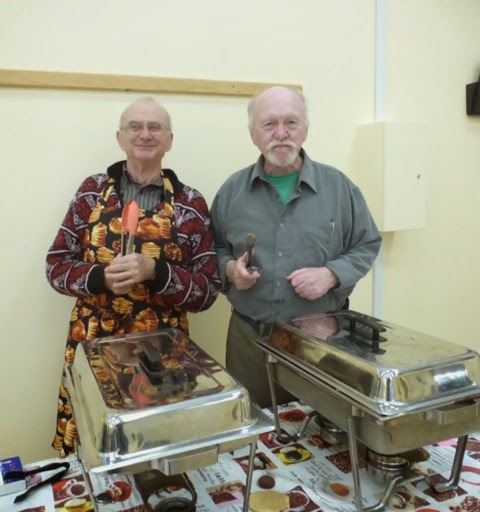
Shrove Tuesday pancake dinner introduces 'fashion ikons' of Christ Church in Cranbrook

The annual Shrove Tuesday Pancake dinner this year at Christ Church Anglican in Cranbrook, not only resulted in the usual great meal, but was also an appearance by the male "fashion ikons' of the parish.

Rev. Yme Woensdregt, the Incumbent, coined the fashion ikon comment after seeing the men who prepare and serve the pancake feast, attired in matching aprons for the occasion -- well almost, as Gerry Warner chose a different apron.

Bill Nightingale, who has been chairing the popular event for many years once again put together an excellent team of chefs aka fashion ikons, for the occasion to start the Lenten season. Congrats again Bill and also to Mark Spence-Vinge, your able assistant.

Although I have been helping at the pancake dinnerfor some years now, I have not been promoted above the rank of server of the excellent pancakes and sausage to a chef position.

In fact, when I tried to don an apron, it was quickly removed and I was pointed to my place behind the serving table.

Regular readers will notice from the photos that many of those involved are also members of the Friday Morning Coffee Club, aka FMCC, These guys get around!!!

Nonetheless, it was another very successful Shrove Tuesday event, and as the old saying goes "A good time was had by all."

Thanks to Joel Vinge for providing the photros.

Maybe one of these years I will be permitted to join the ranks of the fashion ikons, er chefs!


Sunday, December 12, 2010

Christ Church in Cranbrook BC supports Anglican Silent Night Project for Military Chaplains

Jim Scanland, a veteran of World War II, who is considered a "saint" of Christ Church, with his wife Mary, led the singing of Silent Night, with Jim on his omnichord, all organized by Rev. Dr. Yme Woensdregt, Incumbent, (far right) who organized the event.

The church is located in Cranbrook BC, where I now live.

Yes, I was there, up in the back row behind Jim and Mary.

Jim Scanland died a few months after he participated in this project. May he rest in peace.

The Primate of the Anglican Church of Canada, Archbishop Fred Hiltz,  asked that donations from the Silent Night Project be directed to support the ministry of Anglican military chaplains, who work among the women and men of the Canadian Forces.

There are more than 85 Anglican military chaplains who serve in the Canadian Forces.

They minister specifically within the Anglican Military Ordinariate (AMO), the grouping of all Anglicans in the Canadian Forces. Yet their work of spiritual support extends to all members of the Forces—Anglicans, other Christians, and people of other faiths.

Chaplains serve wherever the Canadian Forces are stationed. A chaplain may travel overseas on a humanitarian mission, serve the Eucharist aboard navy ships, or counsel women and men who suffer from post-traumatic stress disorder.

Michael J Morris

Michael J Morris
MJ with Buckwheat (1989-2009) Photo by Leo Ouimet

UNEEK LUXURY TOURS, ORLANDO FL

UNEEK LUXURY TOURS, ORLANDO FL
click on image

MEMORIES FROM CHILDHOOD

MEMORIES FROM CHILDHOOD
Following the American Dream from Chapleau. CLICK ON IMAGE