MICHAEL's EMAIL

WELCOME TO THE MICHAEL J MORRIS REPORT!!!!

EMAIL mj.morris@live.ca

WRITE ME WITH COMMENTS, STORY IDEAS, SUGGESTIONS, INFORMATION REQUESTS. IF YOU CAN'T FIND A STORY, DO NOT HESITATE TO EMAIL ME

Showing posts with label austin. Show all posts

Thursday, April 11, 2019

Mageau and Leblanc establish first lumber mill on Nebskwashi River at Chapleau in 1899

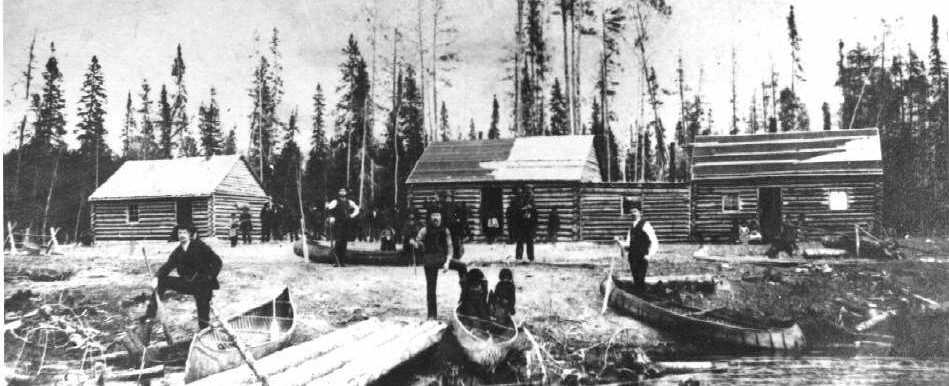
The only lumber mill known to be located at Chapleau prior to the 20th Century was built by Zotique Mageau and Aldye Leblanc in 1899 just south of Chapleau on the banks of the Nebskwashi River near the old power house.

An article about this venture says that in 1903 they and others bought the land for a mill site -- 82 acres for $82,000.

By 1905  the Mageau and Leblanc Lumber Company Limited had received a charter under the Ontario Companies Act. The principals were Zotique Mageau, J.E. Serre Joseph Prioux and A.O. Aubin.

Others involved were Oliver Laberge (lumberman), Saladine Mageau (married woman), Henry Anton West, Kenneth McRae (hotel keeper) and Joseph Debois. (I have no idea why the occupation or status of some was included and not others).

The stated purpose of the company was to "manufacture lumber and other wood products".

Its head office was located in Chapleau and the company had a share capital of $40,000 divided into 40 shares of $1,000 each. Mr. Mageau the president had 11 shares which was the single largest block.

Incorporation was "no doubt" related to the company's plan to build a power plant on its mill site, according to the article.

The power plant was needed to supply lighting for the mill while excess power would be sold to the village of Chapleau.

However, before very much happened, the whole site was sold including the mill was sold to James McNiece Austin in 1909.

Mr. Austin was a member of the family who established the first store in Chapleau after the arrival of the Canadian Pacific Railway in 1885. He had taken over store from his brother T.A. Austin.

 Mr. Austin had entered into an agreement with the CPR to sell them ties.

In 1901, the year Chapleau became incorporated as a municipality Mr. Austin entered into a partnership with George Brecken Nicholson, the community's first reeve, to form Austin, Nicholson Lumber Company.

Their first mill was under construction on a point of land between Lake Windermere and the CPR, 22 CPR miles west of Chapleau, and the community of Nicholson developed at this site including boarding houses, cottages, warehouses and other structures necessary to support the logging operations of the company.

They became the largest supplier of railway ties in the British Empire with Mr. Nicholson as manager of operations.

By about 1908 the Chapleau Electric Light and Power Company was being formed, and the plant was under construction.

Chapleau's first lumber mill lasted about nine years but the area became important as a power generating location even as the saw mill was abandoned.

"The purchase of the Nebskwashi mill by Mr. Austin meant the end of lumbering in Chapleau. For the next three decades lumbering activities in the area were centred at Nicholson's Siding the heart of the Austin Nicholson Empire," the article noted.

Other small operations did start to appear in the area though, and more about them later!

As I was researching this column, Richard Lamoureux posted information about the "Alligator" boat one of which was used by Zotique and Mageau. Mr. Lamoureux is administrator of the very popular Historic Northern Ontario Facebook page. I highly recommend it to anyone interested in Northern Ontario history.

Here is part of his comments which he says was adapted from Wikipedia.

"The Alligator boat from the mill in Chapleau.
"Alligator boats were a type of amphibious vehicle used in the forestry industry throughout Northern Ontario. These boats were so named because of their ability to travel between lakes by pulling themselves with a winch across land.
"Alligators served as "warping tug". They towed log booms across lakes and then portaged themselves using a winch to the next body of water. The rugged, steam-powered tugs were one of the pioneers in the mechanization of the forest industry."

My email is mj.morris@live.ca

Thursday, February 28, 2019

Chapleau becomes thriving community despite obstacles after arrival of Canadian Pacific Railway in 1885

It never ceases to amaze me how quickly Chapleau developed into a thriving community after the Canadian Pacific Railway arrived in 1885, so I decided to share some of the activities described in the Richard Brownlee Papers. 

Some of the first settlers lived in tents, which also included the community's first store opened by T.A. Austin and located near the site of the Lady Minto Hospital in what was called 'Old Chapleau'. After Mr. Brownlee arrived in February 1886, he established his barber shop in the same location.

However, an early publication says that it was a "red letter day" for the Austin brothers, T.A. and J. McN, when they opened their store on Birch Street in September 1886 with a lean to on the side for Mr. Brownlee's barber shop. The building also housed the first post office.

But it was not only the Austin brothers who were establishing stores. By the end of 1886 it appears that five stores including Austin were on the scene or about to be opened. They included Murrays and Mulligan operated by Patrick Mulligan (my great great uncle), Deland and Kellett, P. Manion and the Hudson Bay Company relocated from what is now referred to as the "Memegos Property" on the Nebskwashi River.

Many  of the early settlers lived in tents, others lived in two rows of boxcars on Godlin and Stovepipe Avenues.

In my 1984 book 'Sons of Thunder... Apostles of Love' I noted that the winter of 1885-86 was extremely cold and disease was rampant. Chapleau had about 450 citizens, 90 percent of them men. Fire was also a great threat.

Boarding houses were built quickly  and the Queen's Hotel was opened in 1887, and the Algoma Hotel about 1890, but it burned down and was later rebuilt.


By 1886, three churches had been established -- Roman Catholic, Church of England (Anglican) and Methodist (later United).

The first public library opened in 1888, first in a boxcar then in the Mechanics Institute where it became the "centre of the social and intellectual life" of the community. It burned down in 1906 and at the time had 2000 volumes on its shelves. 


A school was also established, the first in a tent,  and moved locations until settling on Pine Street.

A street plan was completed and streets were named after Governors General of Canada, trees and King and Queen. Residential areas were established.

An open air  arena was established on Lorne Street by J. Gill by 1888 and a Chapleau hockey team made its first road trip to Sudbury in 1893. It lost. Curling had also been introduced. Other sports were also being played.

The Chapleau Brass band was founded in 1888.

Fast Forward to 1915.  An article notes that "In December 1915 they (the CPR) were moving over 450 cars a day through Chapleau -- there were 56 crews needed to handle the work -- they had fifty engines to handle the freight alone,with six passenger and two yard engines: there were three sets of despatchers and new offices all along the line were opened up, employing some thirty extra operators".

Chapleau citizens started going to Mulligan's Bay (named after Patrick Mulligan) early in its history and apparently the very first boat was a sail boat owned by J.B. Dexter, who helped found the Chapleau Brass Band, was a council member and fire chief.

This has just been a gimpse at some of the happenings in Chapleau mostly before 1900. Despite many obstacles the early citizens established a thriving community in the wilderness of Northern Ontario. 

Once again thanks to Margaret Rose (Payette) and Bobby Fortin -- both members of Chapleau pioneer families -- for loaning me the Richard Brownlee Papers. My email is mj.morris@live.ca


Saturday, April 23, 2016

Bachelors of Chapleau sponsor first dance in Chapleau Town Hall in 1915 with Alf Comte's Grand Orchestra

see names below
The first dance in the new Town Hall was held in 1915 sponsored by the "Bachelors of Chapleau", according to an article in the Richard Brownlee Papers. The hall was opened in 1914.

The unidentified writer, noted that a large illuminated sign with the word "BACHELORS" on it was suspended over the centre of the auditorium.

The "Grand Orchestra" under the leadership of Alf Comte was in attendance and the favourite dances were waltzes, two steps, three steps, four steps and barn dances. 

"The bachelors were all in full evening dress while the ladies ... were divinely beautiful and gorgeously gowned, some of them wearing long dresses.'

The writer poses the question, "Do you ever see anything like this in a Chapleau ballroom today?'" My best guess is that this article appeared in the Chapleau Post circa 1930. How about today in 2016? At best maybe an idea to mark moments in Chapleau history?

Some of the "patronesses" for the occasion were the wives of T.J. Godfrey who had just become reeve of Chapleau; G.B. Nicholson who had  served as reeve from 1901 to 1913; V.T. Chapple of Smith and Chapple Ltd. and William McMullen, who had been the postmaster and also assistant superintendent of the Canadian Pacific Railway. Interesting that in 1915, the wives were not identified by their own names. 

Moving on to an observation about the CPR, he notes that in December 1915 it was moving over 450 cars a day through Chapleau and there were 56 crews with 50 engines to handle the freight alone, plus six passenger and two yard engines.

Now, let's go back to the beginnings of Chapleau in 1885, and I do so because since I started sharing insights from the Richard Brownlee papers, kindly loaned to me by Margaret Rose (Payette) and Bobby Fortin, there seems to be quite an interest in the early years of the community. 

I am careful though about assigning exact years for some though as depending on the source they sometimes vary. As always, at best I try to provide the second and maybe third "rough draft" of Chapleau history.

In response to a recent question, by 1887, according to the Brownlee papers five general stores were opened: Murrays and Mulligan, T.A. Austin (moved to the present Birch Street from "Old Chapleau" on the hill in 1886, and Mr. Brownlee's barber shop was included as a leanto); Delland and Kellett; the Hudson Bay Company (moved from what is now referred to as the Memegos Property) and P. Manion. 
HBC post at "Memegos Property"

(Full disclosure: Patrick Mulligan was my great-great uncle,and William McMullen my great uncle)

By 1888, Chapleau's first band had been established with J.B. Dexter as the first bandmaster, with 13 members. The band held its first picnic on May 24, 1889, marking Queen Victoria's birthday, and apparently it was a big success.

The first boat also appeared on the Chapleau river.

I am sharing several photos but in the case of the one apparently showing Chapleau in either 1887 or 1889 here is the description from the Chapleau Public library site, which I highly recommend to those interested in Chapleau history.


"It was taken from a point south of the Canadian Pacific Railway opposite the west end of Pine Street. You may observe the wooden sidewalk along the south side of Pine Street and the C.P.R. houses located there today, to the extreme left of the picture. In the centre may be observed Beech Street and further along to the right Main Street (Birch). To the south side of Birch Street may be seen the Mechanics Institute with the three top windows which was built in 1889. Next to it is the Hudson Bay Store. Opposite to this store may be seen the present Bank of Montreal building (now replaced by the new building on the north-west corner of Birch and Young)
"The two small hills or elevations through which the C.P.R. track passes (track is visible in centre running left to right) may be observed. Upon and over them the present overhead bridge is located. Notice the road coming from the south side of the railroad and crossing the track in the vecinity of Pellow's coal sheds, south of the present day C.P.R. freight offices.
"It would appear that Chapleau extended in those days from the bank of the river along Pine Street, across the present town site in the vicinity of the Fox Theatre and continued south to Cedar Street, then south along Lorne Street to the site of the Imperial and Canadian oil depots."

Thanks to all who are in touch with me and to Ian Macdonald for assistance on photo identification. My email is mj.morris@live.ca, and yes, I am on Facebook and Twitter.

names of the Chapleau gentlemen  ----  Male fashion of 1912. Back row left to right: Albert Desjardin, George White, George Collinson, Gordon Sheppard, Simon Kruger, Claude Christenson. Front row: D.O. Payette, Joe Magail or Magill, George Barclay, unknown, Tom Thompson.Some of these men were undoubtedly at the dance.

Saturday, August 15, 2015

Austin brothers 'keenly alive to possibilities of trade' in Chapleau after CPR arrived in 1885

Austin store Chapleau circa 1886
The Austin brothers opened their "new" store on September 6, 1886, making it a "red letter day" for Chapleau, according to the Chapleau Post.

Actually, they  had moved from "Old Chapleau" where they had pitched a tent near the site of where the Lady Minto Hospital was opened in 1914.

Their store on Birch Street about where the Bank of Montreal was located, and before that Pellow's store, was twenty feet wide and about thirty-five feet long, and had a leanto attached where Richard Brownlee had his barber shop. Mr. Brownlee's first shop was also in a tent near the hospital site. The upstairs was fitted as a lodge room for the Brotherhood of Locomotive Engineers and was also the first hall for the Independent Order of Oddfellows.

However, Chapleau seemed to be a very busy place as the Chapleau Headlight reported that five stores were established in 1886-87 or thereaabouts. Along with the Austin store were Murrays and Mulligan, Deland and Kellett, Hudson Bay Company (moved from what came to be called the Memegos property) and P Manion.

T.A. and J. McN. Austin were from Renfrew County and "keenly alive to the possibilities of trade decided when Chapleau was made a divisional point (on the CPR in 1885) to enter into business on their own account.

"They purchased a lot, pitched a large tent and opened up a general business under the name of T.A. Austin and Company. The business was a success from the first, founded on the principle of fair value and service."

The Chapleau Post story on the founding of the Austin store was included in an edition some 50 years later. 

"Application was made for a post office and this had a double effect of giving service to the community and bringing every newcomer to their store for mail.

"The Austin brothers were ideal merchants and catered to every need of the community: a car of lumber to build a house; the furniture to furnish it. the wedding suit; the ring, or a reliable time piece, and sometimes the funeral casket"

The Chapleau Post story noted that stores were busy supplying trappers, construction gangs, bridge and building gangs, extra gangs and some small lumber operations with goods. 

Supplies were also being freighted from Chapleau to a new railway, which later became the Canadian National Railway, to the north. I was fascinated to learn that as many as 100 teams of horses were working at one time out of Chapleau in the winter on this project, and in the summer boats took "great loads" down the river to the 18 mile rapids, and then on to the new railway line.

However, by 1889, T.A. Austin, "as a result of a stirring evangelistic service" held in a tent where Trinity United Church is now located decided to become a Methodist minister and sold his business interest to his brother.

Soon thereafter J.McN. Austin moved the store to the corner of Birch and Lorne streets. It forms part of the Chapleau Village Shops today. The Austin family lived in rooms above the store.
Store in 1890s

Included in the store was a millinery and tailor shop. The Chapleau Post reported that "millinery was a big part of the business in those days and many a Chapleau belle wore a chapeau that cost her $25.00. (Wow, that would have been very expensive)

In the tailor shop there were as many as nine tailors and cutters working at one time.

J. McN. Austin became good friends with G.B. Nicholson who upon arrival in Chapleau worked as a fireman and later engineer on the CPR. 

Eventually they formed a partnership to develop the business of supplying the CPR with ties, and Austin Nicholson Lumber became the largest supplier of ties in the former British Empire.

By about 1901 he had sold his store interests to Beamish and Smith, while Chapleau was also incorporated as a municipality and Mr. Nicholson became the first reeve. The store later became Smith and Chapple Ltd., now Chapleau Village Shops.

Browsing through the R ichard Brownlee papers kindly loaned to me by Margaret Rose and Bobby Fortin, provides an insightful look into early Chapleau. My email is mj.morris@live.ca

Tuesday, March 5, 2013

Patrick Mulligan founds Murrays and Mulligan in 1886, serves as Chapleau postmaster, attends Sacred Heart Church, builds camp at Mulligan's Bay by Michael McMullen

Patrick Mulligan and family 1895

Here is Michael McMullen's story of the Mulligan family, particularly Patrick Andrew, who arrived in Chapleau almost at the beginning of the community's life, and played various roles in its early years. Patrick Mulligan was Michael's great-great uncle, and mine, as our grandmothers, his nieces, May (Mulligan) McMullen and Lil (Mulligan) Morris were sisters.Since the Chapleau High School reunion, I have been working on several family histories, and will share more as they are completed. My thanks to Michael for the Mulligan story.
by Mike McMullen
In 1885, as the Canadian Pacific Railway (CPR) was constructing its main line west through northern Ontario, it began providing a monthly general store on wheels or as it was commonly called ”a store car” that offered merchandise (dry goods, groceries, etc.) to those living and working along the line. The major supplier of these products was T. & W. Murray of North Bay. One of their senior clerks, Patrick Andrew Mulligan, was in charge of these Murray-supplied store cars that went to construction camps and permanent settlement locations along the developing CPR line, including Cartier, Biscotasing and Chapleau.
Murrays and Mulligan was located in Dominion Store building
In 1886, Patrick joined in partnership with the two Murray brothers, Thomas and William, who were merchants, financiers, politicians and entrepreneurs, to purchase lots and invest in Chapleau. On one of these lots, at the northwest corner of Birch and Young streets, Patrick constructed a two-storey general store that was under construction in 1886 and fully open for business in early 1887. This store became the third permanent general store in Chapleau, following shortly after T. A. Austin & Co (mid-1886) and the Hudson’s Bay Company (late-1886). Murrays and Mulligan, General Merchants, operated until 1897 when the business and the property were sold to Patrick McCool, a long-time Murrays employee and associate. 
Five years later in 1902, the business was sold to Alex Langis and James Jackman and then in 1908 a change in ownership was made to Desjardins (Albert) and Langis. The following year, these partners relocated their general merchant business to the southeast corner of Lorne and Birch streets. From there, that business evolved over time into what is today Collins Home Hardware and Building Centre and Collins Home Furniture.
Following the departure of Desjardins and Langis in 1909, the Murrays and Mulligan building, 4 Birch Street W., among other uses, became the location of the Macnamera general store, a Dominion store, head office for Austin and Nicholson Lumber Company and a branch of the Bank of Montreal. The building was demolished in late 1980.
Patrick was the oldest of seven sons and two daughters born to Hugh and Mary (Griffin) Mulligan in Quyon, Quebec, a village located on the Ottawa River, west of Ottawa, now part of the Municipality of Pontiac. Like many in the Ottawa valley in the 1880s, Patrick moved up the Ottawa River on the Ontario side to places, such as Pembroke and Mattawa, and then on to North Bay and Northern Ontario as the CPR was being built. Not only was there work available with the railroad, but towns were being established and services were needed for both.
He was working in Pembroke as a store clerk in the early 1880s, when he met Julia Catherine (Kate) Flannery. They married in September 1882 at nearby Chapeau, Quebec, on Allumette Island. She was the daughter of William and Catherine (Wells) Flannery, and the family lived in the Pembroke area. Her father died at an early age leaving a wife and five young children. Willietta, a younger sister, married Thomas Mulligan, one of Patrick’s brothers, also in Chapeau in August 1890. Thomas worked for Murrays and Mulligan, and his brother Patrick, as an accountant and clerk in Chapleau. A brother of Catherine’s, Maurice Flannery, originally a merchant, became town treasurer and Divisional Court Clerk in North Bay. Patrick and Kate had four surviving children: Effie, William, Inez and Beatrice.

Besides managing the Murrays and Mulligan store, Patrick developed contracts with the CPR to supply the work crews between Cartier and White River and to supply the CPR restaurants at Cartier, Chapleau and White River. He built a large warehouse near the corner of Birch and Lisgar streets to service these contracts. Today, the Bridgeview Motel, 16 Birch Street W., built by Yen Hong in the mid-1950s, is on the lot where this warehouse was located.


As well, he became the town’s fourth Postmaster in late 1896 (1896-1913). He followed T.A. Austin (1886-1890), J. M. Austin (1890-1892) and H. Nicholson (1892-1896). His sister-in law Winnie Flannery was the Assistant Postmaster for some time around 1900. While Postmaster, he built a small Post Office just to the east of his warehouse on Birch Street. It was the first stand-alone post office in Chapleau as all former facilities were in stores. This building would have been located where an addition was made to the original Boston Café building on Birch Street in the early 1970s. My grandfather, William McMullen, was the fifth Chapleau postmaster (1913-1919) and worked in that post office building.


At least three of Patrick’s brothers worked in Chapleau at various times between 1886 and 1913. In the mid-1890s all four brothers, Patrick, Thomas Michael, John George and Charles R. were in Chapleau at the same time. Patrick and Thomas were working at Murrays and Mulligan, John was the agent for Dominion Express (later named Canadian Pacific Express) and Charles was a carpenter.The Mulligans were involved in Chapleau community activities and attended the Roman Catholic Sacred Heart Church. In 1909, Patrick built a new house at 49 Monk Street, which is still standing today.
Another brother, who never lived in Chapleau, but had an impact on Chapleau, was James Edward Mulligan, my great-grandfather. Originally a storekeeper, he was working as a bailiff in North Bay in the mid-1890s when he died suddenly in December 1895. At the time, he was the father of five children aged 10 and under (three girls and two boys) and his wife, Jennie was pregnant with another daughter. In large part, because of the Mulligan presence in Chapleau, members of this family moved to Chapleau in the early 1900s and some became long-time Chapleau residents.
T hree of the daughters (who were brought up Anglican by their mother) met future husbands in Chapleau and lived there for many years. May married William McMullen, Lillian married Harry Morris  and Kathleen married John Hogg. The other daughter, Nellie, did not live in Chapleau. The two sons, Griffin and Charles, worked for the CPR out of Chapleau, served in World War 1 and subsequently, moved to the United States after the war.
Patrick died in Chapleau in April 1913. Later that year, Kate sold their house to Frank Keenan and moved to North Bay with her two daughters, Inez and Beatrice. Effi, their first born child, died when she was nine years old in 1891. Their son William had left Chapleau and apparently was not actively involved in his father’s business activities in Chapleau at the time of his father’s death. It is likely that Kate sold most of Patrick’s business ventures before she left Chapleau. However, she maintained ownership of property in Chapleau and in 1918 sold three contiguous lots on Birch Street to Hong Fong and Hong Sam. On one of these lots, Hong Fong built the Boston Café in the mid-1920s. The restaurant, now called Hongers Redwood Restaurant and Tavern, 12 Birch Street W., is still in the Hong family in 2013 with Jim Hong the owner and manager. Kate died in April 1945 in Toronto.
One would be hard pressed to find any traces of the Mulligans in Chapleau today. As far as I can determine, this line of the Mulligan family in Chapleau ended with Michael Morris, a grandson of Harry and Lillian (Mulligan) Morris. He grew up in Chapleau,  worked as a journalist, then became a high school teacher and reeve in Chapleau before moving to Cranbrook, British Columbia to continue his teaching career. There is not a Mulligan street sign or a house referred to in the community as the “Mulligan House.” The only legacy would be Mulligan’s Bay. Family history has it that Patrick was the first to build a permanent camp on Brownlee Island (Card Island) in the 1890s and as a result the area became known as Mulligan’s Bay.

My email is mj.morris@live.ca

Michael J Morris

Michael J Morris
MJ with Buckwheat (1989-2009) Photo by Leo Ouimet

UNEEK LUXURY TOURS, ORLANDO FL

UNEEK LUXURY TOURS, ORLANDO FL
click on image

MEMORIES FROM CHILDHOOD

MEMORIES FROM CHILDHOOD
Following the American Dream from Chapleau. CLICK ON IMAGE