MICHAEL's EMAIL

WELCOME TO THE MICHAEL J MORRIS REPORT!!!!

EMAIL mj.morris@live.ca

WRITE ME WITH COMMENTS, STORY IDEAS, SUGGESTIONS, INFORMATION REQUESTS. IF YOU CAN'T FIND A STORY, DO NOT HESITATE TO EMAIL ME

Showing posts with label chapleau centennial park. Show all posts

Thursday, July 13, 2017

Flag raising ceremonies at Chapleau Centennial Museum described as 'heritage moment' in community's history

Totem pole a Terry Way-White, Jack Whitney project
When the Chapleau Centennial Museum was officially opened on July 1, 1967 as part of the community's celebration of Canada's 100th anniversary, the flag raising ceremony was an important part of the proceedings.

The centennial committee headed by Arthur Grout had contacted the premiers of all the provinces and the prime minister requesting that a flag be donated for the occasion. It happened!

The flag raising ceremony was conducted after a Colour Party composed of members of Branch Number 5 of the Royal Canadian Legion arrived.

They just didn't raise the flags  had found representatives from each province to participate and do it.

 As I was working on this column, seeing their names brought back so many memories of growing up in Chapleau.

Here are the participants taken from a Chapleau Sentinel story.

Reg Thrush, who was born In England raised the Canadian flag.

Mrs. Earle Campbell, born in British Columbia raised her home province's flag, while Mrs. Ruth Smith did the honors for Alberta where she was born. Mrs. Edith McKnight raised the flag of Manitoba her home province.

Lorrie Gerset, sister of Jim and Ted Demers travelled from Saskatchewan to raise its provincial flag.

Mr. and Mrs. J.E. Goldstein raised the flag of the Yukon. Their daughter Dawn was working as a nurse there. The Nothwest Territories did not have a flag.

Moving east, D. O. Payette raised the flag of Ontario while Mr. and Mrs. J.E. Martel did so for Quebec.

Nova Scotia born Layton Goodwin raised his province's flag while Mr. and Mrs. James Good from New Brunswick raised their flag and Emmet Brazel did so for Prince Edward Island his province of birth. Mr. and Mrs. Walter Steed raised the flag of Newfoundland.

Thirty years later in 1997, at a flag raising ceremony to replace the flags, Recreation Director Terry Piche described it as a "heritage moment", and his comments applied equally to that ceremony as it did to the 1967 one.
1997

In 1997, coinciding with the celebration of the 75th anniversary of Chapleau High School, the flag raising ceremony was re-enacted but unfortunately the newspaper reports did not name the flag raisers.

However, Terry told those attending of the significance of the flags as "a symbol of the unity of the community" and the importance of preserving its heritage. So true. Throughout its history, people have come from all parts of Canada, and indeed many other countries to live in Chapleau.

Let me conclude with an aside that I came across while doing this column. I found a very short newspaper story suggesting that First Nations people camped on the site where the museum is located before the Canadian Pacific Railway arrived in 1885 --- members of the Memegos family.. If not on the exact site, nearby when they met surveyors circa 1881. I will leave that one alone for another day.


My email is mj.morris@live.ca

Wednesday, June 8, 2016

Chapleau to receive grant under Canada 150 Community Infrastructure Program for museum renovations

The Township of Chapleau will receive a $50.000 grant under the Canada 150 Community Infrastructure Program to assist with renovations to the Chapleau Heritage Museum.
The announcement was made by Terry Sheehan, MP for Sault Ste. Marie, on behalf of Naveep Bains, Minister of Innovation, Science and Economic Development and minister responsible for Fednor in the federal Liberal government.
Specifically it will assist with renovations to the Chapleau Heritage Museum. and address moisture issues, install a ventilation system, replace windows and doors, increase accessibility, and restore artifacts.
The Canada 150 Community Infrastructure Program (CIP 150) funding, delivered through FedNor, is part of the Government of Canada's coordinated approach to mark the 150th anniversary of Confederation. These investstments will help create jobs, boost economic activity, strengthen communities, and celebrate Canada's rich heritage and history.
Crowd at opening of museum in 1967. Engine 5433 in background
"The Government of Canada recognizes that community-based facilities, such as the Chapleau Heritage Museum, contribute to the quality of life in small communities and large urban centres across Canada," Mr Bains said.  "This investment will celebrate Chapleau's diverse history and heritage, enhancing key community infrastructure to be enjoyed by residents and visitors alike for years to come."
"We are pleased that the Government of Canada, through FedNor, is supporting our efforts to upgrade the Chapleau Heritage Museum that will ensure its long-term viability, and provide us with a venue to educate residents and tourists on our community's rich history and many achievements,  Mayor Michael Levesque commented.
The museum was opened in 1967 as a Centennial project.

Monday, November 19, 2012

Moment of childhood ecstasy for Neil Morris riding in steam engine cab with his Uncle Nick as engineer

IAN TELLS ABOUT ENGINES BELOW!!!!!!!
When Neil Morris was 11-years-old, he took his first ride on steam engine with his uncle F.A. 'Nick' Card, a Canadian Pacific Railway engineer in Chapleau.

Years later, Neil, no relation to me, a reporter at The London Free Press, wrote 'Moment of Childhood Ecstasy' after his uncle had retired from the CPR in 1978. It appeared in the Chapleau Sentinel, and is a wonderful heartwarming story about a child's trips in the cab of steam and diesel engines with his Uncle Nick as the engineer.

Neil wrote that his uncle to him as "a giant of a man."

"His engineer's cap shoved shoved back on his prematurely balding head he'd toss that enormous plumber's tool box that was really his next 24 hour's meals onto to the steel doorway. Then he was up the ladder and through the doorway."

Then it was time for Neil to join him.

"Up you come fella," his uncle would say "with a grin, arms reaching down to me when what I really needed wasn't a help up the ladder but something to hold a kid's pounding heart from exploding."

Nick Card was born in Lady Minto Hospital in Chapleau in 1914, and served the community as a councillor and reeve as well as being active in other community organizations throughout his life. He attended Chapleau Public School and graduated from Chapleau High School in 1934. His father, William Card, also had served on Chapleau council.

Neil continues: "Inside the warm cabin with its throbbing steam guages, his fireman smiled my way while swinging huge shovelfuls of coal into the gaping firebox.

"The engine lurched as my uncle's gloved hand eased the throttle lever open. Steam blasted from the cylinders behind the cowcatchers. We were moving."

Neil explained that for an 11-year-old it was a moment never to be forgotten, "a thrill relived every time I see a huge steam locomotive on display for a new generation of children to stand in awe over, albeit never to ride."

I contacted Ian Macdonald, now professor emeritus and retired head of the department of architecture at the University of Manitoba and a great railway buff to ask if he knew the type of engines being used by the CPR when Nick was an engineer. Ian also worked on the CPR and received training on both steam and diesel engines.

As always, Ian was back to me quickly: "Steam engine 5433 was actually a Winnipeg locomotive but this locomotive type was the dominant locomotive type on the Schreiber Division during the time Nick was on the road.  This is what makes it the  most appropriate locomotive to preserve. Kudos to Art Grout."

Steam engine 5433 has been on display in Chapleau Centennial Park since 1964 when Mr. Grout, the president of Smith and Chapple Ltd.,  arranged to get it from the CPR. N.R. Crump, then CPR president, was on hand for the ceremony.

As a matter of historical interest, when 5433 was being moved to the site on a temporary track, J.M. 'Bud' Park was the engineer and Earle Freeborn was engineer on the yard engine.

Back to Neil's story. Although he wasn't there  when that "giant of an uncle" retired, others were, nephews like himself who had "enjoyed their moment of glory in one of his engines in their childhood. Each in his turn had climbed that ladder first of steam engines then later of those diesels with their strangely different sounds and smells."

He explained that the diesels were never like the steamers with their familiar pant, hissing jets of steam and huge clouds of smoke billowing upward as they strained to tug a long freight" out of Chapleau.

Referring to his uncle's retirement:

"Gone are the days when an engineer's heart was in his mouth as his own headlight reflected back at him of a snow-covered evergreen on a curve  - his moment of  terror that he was meeting another engine head on.

"Gone are the days when he climbed back into an engine, his coveralls ice coated after a water tender spout took a crazy turn and drenched him in freezing  January weather.

"And gone are the nights of the 'call boy' shouting at the front door that he was called for this train and that.

His Uncle Nick would be home for Christmas when Neil wrote his article and would not have to leave when his 'call' arrived just as the aroma of turkey was starting to emerge from the oven.

"And then he would be gone into the snow without a grumble - just a grinning wish for a happy Christmas for all"

Neil noted this was the railroad life and his uncle loved it adding he hoped other uncles or dads would continue to slip a son or daughter, a nephew or niece onto one of those big diesels for Their "moment of childhood ecstasy."  I don't know if it would be possible today but Neil's story sure brings back memories of train travel.

Neil concluded: "To me, my uncle was a close kin to Santa Claus. Perhaps, in away, he was the spirit of what Santa Claus is all about. And not too surprisingly his name just happens to be Nick."

F.A. 'Nick' Card died in 1986.

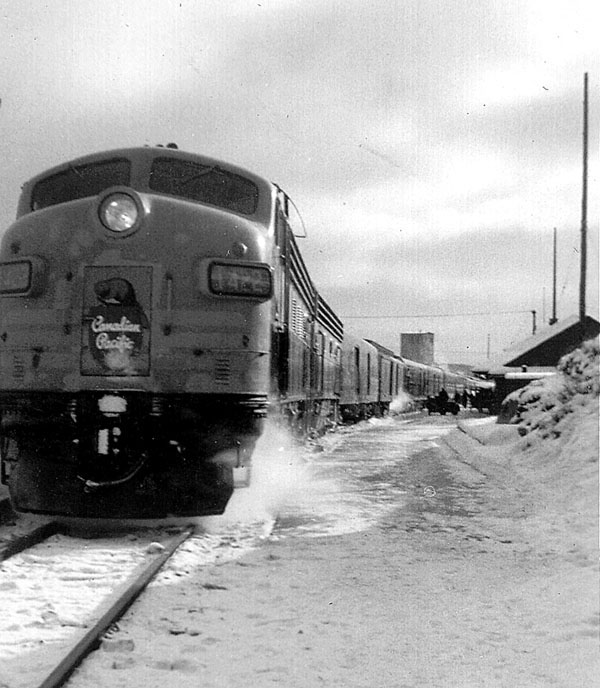
Ian sent me other photos and explained: "There are two types of Alco locomotives.  Both were of the earliest type used on the CPR in the 1950's and 60's.  The two road engine consist is pulling a freight train over the trestle into Chapleau. The other more typical locomotive onsist is sitting outside the Chapleau shops.

"2841 is a classic Hudson locomotive was used mainly on the transcontinental trains before they were replaced by diesels. 2841 was relegated to freight service in the late 1950's before being scrapped.

"I include an image of the GM demonstrator locomotives which were the first through Chapleau in 1949.  I include the image because it shows the complete train including the dynamometer car immediately behind the locomotives that monitored locomotive performance. I attach another image of the same GM type in CP paint sitting outside the Chapleau shops."

Thanks Ian as always for your assistance. I received the Neil Morris story from the late David McMillan, who gave it to me when he came to visit me in Cranbrook.  My email is mj.morris@live.ca

Wednesday, March 23, 2011

Chapleau reeve Terry Way-White created colourful totem pole from old log as project for Canada's centennial in 1967

.
While fishing at Seven Mile Lake in 1966, Terry Way-White, saw a pole at the bottom of the lake, dragged it out, took it home and put it in his basement to dry out.

In May, 1967, as Canada was celebrating its 100th anniversary as a nation, and after eight months work, Mr. Way-White and his friends who had helped him, raised a colourful totem pole at Chapleau's Centennial Park, on Monk Street.

Larry Carroll, Mr. Way-White's nephew helped him get the log home and into his basement, while his friend and neighbour Jack Whitney, carved two of the figures that appeared on it during the eight months it took to transform it from an 17-foot long old log to a colourful totem pole.

Part of totem pole in Chapleau Heritage Museum, 2011. Courtesy Doug Greig
While working on his personal Centennial project, Mr. WayWhite, who had been a township councillor, became the reeve in January 1967. As he was finishing work on the totem pole and preparing for Chapleau's celebration of Canada's Centennial, he was also occupied with the devastating forest fire of June 1967, when he had to give the order to evacuate the municipality. He served as reeve until 1973.

Included on the colourful totem pole were a thunderbird, bear, native spirit, Expo 67 Logo and the Centennial Maple Leaf. Also engraved were the Latin words, "Ad mari usque ad mare" meaning from sea to sea, which were emblematic of Queen Victoria's words apparently used when she chose Ottawa as Canada's capital, and was quoted as saying, "You shall have dominion from sea to sea."

Twenty-five years later, on July 1, Mr. Way-White, now retired from the Canadian Pacific Railway, was at the Centennial Park and the totem pole was cut down as the wood had been deteriorating for several years.

When it was placed in the park in 1967, Mr. Way-White had put a time capsule in the base, however, over the years the glass jar had broken and some of the contents had been destroyed. In a glass jar were stamps, centennial coins, a Chapleau newspaper and a note from Mr. Way-White as reeve. Those salvaged were placed on display in the museum.

In an article in Algoma Hi-Rail, Marg Byer told about Mr. Way-White's project. He told her it was easy getting the log into his basement compared to getting it out.

"We had one helluva time getting the pole out. We didn't think about that once it was carved with wings and what not it was wider than before."

But they managed and the totem pole stood proudly in Centennial Park for 25 years.

In the same article Marg Byer also noted that Mr. Way-White was on duty with the CPR in 1939 when the Royal Train with King George VI and Queen Elizabeth on it arrived in Chapleau about two a.m. He noted that he had to wear a special armband and security was provided by the RCMP and CPR Police.

Since I wrote in a recent column about Chapleau Reeve George Fife paying a visit to the train to meet the Royals, it seems that Chapleau was awake for the early morning train stop.

Elizabeth Austin advised that her father Jim Austin was a member of the Chapleau High School Cadet Corps who were on hand for the visit, while June Marie (Charette) Charlwood wrote that her grandfather Edward Woodard had been an engineer on the Royal Train. June Marie's father, Maurice Charette, was part of the CPR Police security detail for the Royal Train, as was Jim Morris, my father.

My thanks to Dave Way-White, Terry's son for providing information on the building of the totem pole. My email is mj.morris@live.ca

Wednesday, August 18, 2010

Sam Chappise from James Bay to Chapleau to presenting gift to CPR president N.R. Crump when 'Iron Horse Number 5433' arrives in Chapleau's Centennial Park in 1964

Sam Chappise with N.R. Crump
When N.R. Crump visited Chapleau in 1964 on the occasion of the placement of 'Iron Horse Number 5433" in Centennial Park, Sam Chappise presented the president of the Canadian Pacific Railway with an antique rifle as part of the ceremony.

His parents, James and Rebeckah Chappise, with their family, were among the Cree First Nation people who made the arduous canoe trip from James Bay to Chapleau around the beginning of the 20th century.

Wilf Simpson, writing in his history of Chapleau and area published in the 1970s noted that Sam Chappise had an excellent memory of the trip and told stories of the portages, the fishing and wildlife, "for in those days, the food that could be carried in a birch bark canoe, with a family, was of necessity limited and it was necessary to live off the land. Everyone had a direct hand on a trip of this magnitude and Sam recalled his chore of collecting the wood for cooking fires."

Mr. Chappise's parents were expert crafters building birch bark canoes, according to Ian White writing in Chapleau Trails, and after they set up home in Chapleau, at least two canoes were in production at amy time and could be viewed in their yard.

In Wilf Simpson's story he writes that Mr. Chappise noted that in the early days of birch bark canoe construction, the gunwales of the canoe were made solid and he watched his father empty any water in the canoe at every portage. Due to the solid gunwhale there was always water that could not be dumped out.

"Sam remembered this and in later years developed the gunwhale in use today with openings in the gunwhale to permit all the water to be dumped out." This may sound like a minor detail but it sure wasn't to people whose only way of travel was by canoe.

Wilf relates the story that Mr. Chappise told of making the transition from "wilderness to civilization" after his family had completed the trip from the James Bay area and at first settled in the area of Nicholson, about 20 miles west of Chapleau on the CPR line.

"He (Mr. Chappise) recalled that for the first weeks after settling there, every time a train whistled, he would race to the shelter of the forest, throw himself down and peer through the underbrush as the iron monster, belching smoke and sparks steamed by. Needless to say, Sam had never heard of, let alone seen a railway engine. for the Ontario Northland, now serving Moosonee, was not even a dream in those far off days."

In fact, as I wrote in my book Sons of Thunder... Apostles of Love, at about this time in the early 20th century, Robert J. Renison, later an Archbishop in the Anglican church noted that Chapleau on the CPR main line was "the only window on the outside world" for the church's Diocese of Moosonee. Chapleau had a railway station, telegraph office and post office.

In 1964 when "Iron Horse 5433" had been obtained for Chapleau in large measure through the efforts of Arthur and Nettie Grout, Mr. Chappise's boyhood story about his introduction to trains was recalled and he was invited to participate in the ceremony.

The engine had actually worked on the CPR line through Chapleau, while Mr. Crump had worked for the CPR in Chapleau some years earlier.

In 1967, Canada's Centennial, Mr. Chappise returned to the CPR station for "one of great thrills of his life" according to Wilf, to sound the 'O Canada' whistle when the Centennial Caravan train arrived in Chapleau.

Mr. Chappise's brother Peter served in Canadian Forces in World War I. He was killed in action on June 23, 1916, and is buried at Menin Gate (Ypres) Memorial, Belgium. He was 22.

Samuel Chappise served in World War I with the 227th Battalion, Canadian Forces.

Samuel and Dina Chappise stand out among the pioneers of Chapleau who established the community in its early years and made a contribution to its life for many years. Their son Richard Robert Chappise, enlisted in the Royal Canadian Air Force in World War II, became a Flying Officer and became part of Number 99 RAF Squadron in the Pacific area of the war. He was killed in action on June 5, 1945, after the war in Europe had ended but Japan had not yet surrendered.

Richard is honoured on the Singapore Memorial along with over 24000 who have no known grave who were involved in operations over the whole of southern and eastern Asia and surrounding seas and oceans. Richard Chappise was 20.

Let us never forget the good people of Chapleau who have done so much for their community and the world beyond home. My email is mj.morris@live.ca

FORMER CHAPLEAU RESIDENT GERRY BOWLAND SENT THE FOLLOWING. GERRY RUNS THE N.R. CRUMP CENTRE AT SAIT IN CALGARY

It is good that some of these stories are getting told. A lot of history is getting lost and it appears that some of the next generation do not value the past to the same degree as we do.

In a strange quirk….. I actually run the N.R. ' Buck Crump' Centre for Rail Training and Technology here at Southern Alberta Institute of Technogy. (SAIT).  We actually have a bust of him in the foyer and also have a “lathe” that he highly valued and that he gave to the centre in his last will. When the centre was originally set up, CPR training and development was co-located in the building. They moved from here back onto CPR property last December as SAIT needed the space.

I look forward to your “blogs” as they certainly set up a trip down memory lane.

Michael J Morris

Michael J Morris
MJ with Buckwheat (1989-2009) Photo by Leo Ouimet

UNEEK LUXURY TOURS, ORLANDO FL

UNEEK LUXURY TOURS, ORLANDO FL
click on image

MEMORIES FROM CHILDHOOD

MEMORIES FROM CHILDHOOD
Following the American Dream from Chapleau. CLICK ON IMAGE