MICHAEL's EMAIL

WELCOME TO THE MICHAEL J MORRIS REPORT!!!!

EMAIL mj.morris@live.ca

WRITE ME WITH COMMENTS, STORY IDEAS, SUGGESTIONS, INFORMATION REQUESTS. IF YOU CAN'T FIND A STORY, DO NOT HESITATE TO EMAIL ME

Showing posts with label donald white. Show all posts

Saturday, May 2, 2015

St. John's Anglican Church marks 130th anniversary in 2015 as it plans for the future

St. John's Anglican Church marks its 130th anniversary in 2015, as members of the congregation plan the future of one of the last historic public buildings in Chapleau.

St. John's was established in 1885 with the first services being held in a boxcar used by the Canadian Pacific Railway as a station. The first church building was located on the old tennis court across from the present church.
First St john's. Rev Robert Warrington in photo

The first service in the present church was held on March 29. 1908 when it was dedicated by Bishop George Holmes. From 1905 to 1913, St. John's was the Pro-Cathedral of the Diocese of Moosonee and Bishop Holmes and his successor Bishop John Anderson both lived in Chapleau.

Let's fast forward from 1885 to 1935 in the midst of the Great Depression when St. John's celebrated its 50th anniversary. It was not only a highlight in the parish history, but in the interests of full disclosure, it is of great personal interest to me.

First, family members were involved in the 50th anniversary celebration. My grandfather, George Hunt, was the choirmaster; my mother, Muriel (Hunt) Morris was a soloist at the anniversary service, and my grandmother, Edith Hunt and aunt Elsie were in the choir. My grandmother with Mrs. P.J. Collins was a convener of the anniversary banquet.

Second, the visit by Rt. Rev. Derwyn T. Owen, Archbishop of Toronto and Primate of the Anglican Church as guest preacher contributed to me being hired by the Kingston Whig-Standard some 30 years later.

Prior to the actual celebration St. John's,  Chapleau lost an outstanding citizen when G.B. Nicholson died on January 1. Mr. Nicholson was Chapleau's first reeve from 1901 to 1913, and at the time of his death was the Member of Parliament for the area.

For 25 years Mr. Nicholson. who had been People's Warden for many years, also conducted an Adult Bible Class for 25 years, returning from Ottawa on weekends to teach it.

In 1935, despite the depression and loss of members through CPR transfers after it moved its district offices to Schreiber, and other factors, the church was debt free.

Archbishop Owen preached at the anniversary service and gave address at the banquet. A vote of thanks was given to him moved by P.J. Collins and seconded by Albert Evans.

William Card spoke on the early history of the parish. Church wardens were Charles W. Collins and Albert Evans. Vestry board members included George Collinson, Charles McKnight, F.J. Morris, Jim Good, R.J. Hopper, P.J. Collins, John Corston, Fred Matters, A.C. Whybray, W. Broomhead, E. Woodard, Harry Searle, F. Bacchus and W. Card. George Hunt was Choirmaster and Miss Nettie Herner, the church organist.

The Chapleau Post reported that a "splendid banquet" in the Town Hall brought the anniversary celebration to a close. 

Here is part of the newspaper report:  ..."the hall was tastefully decorated for the occasion. The tables looked very pretty each table having silver baskets with yellow mum. also yellow candles, white and yellow being the colour scheme throughout."

My grandmother and Mrs. Collins were overall conveners, assisted by George Collinson and Charles Collins, decorations; Mrs. A Simpson, tables and ladies in charge of tables were Mrs. W. Card, Mrs. F. Matters, Mrs. J. Corston, Miss Swanson, Mrs. A. Whybray, Mrs. Bacchus, Mrs. C. Matheson, Mrs. Glabb, Mrs. W. McMullen, Mrs. W. McLeod, Mrs. Machan and Mrs. Encil.

Mrs. J. Coulter and Mrs. F.J. Morris were in charge of the food table while Mrs. G. Collinson looked after tickets; Mrs. Westerman, the kitchen assisted by Mrs. Folkerts, Mrs. Herbert and Mrs. Chappise.

The young men "ably assisting pouring tea" were John Woodard, Lorne Woodard, Harvey Glabb. John Way-White, Bill Pepper, ken Crowhurst, Harry Searle, David and Elbert Collinson and Percy Encil.

Rev. Harold Hesketh, Rector of St. John's was "in the chair".

I am sure it was a precious moment for my Grandpa Hunt to be the Choirmaster on this special occasion and have his daughter singing a solo. Mom, who would have just returned home to teach at Chapleau Public School sang "Now the Day is Over". Having my grandmother and aunt in the choir would have made it even more special.

Fast forward to 1965 and I went to Kingston for a job interview at the Kingston Whig-Standard as a reporter, with Robert D. Owen, the executive editor of the newspaper. Mr Owen was a nephew of Archbishop Owen, and knew where Chapleau was, and the anniversary of St. John's

In the course of the interview he asked me if I was staying the weekend. Mom was visiting in Toronto at the time, and had driven over with me. I told Mr. Owen we were and would be attending St. George's Anglican Cathedral where they had a magnificent choir. That did it. Mr. Owen hired me. Small world!

I wish the good people of St. John's and Bishop Tom Corston who has accepted position as interim priest in charge of St. John's well as  they plan for the future of this historic place in the life and times of Chapleau

HAPPY  BIRTHDAY DONALD WHITE
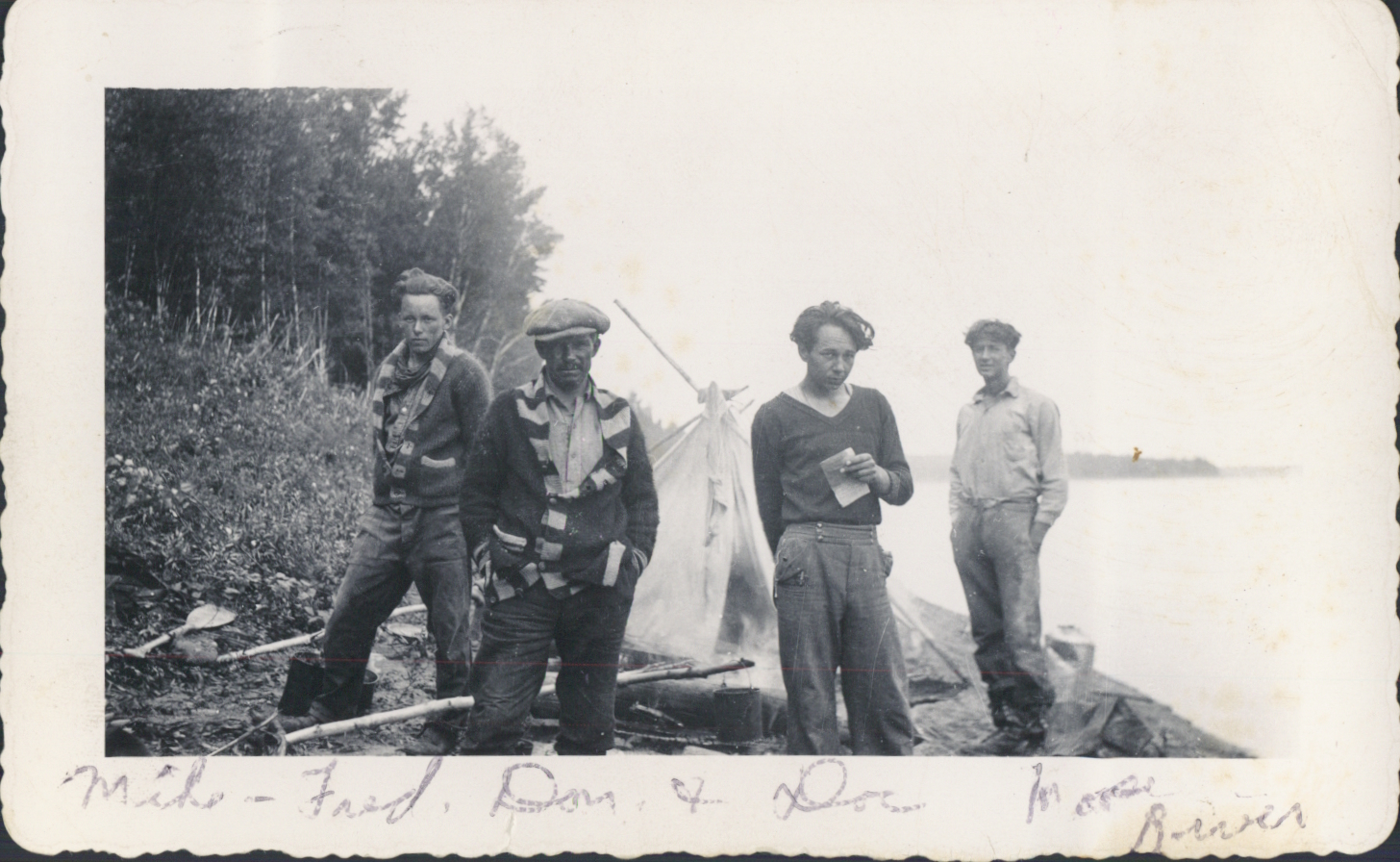
Mike Turner, Fred McAuley, Donald White, Doc Potts 1932 canoe trip


My very best wishes to Donald White. World War II veteran and member of Chapleau Cree First Nation, who celebrated his 102nd birthday recently.  My email is mj.morris@live.ca


Thanks to Dorothy Turner for photo from canoe trip in 1932 from Chapleau to Moose Factory.


Wednesday, July 31, 2013

Six young Chapleau adventurers make trip to Moose Factory mostly by canoe in 1932

Six adventurers made a canoe trip from Chapleau to Moose Factory in July 1932 recording their progress in writing as they travelled. Their chronological account was kindly made available to me by Dorothy Turner, and I am delighted to share parts of it as the Chapleau Cree First Nation hold their annual Traditional Gathering and Pow-Wow on August 17 and 18.

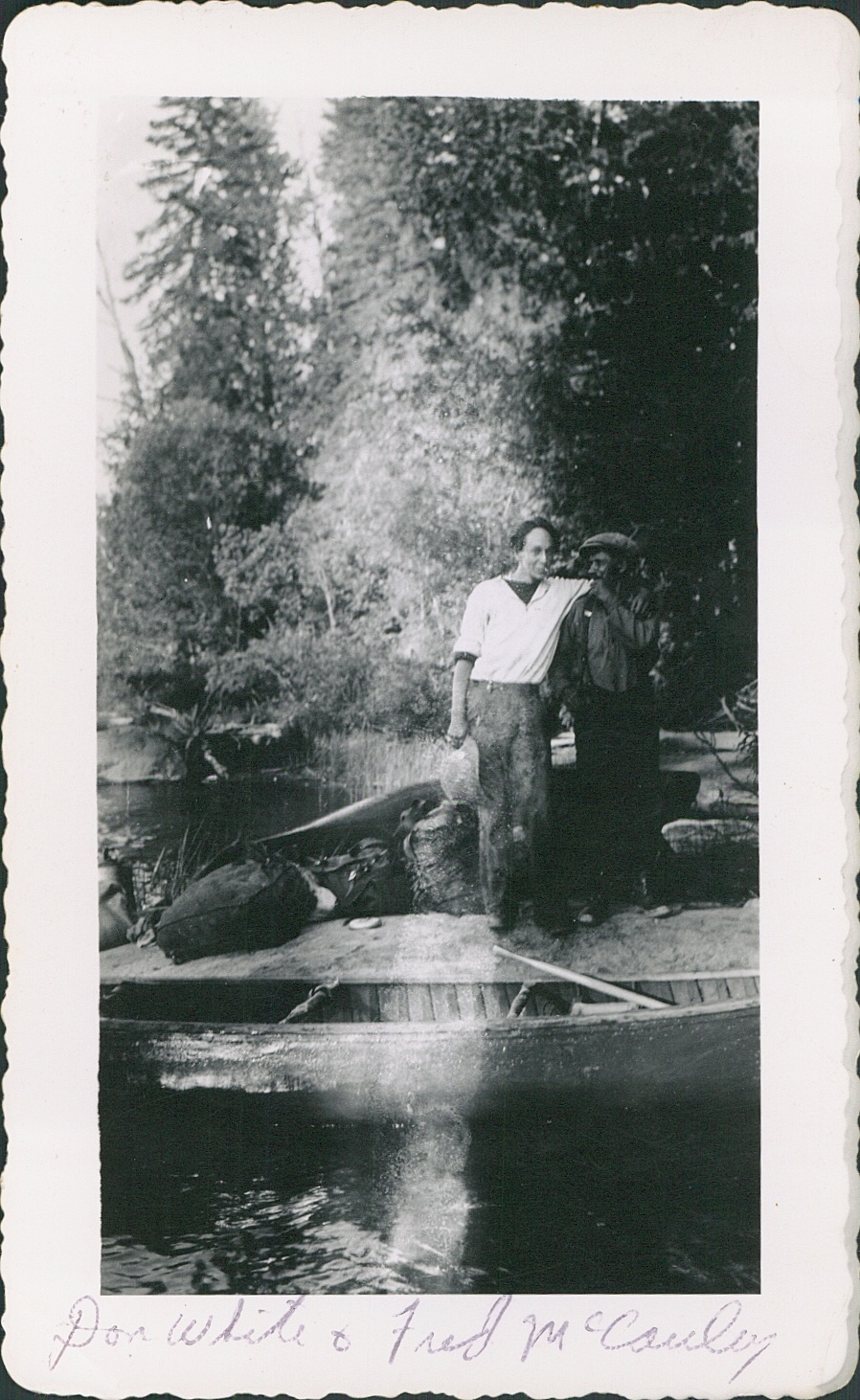
The young men were Donald White, Oliver 'Doc' Potts, Howard Cachagee, Mike Turner, Fred McAuley and Vince Crichton. In 1968, Vince typed out an account of the trip from the notes and sent it to Mike Turner, Dorothy's uncle, with the following comment written on the top of the first page: "Mike. I hope I have recorded this properly. Vince".
Mike Turner, Fred McAuley, Don White, Doc Potts


They left Chapleau on July 1, 1932, by train for Missanabie with two canoes and all their equipment. "We arrived at Missanabie about 8;30 p.m. and immediately started on the first lap of our canoe journey. We camped a couple of miles north of the railroad track... After a late supper we sat around the camp fire, telling stories, as the fuel turned into dying, glowing embers. The night was clear and cold and after making our canoes and provisions safe from marauding animals we turned in with high expectations of the morrow."

"Shortly after sun up the next morning we were having breakfast of bacon and eggs. The aroma of the repast with the boiling coffee whetted our desire for the adventure and it was not long before we were on our way. Loading up our big freight canoes with equipment and three men to a canoe, we were content to let a small three horsepower engine do most of the work for the first day.
Howard Cachagee, Vince Crichton, Don White

"The night had been cold and frosty. The surface of the lake was like a sheet of glass and covered with millions of mosquitoes, presumably killed by the frost of the previous night.

After a seven mile run up Dog Lake, they portaged to Crooked Lake a distance of about 150 yards. "All along Crooked Lake we saw moose and bear and in almost every bay either a live of dead beaver house."

At the end of the lake they made another portage over the height of land to Missinaibi Lake. This height of land separates the waters flowing into Lake superior from those flowing into James and Hudson Bay.
Don White, Mike Turner, Doc Potts

Upon reaching Baltic Bay they took a route to the northeaast arm arriving at a long peninsula varying in width to three miles.

"It terminates abruptly in a granite cliff, towering in places to well over two hundred feet. This is known as Fairy Point. Many years ago, the Cree and Ojibway banded together for self protection from bands of Iroquois and drove an armed band over the cliffs to complete destruction. Looking closely at the cliffs one can discern Indian pictographs of centuries ago which only time can eliminate."

They arrived at Brunswick House to explore the remains of the once thriving Hudson Bay Company Post. They note that most of the buildings were in ruins but some still some were standing, the remains of an old boat were on the shore and along the beach and in the ruins were old rifles and flintlocks with the stocks nearly eroded completely away.

They also visited a cemetery to which pilgrimages were still made "every few years to keep the hallowed spot of their loved ones clean and in good order."

By the end of the first day, they had run rapids and travelled about 60 miles making camp at Peterbell on the Canadian National Railway.

They enjoyed a "well earned supper of fish, bannock, jam and tea" and then "crawled into their eiderdowns and with the sky for a roof, slept as only those on the trail can sleep, seldom being troubled by the mosquitoes and black flies. 
Don White, Fred McAuley

The next day after shooting rapids calling one a "thrilling experience" Donald White remarked, "It gives you a tingling feeling, shooting rapids like these." (Perhaps someone can ask Donald if he recalls the remark).

The adventurers reached the Hudson Bay Post at Mattice on the CNR and decided to spend the day there washing their clothes and darning socks. 

After supper, the Indian Chief, who they do not name, came down to their tents and invited them to a dance being held at his home that evening. The cost for all six was 25 cents. When the chief was asked what it was for, he replied "to buy coal oil for the lamps".

They found themselves at the chief's home "Listening to music from two violins and a moose hide drum. Everyone danced jigs and reels which included the Midsummers Night and the Rabbit dance. To top off the evening's entertainment, Fred (McAuley) who is a violin player of no mean ability gave the folks a lesson in step dancing which was received with loud cheers and hand clapping."

The only mishap of the trip appears to have been while shooting the rapid below the Black Feather where a canoe hit  a submerged rock, but they made shore all right and got it fixed. But, while they were making dinner, in opening a packsack they discovered that a top had blown off a can of jam.

"What a mess. Howard and Fred cooked dinner while the rest washed every article and including the packsack and repaired the canoe."

As they neared the end of their trip, here is part of one of the vivid descriptions provided. "We shot Frenchman's rapid and then portaged Frenchman's gorge. It is a very beautiful place. The gorge is cut out of red granite and the square cut rock is topped with black spruce.

"What a place to stop and ponder over the beauties of nature that the north is so profusely endowed with."

On the final day they travelled the broad expanse of the Moose River, past the mouth of the Abitibi and Kwataboahegan rivers and reached Moose Factory about four in the afternoon. They had made the trip in six days, apparently a record time which was still stood in 1968 -- they note only two other parties had made the trip and it took them about two weeks.

For the next two weeks they stayed in Moose Factory visiting and relaxing. "We loafed and rested." Some of the adventurers were recruited to play ball for the Moose Factory team.

They returned to Chapleau via the moose, up the Mattagami, and then into the Kapuskasing River to the town of Kapuskasing. From there they continued to Elsas on the CNR to the northeastern corner of the Chapleau Game Preserve, into the Nemegosenda River to Trout Lake  and into Twin, Round, West, LeBlanc, Emerald and Loon (Borden) lakes. A portage of a mile took them into the Chapleau River and home. 

It took them 12 days and was a much harder journey. Over the years, notes were lost of the return trip.

My sincere thanks to Dorothy Turner for sending me the account of the trip. I have provided some highlights but the complete story is fascinating. My email is mj.morris@live.ca

Michael J Morris

Michael J Morris
MJ with Buckwheat (1989-2009) Photo by Leo Ouimet

UNEEK LUXURY TOURS, ORLANDO FL

UNEEK LUXURY TOURS, ORLANDO FL
click on image

MEMORIES FROM CHILDHOOD

MEMORIES FROM CHILDHOOD
Following the American Dream from Chapleau. CLICK ON IMAGE