MICHAEL's EMAIL

WELCOME TO THE MICHAEL J MORRIS REPORT!!!!

EMAIL mj.morris@live.ca

WRITE ME WITH COMMENTS, STORY IDEAS, SUGGESTIONS, INFORMATION REQUESTS. IF YOU CAN'T FIND A STORY, DO NOT HESITATE TO EMAIL ME

Wednesday, August 7, 2013

Chapleau Cree First Nation seeks help with names in St. John's Indian Residential School Graveyard restoration project

Donald and Ian White at Fox Lake Memorial Service
As Chapleau Cree First Nation continues the process of restoring the St. John’s Indian Residential School Graveyard beside the Blue Heron Inn at Chapleau, assistance is needed in confirming the names of all those who are buried there.
Donna Byce, the economic development officer of CCFN contacted me asking if I may have information that may help, but although I am aware of the graveyard and was on Chapleau council when Tom Corston, now bishop of the Anglican Diocese of Moosonee, headed a restoration project in 1973, I do not know  the names of students who attended the school..
However, after a delightful telephone chat with Donna, I told her I would help spread the word and hopefully someone will come forward who is more familiar with the school and its students from when it opened in 1921 until its closure in 1948.
Donna explained: "Currently we have a hand drawn map with most of the names of the deceased, I was wondering if you would happen to have any information on this as it is difficult to read the hand writing and we would like to have all the names put on a commemoration cairn."
She added that they have been working at this project for the past two months removing brush, raking, identifying graves and replacing old grave markers.
Although restoration of the Residential School burial ground located on the outskirts of Chapleau within the area of Chapleau Ojibwe First Nation is one of the project goals,  "Raising awareness and educating everyone on the history of Residential Schools and securing a dignified resting place for the deceased is the main goal.  A Commemorative Plaque will be created and displayed for visitors."
On August 16, a day before the CCFN Traditional Gathering and Pow-Wow is held on August 17 and 18,  "Ceremonies... for the welfare of our elders and families affected by Residential Schools and  to pay respect to the former Indian Residential School survivors and those who have passed" will be held.
While chatting with Donna, I could not help but ask her if she would extend my warmest regards to folks in Chapleau, but my list kept getting longer and longer, so I will say "HI" to everyone there, with special thoughts to my First Nation friends as they hold ceremonies in connection with the residential school and participate in their traditional gathering and pow-wow.
Thank you Donna for the kind invitation to attend, but I will be unable to do so this year.
 If anyone can assist with the names, please contact Donna at e-mail: ccfn.edo@chapleaucree.ca
After receiving the email from Donna and chatting with her on the telephone, I thought about an email, among many that I have received from Ian White, whose older brother Donald lives on the Fox Lake reserve. Donald was one of the 1932 adventurers who made the canoe trip from Chapleau via Missanabie to Moose Factory.
Ian shares an anecdote regarding my mother, Muriel E. (Hunt) Morris, my grandmother, Edythe Hunt, and him which took place shortly after he was born in 1920.
Ian relates that his family lived in a flatroofed cottage at the corner of Grey and Birch streets where eventually Henry Pellow built a log house.
"When i was about four months old for some unknown reason I stopped taking food. This lasted for many days and caused my mother much anxiety. At wits end and very discouraged about her baby she decided to take me out into the cool Autumn air hoping it would create an appetite.
"While pushing the carriage and crying at the same time two little girls who were out walking and munching on oatmeal cookies stopped and asked why she was crying. So she explained what the cause was. One of the little girls asked if she could give the baby some of her cookie. My mother consented and the youngest girl (your mother) put a piece of her cookie in my mouth. The taste must have been good because it was the first piece of nourishment I had for many days and apparently I finished the rest of the cookie.
"My mother told me this story many times and insisted your mum saved my life because I started eating after that..." My mother would have been about nine years old at the time
Ian added that for about six years of the Great Depression he had an arrangement with my grandmother to bring her two rabbits every second week during the Winter for which she paid him 50 cents.
Although my father, Jim Morris was older than Ian, closer to Donald's age, they knew each other through the Youth Bible Class at St. John's Anglican Church. Ian told me that when he was in Toronto waiting to leave for overseas during World War II, my parents came to visit with him. At the time  my Dad was a Flying Instructor with the British Commonwealth Air Training Plan after having enlisted in the RCAF. Donald also served in the Canadian forces in World War II.
Every so often, I receive an email about something or other that I have written, and the person comments, referring to me, "You can take the boy out of Chapleau, but you can't take Chapleau out of the boy." As I write I have lived in British Columbia 24 years now, but I will do what I can to help with the Chapleau Cree First Nation project to restore the residential school graveyard.
And as Ian White tells us in his anecdotes, Chapleau friendships last a long, long time. My email is mj.morris@live.ca


Wednesday, July 31, 2013

Six young Chapleau adventurers make trip to Moose Factory mostly by canoe in 1932

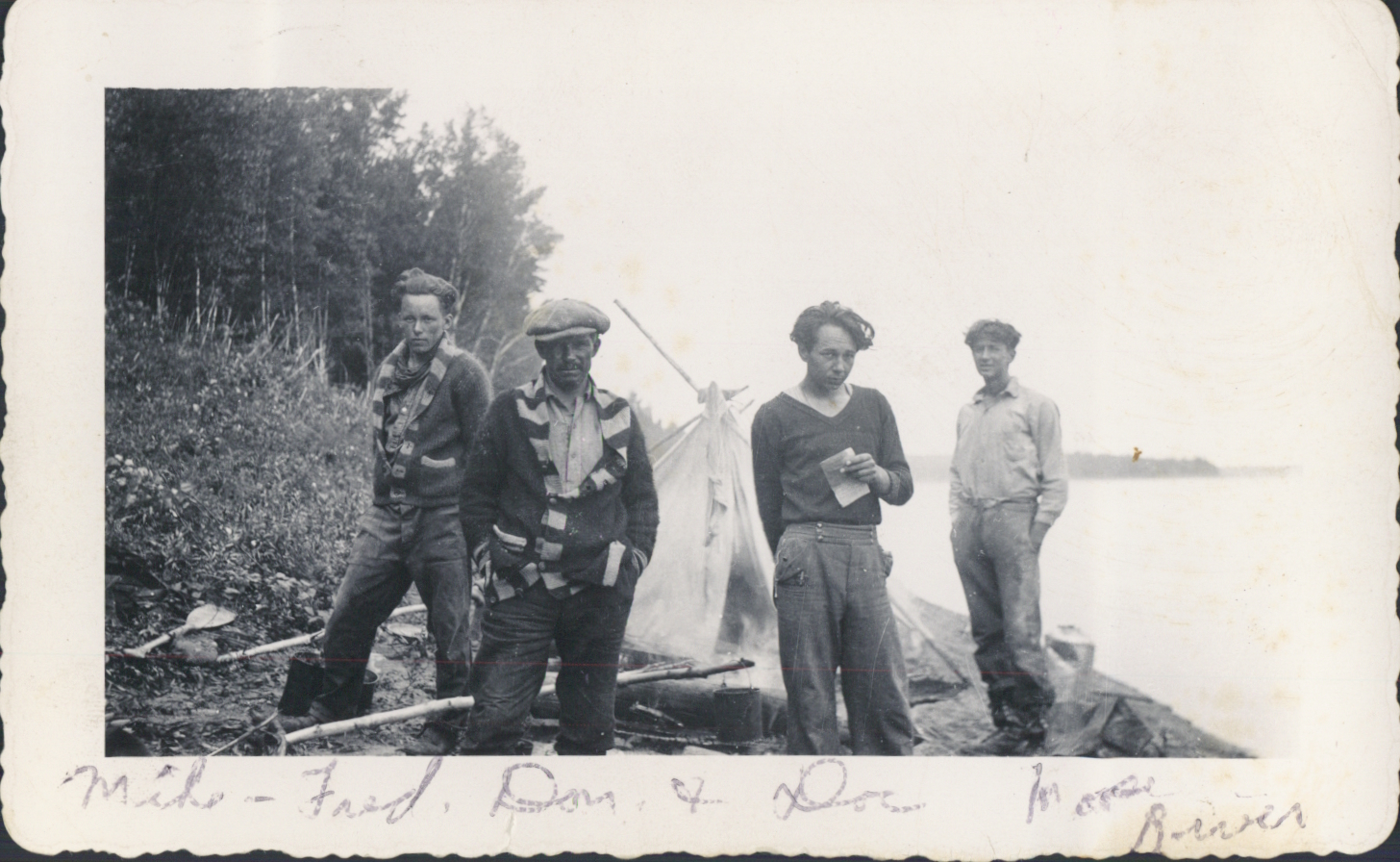
Six adventurers made a canoe trip from Chapleau to Moose Factory in July 1932 recording their progress in writing as they travelled. Their chronological account was kindly made available to me by Dorothy Turner, and I am delighted to share parts of it as the Chapleau Cree First Nation hold their annual Traditional Gathering and Pow-Wow on August 17 and 18.

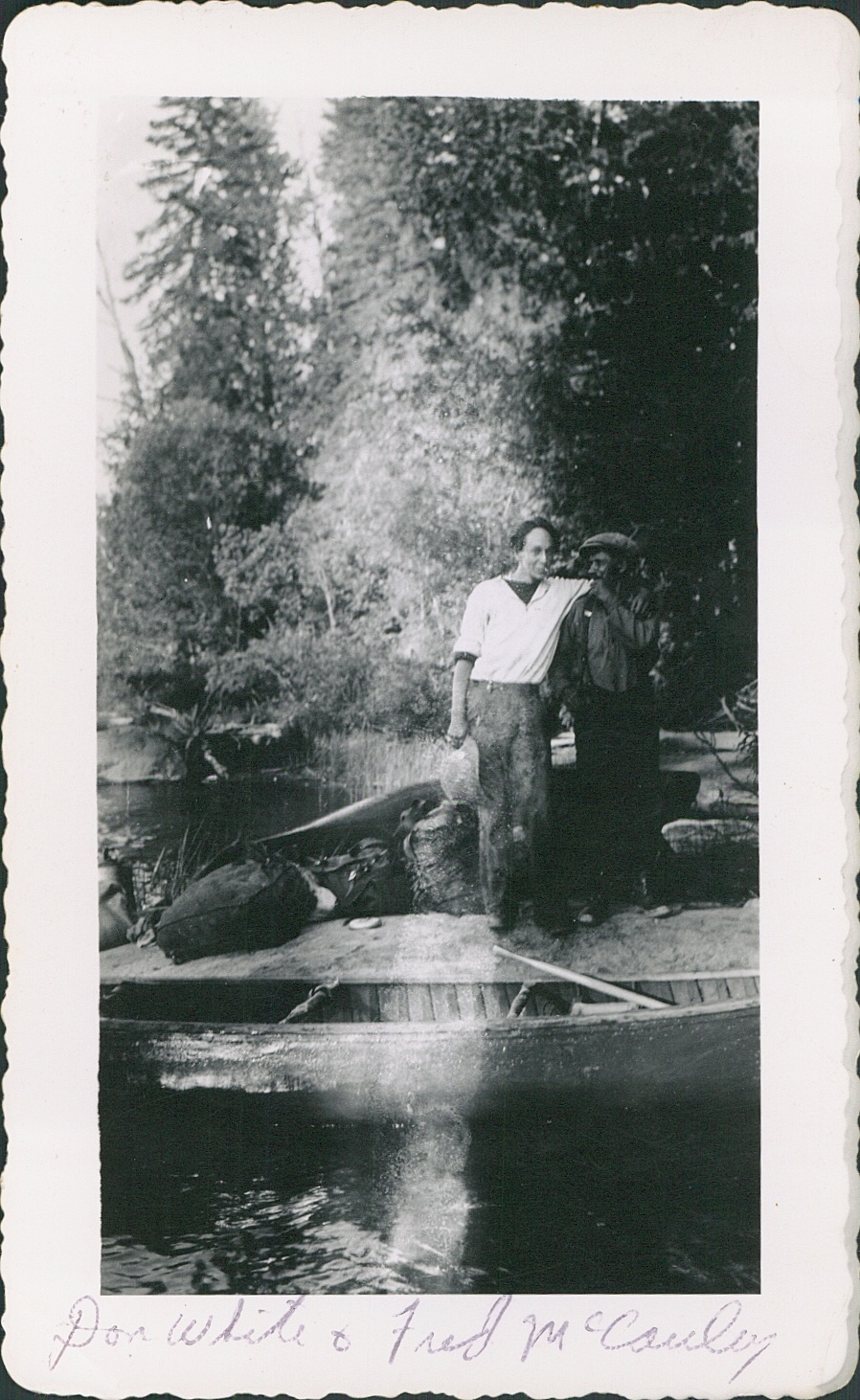
The young men were Donald White, Oliver 'Doc' Potts, Howard Cachagee, Mike Turner, Fred McAuley and Vince Crichton. In 1968, Vince typed out an account of the trip from the notes and sent it to Mike Turner, Dorothy's uncle, with the following comment written on the top of the first page: "Mike. I hope I have recorded this properly. Vince".
Mike Turner, Fred McAuley, Don White, Doc Potts


They left Chapleau on July 1, 1932, by train for Missanabie with two canoes and all their equipment. "We arrived at Missanabie about 8;30 p.m. and immediately started on the first lap of our canoe journey. We camped a couple of miles north of the railroad track... After a late supper we sat around the camp fire, telling stories, as the fuel turned into dying, glowing embers. The night was clear and cold and after making our canoes and provisions safe from marauding animals we turned in with high expectations of the morrow."

"Shortly after sun up the next morning we were having breakfast of bacon and eggs. The aroma of the repast with the boiling coffee whetted our desire for the adventure and it was not long before we were on our way. Loading up our big freight canoes with equipment and three men to a canoe, we were content to let a small three horsepower engine do most of the work for the first day.
Howard Cachagee, Vince Crichton, Don White

"The night had been cold and frosty. The surface of the lake was like a sheet of glass and covered with millions of mosquitoes, presumably killed by the frost of the previous night.

After a seven mile run up Dog Lake, they portaged to Crooked Lake a distance of about 150 yards. "All along Crooked Lake we saw moose and bear and in almost every bay either a live of dead beaver house."

At the end of the lake they made another portage over the height of land to Missinaibi Lake. This height of land separates the waters flowing into Lake superior from those flowing into James and Hudson Bay.
Don White, Mike Turner, Doc Potts

Upon reaching Baltic Bay they took a route to the northeaast arm arriving at a long peninsula varying in width to three miles.

"It terminates abruptly in a granite cliff, towering in places to well over two hundred feet. This is known as Fairy Point. Many years ago, the Cree and Ojibway banded together for self protection from bands of Iroquois and drove an armed band over the cliffs to complete destruction. Looking closely at the cliffs one can discern Indian pictographs of centuries ago which only time can eliminate."

They arrived at Brunswick House to explore the remains of the once thriving Hudson Bay Company Post. They note that most of the buildings were in ruins but some still some were standing, the remains of an old boat were on the shore and along the beach and in the ruins were old rifles and flintlocks with the stocks nearly eroded completely away.

They also visited a cemetery to which pilgrimages were still made "every few years to keep the hallowed spot of their loved ones clean and in good order."

By the end of the first day, they had run rapids and travelled about 60 miles making camp at Peterbell on the Canadian National Railway.

They enjoyed a "well earned supper of fish, bannock, jam and tea" and then "crawled into their eiderdowns and with the sky for a roof, slept as only those on the trail can sleep, seldom being troubled by the mosquitoes and black flies. 
Don White, Fred McAuley

The next day after shooting rapids calling one a "thrilling experience" Donald White remarked, "It gives you a tingling feeling, shooting rapids like these." (Perhaps someone can ask Donald if he recalls the remark).

The adventurers reached the Hudson Bay Post at Mattice on the CNR and decided to spend the day there washing their clothes and darning socks. 

After supper, the Indian Chief, who they do not name, came down to their tents and invited them to a dance being held at his home that evening. The cost for all six was 25 cents. When the chief was asked what it was for, he replied "to buy coal oil for the lamps".

They found themselves at the chief's home "Listening to music from two violins and a moose hide drum. Everyone danced jigs and reels which included the Midsummers Night and the Rabbit dance. To top off the evening's entertainment, Fred (McAuley) who is a violin player of no mean ability gave the folks a lesson in step dancing which was received with loud cheers and hand clapping."

The only mishap of the trip appears to have been while shooting the rapid below the Black Feather where a canoe hit  a submerged rock, but they made shore all right and got it fixed. But, while they were making dinner, in opening a packsack they discovered that a top had blown off a can of jam.

"What a mess. Howard and Fred cooked dinner while the rest washed every article and including the packsack and repaired the canoe."

As they neared the end of their trip, here is part of one of the vivid descriptions provided. "We shot Frenchman's rapid and then portaged Frenchman's gorge. It is a very beautiful place. The gorge is cut out of red granite and the square cut rock is topped with black spruce.

"What a place to stop and ponder over the beauties of nature that the north is so profusely endowed with."

On the final day they travelled the broad expanse of the Moose River, past the mouth of the Abitibi and Kwataboahegan rivers and reached Moose Factory about four in the afternoon. They had made the trip in six days, apparently a record time which was still stood in 1968 -- they note only two other parties had made the trip and it took them about two weeks.

For the next two weeks they stayed in Moose Factory visiting and relaxing. "We loafed and rested." Some of the adventurers were recruited to play ball for the Moose Factory team.

They returned to Chapleau via the moose, up the Mattagami, and then into the Kapuskasing River to the town of Kapuskasing. From there they continued to Elsas on the CNR to the northeastern corner of the Chapleau Game Preserve, into the Nemegosenda River to Trout Lake  and into Twin, Round, West, LeBlanc, Emerald and Loon (Borden) lakes. A portage of a mile took them into the Chapleau River and home. 

It took them 12 days and was a much harder journey. Over the years, notes were lost of the return trip.

My sincere thanks to Dorothy Turner for sending me the account of the trip. I have provided some highlights but the complete story is fascinating. My email is mj.morris@live.ca

Wednesday, July 24, 2013

Ian Macdonald and Mike McMullen look at 'Old Fort' legend in broader sweep of fur trade history in Chapleau area

Old Fort site at Mulligan's Bay 2012
 Ian Macdonald and Mike McMullen follow up on their earlier article about the location of the Hudson's Bay outpost at Chapleau, in which they confirmed  that it was located on the Nebskwashi River, commonly known known as the Memegos Property, and not at the Old Fort on Mulligan's Bay. They provide more historical background and make suggestions as to what was at the Old Fort on Mulligan's Bay. Mike McMullen traces his Chapleau connection to 1885 when his great-great uncle Patrick Mulligan arrived, and Ian Macdonald spent most of his growing up years there. Mike and Ian visited Chapleau in May 2013 and also attended the Chapleau High School reunion in 2012. Mike and I are cousins -- our grandmothers May (Mulligan) McMullen and Lil (Mulligan) Morris were sisters.Your comments are most welcome. My email is mj.morris@live.ca 
Here is link to earlier story: http://michaeljmorrisreports.blogspot.ca/2013/05/mike-mcmullen-and-ian-macdonald-confirm_28.html
The Old Fort on Mulligan’s Bay
By Ian Macdonald and Mike McMullen

Growing up in Chapleau in the late forties and fifties, we were all aware of the story of the old fort at the Mulligan’s Bay side of the portage to Borden Lake and remember the ruins of the old log cabins. We like most everybody else, simply accepted this as fact and never questioned whether or not such a fort ever existed. It wasn’t until almost a full lifetime has passed that we re-examine this old tale in the context of the actual history of the fur trade in the Chapleau region. It might be prudent to start by taking a step back and viewing this local legend in the broader sweep of history.

The fur trade in Canada was controlled by the Hudson’s Bay Company (HBC) since its formation in 1670 and then with the North West Company (NWC) from the late 18th century until 1821 when, after decades of fierce competition, HBC finally achieved a complete monopoly again by merging with NWC. We do know that during this early period, both HBC and NWC maintained trading posts side by side at Michipicoten on Lake Superior and possibly on or near Kapuskasing Lake at the northern end of both the Kebsquasheshing and Nemegosenda River systems near the present CNR siding at Elsas. 

Following the merger in 1821, HBC eliminated half of their inland trading posts including those on Kapuskasing Lake and concentrated their trading activity on the profitable Missinaibi river route. Following construction of the Soo locks in the 1850’s, it became easier to supply the inland trading posts from Michipicoten on Lake Superior rather than James Bay and the original north-south supply route to and from Moose Factory ceased completely in the 1860s. The historic monopoly of the HBC on the fur trade in Canada came to an end in 1870 with the sale of HBC lands (Rupert’s Land) to the Crown referred to as the Deed of Surrender. This marked the beginning of the end of the era of the storied Company of Adventurers and the highly profitable fur trade in the Moose-Missinaibi River Valley.
HBC store in Chapleau


We now know for certain that the first recorded presence of the HBC in Chapleau was the construction of a Michipicoten subpost in 1884 (Chapleau Outpost) a mile south of Chapleau on the Nebskwashi River, followed by the opening of a retail store in Chapleau in 1886 managed by Peter Bell.
Survey crew at HBC outpost


Peter Warren Bell was a commissioned officer of the HBC and Chief Trader and Factor of the HBC post at Michipicoten from 1865 until 1886 when he became the first Chief Factor of the HBC store in Chapleau. Bell conceived the concept of the outposts at Chapleau, Dog River and Magpie that were built in 1884 to intercept native trade. He remained Chief Factor in charge of the Michipicoten district at Chapleau from 1886 to 1889 until being replaced by Donald McTavish.


Peter Bell
 Bell, as evidenced in many lengthy post reports and letters, obviously struggled with the challenges of the new era of aggressive retail competition but remained well respected for his empathy with aboriginal culture and frequently expressed concerns about the impact of the new rail era on traditional native life and values. One testament to Bell's contribution to the development of this region of Northern Ontario was the naming of a railway siding in his honour at Peterbell, Ontario where the CN line crosses the historic Missinaibi River.

There is no evidence to date to support the notion that HBC was ever located on Mulligan’s Bay. We know, for certain, that the site of the old fort on Mulligan’s Bay was crown land from 1870 until 1907 when it was transferred to John Mathew Birmingham of Kingston, Ontario, as a land grant (191 acres). In 1901, an Act to provide for the appropriation of certain lands for the Volunteers who served in South Africa and the Volunteer Militia who served on the frontier in 1866 was passed in Ontario. To be eligible, one had to have been a resident or domiciled in Ontario at the time of enlistment or enrolment for active service. Mr. Birmingham was one who met the criteria. As result of the Act, land grants (usually 160 acres) were available in 27 townships in Northern Ontario, including Cochrane Township in the Sudbury District where Mulligan’s Bay is located.

One is left to speculate, therefore, on the era prior to 1870. Perhaps during the early days of heated competition between HBC and the NWC in the period from 1770 to 1821, one or the other company may have built an outpost in the Chapleau area. Unfortunately, there is no record of such a post anywhere in the HBC archives and many NWC records have been lost. The possibility of a hastily built log building surviving from the early 1800s until the mid-20th century is also very unlikely. A more reasonable argument might be that a cabin(s) was built on the site by an independent trader following the end of the HBC monopoly, sometime between 1870 and 1907. 
Bruce Poynter at Old Fort beach 2012


The location was obviously on an established canoe route with an excellent natural beach. Another possibility is that somebody simply built a cabin there as a summering place. The present owner, Bruce Poynter, has discovered many artifacts on the site that suggest that the Mulligan’s Bay site, given a natural beach and location on a major canoe route could well have been an important aboriginal meeting place long before the fur trade era began.

Michael J Morris

Michael J Morris
MJ with Buckwheat (1989-2009) Photo by Leo Ouimet

UNEEK LUXURY TOURS, ORLANDO FL

UNEEK LUXURY TOURS, ORLANDO FL
click on image

MEMORIES FROM CHILDHOOD

MEMORIES FROM CHILDHOOD
Following the American Dream from Chapleau. CLICK ON IMAGE