MICHAEL's EMAIL

WELCOME TO THE MICHAEL J MORRIS REPORT!!!!

EMAIL mj.morris@live.ca

WRITE ME WITH COMMENTS, STORY IDEAS, SUGGESTIONS, INFORMATION REQUESTS. IF YOU CAN'T FIND A STORY, DO NOT HESITATE TO EMAIL ME

Saturday, April 23, 2016

Bachelors of Chapleau sponsor first dance in Chapleau Town Hall in 1915 with Alf Comte's Grand Orchestra

see names below
The first dance in the new Town Hall was held in 1915 sponsored by the "Bachelors of Chapleau", according to an article in the Richard Brownlee Papers. The hall was opened in 1914.

The unidentified writer, noted that a large illuminated sign with the word "BACHELORS" on it was suspended over the centre of the auditorium.

The "Grand Orchestra" under the leadership of Alf Comte was in attendance and the favourite dances were waltzes, two steps, three steps, four steps and barn dances. 

"The bachelors were all in full evening dress while the ladies ... were divinely beautiful and gorgeously gowned, some of them wearing long dresses.'

The writer poses the question, "Do you ever see anything like this in a Chapleau ballroom today?'" My best guess is that this article appeared in the Chapleau Post circa 1930. How about today in 2016? At best maybe an idea to mark moments in Chapleau history?

Some of the "patronesses" for the occasion were the wives of T.J. Godfrey who had just become reeve of Chapleau; G.B. Nicholson who had  served as reeve from 1901 to 1913; V.T. Chapple of Smith and Chapple Ltd. and William McMullen, who had been the postmaster and also assistant superintendent of the Canadian Pacific Railway. Interesting that in 1915, the wives were not identified by their own names. 

Moving on to an observation about the CPR, he notes that in December 1915 it was moving over 450 cars a day through Chapleau and there were 56 crews with 50 engines to handle the freight alone, plus six passenger and two yard engines.

Now, let's go back to the beginnings of Chapleau in 1885, and I do so because since I started sharing insights from the Richard Brownlee papers, kindly loaned to me by Margaret Rose (Payette) and Bobby Fortin, there seems to be quite an interest in the early years of the community. 

I am careful though about assigning exact years for some though as depending on the source they sometimes vary. As always, at best I try to provide the second and maybe third "rough draft" of Chapleau history.

In response to a recent question, by 1887, according to the Brownlee papers five general stores were opened: Murrays and Mulligan, T.A. Austin (moved to the present Birch Street from "Old Chapleau" on the hill in 1886, and Mr. Brownlee's barber shop was included as a leanto); Delland and Kellett; the Hudson Bay Company (moved from what is now referred to as the Memegos Property) and P. Manion. 
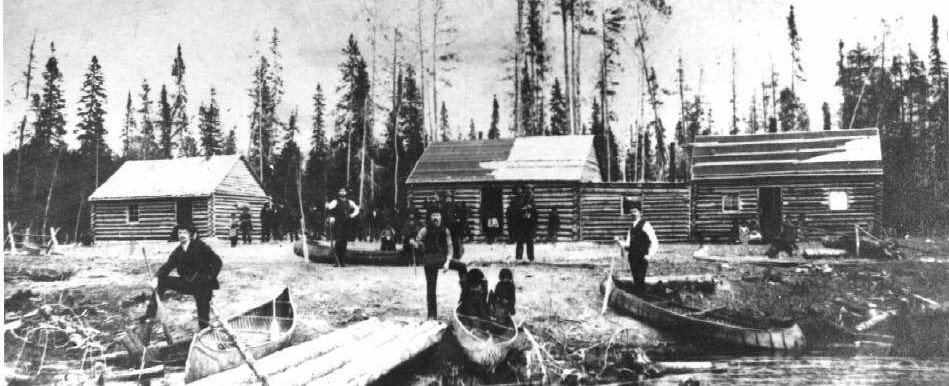
HBC post at "Memegos Property"

(Full disclosure: Patrick Mulligan was my great-great uncle,and William McMullen my great uncle)

By 1888, Chapleau's first band had been established with J.B. Dexter as the first bandmaster, with 13 members. The band held its first picnic on May 24, 1889, marking Queen Victoria's birthday, and apparently it was a big success.

The first boat also appeared on the Chapleau river.

I am sharing several photos but in the case of the one apparently showing Chapleau in either 1887 or 1889 here is the description from the Chapleau Public library site, which I highly recommend to those interested in Chapleau history.


"It was taken from a point south of the Canadian Pacific Railway opposite the west end of Pine Street. You may observe the wooden sidewalk along the south side of Pine Street and the C.P.R. houses located there today, to the extreme left of the picture. In the centre may be observed Beech Street and further along to the right Main Street (Birch). To the south side of Birch Street may be seen the Mechanics Institute with the three top windows which was built in 1889. Next to it is the Hudson Bay Store. Opposite to this store may be seen the present Bank of Montreal building (now replaced by the new building on the north-west corner of Birch and Young)
"The two small hills or elevations through which the C.P.R. track passes (track is visible in centre running left to right) may be observed. Upon and over them the present overhead bridge is located. Notice the road coming from the south side of the railroad and crossing the track in the vecinity of Pellow's coal sheds, south of the present day C.P.R. freight offices.
"It would appear that Chapleau extended in those days from the bank of the river along Pine Street, across the present town site in the vicinity of the Fox Theatre and continued south to Cedar Street, then south along Lorne Street to the site of the Imperial and Canadian oil depots."

Thanks to all who are in touch with me and to Ian Macdonald for assistance on photo identification. My email is mj.morris@live.ca, and yes, I am on Facebook and Twitter.

names of the Chapleau gentlemen  ----  Male fashion of 1912. Back row left to right: Albert Desjardin, George White, George Collinson, Gordon Sheppard, Simon Kruger, Claude Christenson. Front row: D.O. Payette, Joe Magail or Magill, George Barclay, unknown, Tom Thompson.Some of these men were undoubtedly at the dance.

Saturday, April 16, 2016

Ice harvesting for CPR passenger trains enjoyed banner year in 1958 with over 15, 000 tons garnered

Harvesting ice in the winter months was at one time a major project for the Canadian Pacific Railway at Chapleau, and in 1958, it was considered a banner year as over 15,000 tons were garnered from the ice fields.
In an interview with Margaret Costello, Assistant Superintendent Jim Haddow. roadmaster Sidney Baker and ice harvesting foreman Eldon Eveline noted it was "clear blue ice 40 inches thick".
For about seven weeks during the coldest part of a Chapleau winter, heavily laden sleighs could be seen hauling ice from the river near the old pumphouse to the ice houses.
I never caught a ride on the back of the sleighs but would watch them go by the home of my grandparents Harry and Lil (Mulligan) Morris on Elgin Street when visiting them. As I lived on the "other side of town" this was something enjoyed more by my friends who lived "over the bridge".  
In her story Maggie pointed out that Chapleau was the only point on the CPR that had its employees do ice harvesting. Others contracted it out.
Mr. Eveline pointed out that he had about 49 workers  -- six were loaders, 20 were on lake operations, and 20 were at the ice houses, plus cooks and watchmen.

Ed Swanson standin and unknown

In early December when the ice was about three inches thick, clearing the ice field was started using bulldozers and other equipment. At 12 inches thickness trucks and sideplows moved in. The first cut was made in January when the ice was 16 inches thick.
Blocks of ice were taken from the river by jackladder one at a time and moved on to the waiting sleighs for their journey to the ice house.
"There the hefty ice cubes are taken off the sleigh by an elevator and slid down a cute to the bins By the time the ice reached a thickness of 40 inches the blocks weighed 500 pounds each and a sleigh .load weighed 10 tons."
Maggie's story also revealed that about 8,000 tons were stored in the two Chapleau ice houses: 7.000 tons were shipped to White River in wooden box cars, and 420 tons to Schreiber.
The ice was used to air condition cars on passenger trains cool liquids as well as on meat cars.
The story also made the point that the project provided employment for about 50 workers during a time when employment was not so plentiful in Chapleau.
loading ice on passenger car
Dr. Bill Pellow worked at the ice houses during the winter months on weekends. He described what it was like.
"Saturday mornings freezing to death working on the ice gangs for the CPR made a body wonder about an inside job where you could "look out" and always be warm. It was a perpetual dream and the thought crossed my mind many a Saturday. Two pairs of pants, sometimes overalls three sweaters, Stanfield long underwear was standard apparel, flight boots and heavy woollen inserts over leather mitts, a beaver hat with lugs, ( my head at least was always sweating) and scarves just would not keep you warm.
"You couldn't put on more clothes even if you had them, because you had to navigate and work and there was a limit on wearing too much bulky clothing and being practical. Work was the salvation. So you constantly kept moving, and kicking your toes against something to remind you that your feet were down there and they were not turning to ice although it felt like that and maybe your feet could fall off if you didn't keep the circulation moving."
Bill became a dentist after working on the CPR running trades.
My good friend Louis Fortin. who worked on ice gangs in the 1950s while still attending high school provided this description of his work:
"Our first job was to literally chop, saw, chisel the large blocks from the ice house and load the large steel carts in preparation for train arrival. The original blocks were approximately 3 feet high by 2 feet. We sawed the blocks in half and with the use of steel chutes sent the ice down to the platform level where it was loaded in the steel carts. At train time we met the train, opened the bunkers on the side of the passenger cars into which we loaded these blocks of ice each weighing approx. 100 lbs. This function was performed manually. We had to literally bend down below the bunker doors and slide the ice into the bunker. It goes without saying that the ice was necessary for air conditioning purposes."
From an article I was able to find by an H.B. Bowen, chief of motive power and rolling stock of the CPR, the railroad was using ice on some trains by 1936. By the 1970s it was part of history. Thanks Bill and Louis. My email is mj.morris@live.ca

Saturday, April 9, 2016

Olive Warren who started teaching career at Nicholson honoured at retirement party from Chapleau Public School staff in 1971

Frank Coulter, Olive Warren
Tributes were paid to Olive Warren, a long-time member of the Chapleau Public School teaching  staff when she retired in 1971.

Born and raised in Chapleau she was the daughter of Mr. and Mrs. Walter Leigh, one of the community's pioneer families. She attended Chapleau Public and Chapleau High schools.

After attending North Bay Teachers College then called Normal School, Mrs. Warren recalled that her first teaching position was in 1934-35 during the Great Depression at Nicholson Siding on the Canadian Pacific Railway 22 miles west of Chapleau. In those days Nicholson was a "flourishing community, with a two classroom school, complete with a wood burning stove, "... a far cry" from facilities available in most schools of 1971.

Her salary?: "$600 a year."

Mrs. Warren worked as a supply teacher at Chapleau Public School from 1935 to 1941, then became full time. She took some years off to raise her children, Leigh and Bert, then was fulltime until she retired. She married R.L. "Bob" Warren.

For most of her teaching career she taught Grades 3 and 4.

The decor in the Trinity United Church Hall where the retirement party took place was "hearts and flowers"  created by Maartje Doornekamp and Gail Poulin, with the assistance of students.

Referring to the decor, Rev. Murray Arnill, chair of the Chapleau Board of Education,  commented that it was suitable for "a happy and sad occasion" paying tribute to Mrs. Warren's contribution as a teacher, but adding she would be missed.

Public school principal Foy Wright said that Chapleau can be grateful for the contribution that Mrs. Warren had made to the teaching profession, adding that she was "always trying to think of something new, always striving for improvement."
Names not with photo about 1969 though

Board of education member Frank Coulter made a presentation on behalf of the board while Lillian Robinson presented a gift on behalf of the teachers. Both paid tribute to Mrs. Warren in their remarks.

In her remarks, Mrs. Warren said that kindness and understanding play an important part in molding and developing desirable characteristics in pupils, and that proper attitudes must be taught. To accomplish this teachers must always seeking new methods to make it happen, she added in a Sault Star story about her retirement.

Mrs. Robinson greeted the guests who filled the church hall to pay tribute to Mrs. Warren, while Mrs. Jack Cockburn, Mrs. Opal Simpson, and my mother, Muriel E. Morris, who had retired from the public school staff in 1970, served them.  My email is mj.morris@live.ca

Michael J Morris

Michael J Morris
MJ with Buckwheat (1989-2009) Photo by Leo Ouimet

UNEEK LUXURY TOURS, ORLANDO FL

UNEEK LUXURY TOURS, ORLANDO FL
click on image

MEMORIES FROM CHILDHOOD

MEMORIES FROM CHILDHOOD
Following the American Dream from Chapleau. CLICK ON IMAGE