MICHAEL's EMAIL

WELCOME TO THE MICHAEL J MORRIS REPORT!!!!

EMAIL mj.morris@live.ca

WRITE ME WITH COMMENTS, STORY IDEAS, SUGGESTIONS, INFORMATION REQUESTS. IF YOU CAN'T FIND A STORY, DO NOT HESITATE TO EMAIL ME

Thursday, April 18, 2019

Chapleau Intermediate 'A' Huskies set new record for three goals scored in Northland Intermediate Hockey League in 1977

John Theriault photo
Three goals in 19 seconds!!!!

That's how long it took the Chapleau Intermediate "A" Huskies to score three goals in a game against the Hearst Lumberkings in Northland Intermediate Hockey League play at the Chapleau Memorial Arena in November 1977.

The Chapleau Sentinel  reported that the Huskies "exploded" for three goals late in the second period. League officials confirmed later that the three goals in 19 seconds smashed the previous league record of three in 27 seconds.

The Sentinel reported that the record setting performance was started by Ron Larcher with 3:17 left to play in the second period "when he scored a power play goal assisted by Dave McMillan and Jamie Doyle.

"Following a line change Paul Scheer took an excellent pass from Pat Swanson and beat Hearst netminder Simon Charbonneau just 12 seconds later.

"From the centre ice faceoff Pat Swanson took a pass from Bill Scheer and an easy shot from the left side dribbled past Charbonneau seven seconds after Paul Scheer's goal to set the record..."

The first place Huskies with Doug Prusky in his first year as coach, went on to defeat the Lumberkings 10-2.
Ron Larcher, (left) Bill Scheer  a John Theriault photo

They had to settle for a 7-5 win in a second game Sunday afternoon at the memorial arena.

At the time the Huskies were in first place with 11 wins and two ties with Calvert GMs and Kapuskasing As in second and third place respectively. The Huskies had an eight point lead in the standings.

Bill Scheer was the leading scorer with 25 goals and 21 assists followed by Pat Swanson with 14 goals and 25 assists and Paul Scheer with seven goals and 23 assists.  

In the second weekend encounter  Jamie Doyle notched two goals while singles went to Bill Scheer, Pat Swanson, Ted Swanson and Ron Larcher got singles.

Despite the team's success in early season play the Sentinel writer noted that the Huskies "seem to play just as well as required to win a hockey game which can't be faulted considering their record this season. However, they will have to watch for lapses during the second half of the season."  The lapse actually occurred in the playoffs when they were defeated in the semi finals by their archrivals the Timmins North Stars in six games, for the third consecutive year.

They finally defeated Timmins in the 1978-79 semi finals.

A couple of other notes from the article said that David McAdam and Glen Cappellani shared goaltending duties while Jamie Doyle "gave a fine exhibition of penalty killing Sunday which was described by one fan as "poetry in motion'.

I was the manager of the Huskies in the 1977-78 season and don't recall that we celebrated any more than usual when this league record was set. I found this article while going through old files.

A quick Google search indicates  that in the National Hockey League it appears that Bill Mosienko may hold the record for fastest three goals by one player at 21 seconds in a game between Chicago Blackhawks and New York Rangers in 1952. The fastest by a team may have been around 15 seconds so the Huskies were close!!  If anyone has further information, please email me at mj.morris@live.ca


Thursday, April 11, 2019

Mageau and Leblanc establish first lumber mill on Nebskwashi River at Chapleau in 1899

The only lumber mill known to be located at Chapleau prior to the 20th Century was built by Zotique Mageau and Aldye Leblanc in 1899 just south of Chapleau on the banks of the Nebskwashi River near the old power house.

An article about this venture says that in 1903 they and others bought the land for a mill site -- 82 acres for $82,000.

By 1905  the Mageau and Leblanc Lumber Company Limited had received a charter under the Ontario Companies Act. The principals were Zotique Mageau, J.E. Serre Joseph Prioux and A.O. Aubin.

Others involved were Oliver Laberge (lumberman), Saladine Mageau (married woman), Henry Anton West, Kenneth McRae (hotel keeper) and Joseph Debois. (I have no idea why the occupation or status of some was included and not others).

The stated purpose of the company was to "manufacture lumber and other wood products".

Its head office was located in Chapleau and the company had a share capital of $40,000 divided into 40 shares of $1,000 each. Mr. Mageau the president had 11 shares which was the single largest block.

Incorporation was "no doubt" related to the company's plan to build a power plant on its mill site, according to the article.

The power plant was needed to supply lighting for the mill while excess power would be sold to the village of Chapleau.

However, before very much happened, the whole site was sold including the mill was sold to James McNiece Austin in 1909.

Mr. Austin was a member of the family who established the first store in Chapleau after the arrival of the Canadian Pacific Railway in 1885. He had taken over store from his brother T.A. Austin.

 Mr. Austin had entered into an agreement with the CPR to sell them ties.

In 1901, the year Chapleau became incorporated as a municipality Mr. Austin entered into a partnership with George Brecken Nicholson, the community's first reeve, to form Austin, Nicholson Lumber Company.

Their first mill was under construction on a point of land between Lake Windermere and the CPR, 22 CPR miles west of Chapleau, and the community of Nicholson developed at this site including boarding houses, cottages, warehouses and other structures necessary to support the logging operations of the company.

They became the largest supplier of railway ties in the British Empire with Mr. Nicholson as manager of operations.

By about 1908 the Chapleau Electric Light and Power Company was being formed, and the plant was under construction.

Chapleau's first lumber mill lasted about nine years but the area became important as a power generating location even as the saw mill was abandoned.

"The purchase of the Nebskwashi mill by Mr. Austin meant the end of lumbering in Chapleau. For the next three decades lumbering activities in the area were centred at Nicholson's Siding the heart of the Austin Nicholson Empire," the article noted.

Other small operations did start to appear in the area though, and more about them later!

As I was researching this column, Richard Lamoureux posted information about the "Alligator" boat one of which was used by Zotique and Mageau. Mr. Lamoureux is administrator of the very popular Historic Northern Ontario Facebook page. I highly recommend it to anyone interested in Northern Ontario history.

Here is part of his comments which he says was adapted from Wikipedia.

"The Alligator boat from the mill in Chapleau.
"Alligator boats were a type of amphibious vehicle used in the forestry industry throughout Northern Ontario. These boats were so named because of their ability to travel between lakes by pulling themselves with a winch across land.
"Alligators served as "warping tug". They towed log booms across lakes and then portaged themselves using a winch to the next body of water. The rugged, steam-powered tugs were one of the pioneers in the mechanization of the forest industry."

My email is mj.morris@live.ca

Thursday, April 4, 2019

Dr. Vince Crichton (Doc Moose) from Chapleau coming to Cranbrook to speak at Big Game Symposium sponsored by Kootenay Heritage Wildlife Fund

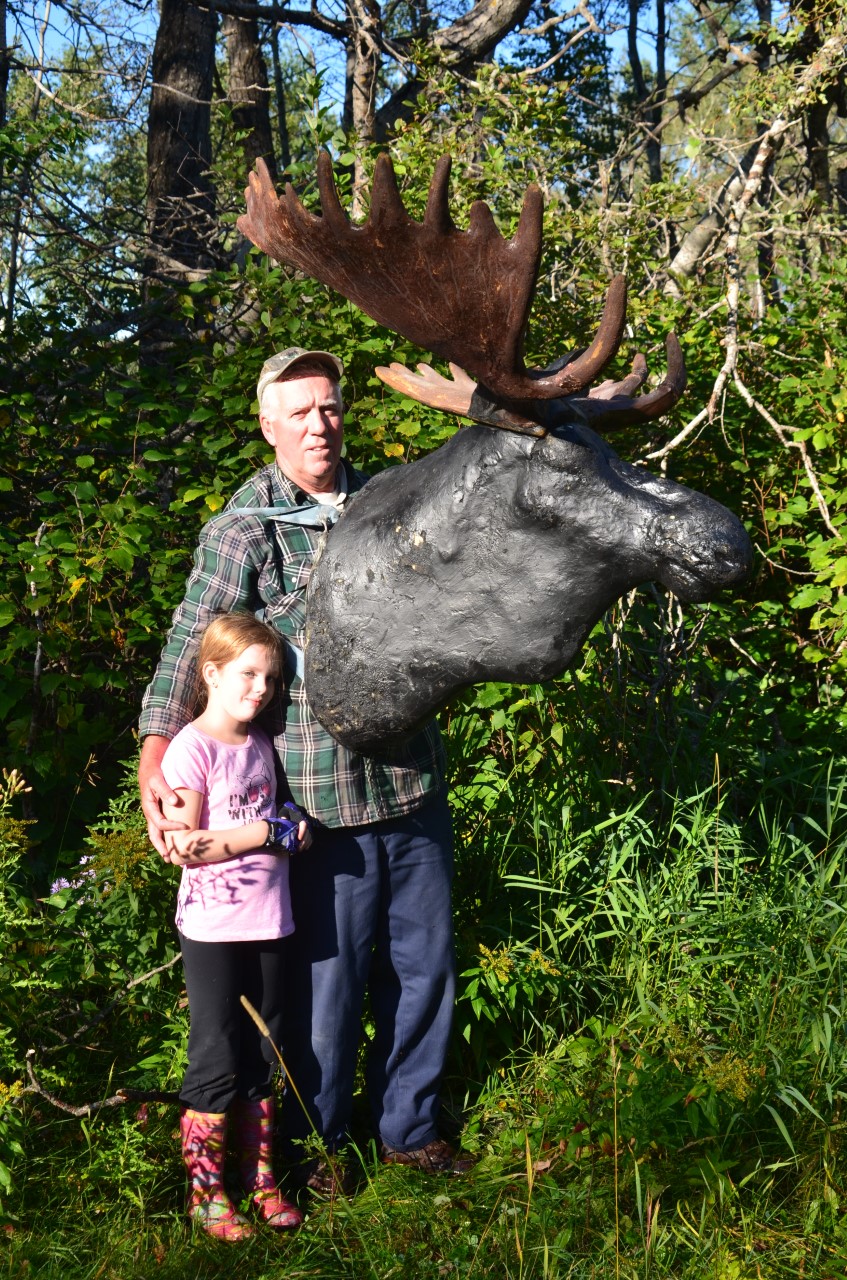
Doc Moose (Vince Crichton Collection)
When I saw news about a Big Game Symposium scheduled for Cranbrook where I now live, on April 13,  I reflected on my childhood days in  northern Ontario in Chapleau where I was raised. 

 There were many moose in the Chapleau area. In fact, I could stand in front of our house on Grey Street as a kid, look across the Nebskwashi River and see them.

Right away I thought "Who speaks for the moose?

Well it did not take long to find the answer. It is no one other than Dr. Vince Crichton also known as “Doc Moose”. Was I surprised!!– yes and no. Doc Moose also comes from Chapleau and he followed in the footsteps of his father Vince Crichton Sr., into the wildlife game. Further, his dad and my my mother Muriel (Hunt) Morris are cousins.

Vince was coming to Cranbrook. to speak at the Kootenay Heritage Wildlife Fund one day Big Game Symposium with six professional presenters each covering a different topic . I got in touch with him. 

Vince retired just a few years back after 40 years with the Manitoba’s Wildlife Branch and had many positions such as regional wildlife biologist, provincial moose/elk/caribou biologist and for the 10 years prior to retiring he was manager of game fur and problem wildlife. Although retired from government he has not retired from the Wildlife Game and is active in the moose world where he is recognized internationally by colleagues and by the general public and in the field of moose and wildlife diseases.

His  biography includes  highlights of his career. Born in Chapleau, he attended Chapleau Public and Chapleau High Schools.
Vince Crichton collection

Advanced degrees were done at the Universities of Manitoba and Guelph in the field of wildlife diseases. He retired after 40 years with Manitoba’s Wildlife and Ecosystem Protection Branch where he served in many capacities two of which were Provincial Moose, Elk, Caribou Biologist and prior to retiring Manager, Game, Fur & Problem Wildlife. 

He is a certified Wildlife Biologist and has published in scientific journals, popular magazines, authored 2 chapters in a book entitled “The Ecology and Management of the North American Moose”, past eeditor and now associate editor of the journal ALCES, editorial panel for various journals, editor of the Moose Call newsletter for 12 years and past president of the Manitoba Big Game Trophy Association. 

Vince produced a video entitled Moose Close Up and a CD entitled Moose Music and has been featured in documentaries on the Discovery Channel and Animal Planet. Recently he has been featured with his 13 year old granddaughter in a four episode series on moose. 
Vince and grandaughter. Vince Crichton collection


A hunter, conservationist, university lecturer, guest speaker and amateur photographer he is recognized internationally as an expert on moose biology and management. His peers awarded him the Distinguished Moose Biologist Award in 1988 and a special award in 2016 at the 50th North American Moose Conference/8th International Moose Symposium (which he co-chaired) for his long standing commitment to these events. 

He is a recipient of the Conservation Award presented by the Manitoba Chapter of The Wildlife Society and in 2018 the Manitoba Wildlife Federation recognized his contributions by presenting him with their Outdoor Heritage Award. He is recognized for his ability to communicate with his peers and the public. Although retired, he is still active in the wildlife game – a strong advocate for public education and for contemporary management programs in these challenging times to ensure there are resources for future generations. Next to family, wildlife runs in his veins and he speaks for “The Moose".

Vince will be one of the guest speakers at the symposium that include some other well-known and respected speakers. His presentation will focus on moose and cover items such as where did they come from, how they distributed themselves across Canada and the United States, some significant diseases, natural and anthropogenic mortalities, reproduction and hunting.
Vince Crichton collection


In light of extremely low populations in a number of jurisdictions what can be done?? He will touch on these and some will be controversial. But, if our generation is to manage the resources passed to us and pass them on in a sustainable fashion then there is a need now to invoke action plans which will ensure the legacy is there, he argues.

Vince believes that a fundamental change that must happen and he is outspoken on this is the need for science to come before politics and recognize that moose and other big game are there not just for hunters of all stripes but for those societal members who do not hunt but enjoy seeing all wildlife. 

He adds that legislation must be universally applicable and not just directed at licensed hunters. Since moose migrated to North America they have not changed but look at what society has in these contemporary times – cars, trucks, aircraft hi-powered firearms, atvs, snow machines etc and greater access via roads. 

He poses a challenge: "What chance do they have? It is time all members of society and politicians looked in the mirror and recognize that if changes are not made what a legacy to leave."

Now that we know who speaks for the moose will you step forward and work with Doc Moose and his colleagues. All photos are from the Dr. Vince Crichton collection and are used with permission.  My email is mj.morris@live.ca

Michael J Morris

Michael J Morris
MJ with Buckwheat (1989-2009) Photo by Leo Ouimet

UNEEK LUXURY TOURS, ORLANDO FL

UNEEK LUXURY TOURS, ORLANDO FL
click on image

MEMORIES FROM CHILDHOOD

MEMORIES FROM CHILDHOOD
Following the American Dream from Chapleau. CLICK ON IMAGE