As I was browsing through a wonderful pile of Chapleau material recently received from David McMillan, it intrigued me to discover one clipping noting that D.O. (Ovide) Payette would sing "the Mass of Angels" all in Latin at Sacred Heart Roman Catholic Church.
I was aware of Mr. Payette's very significant role in the history of Chapleau, but did not know that he had been a soloist and choir director at Sacred Heart church.
Lucien Bouillon, who would become a Roman Catholic priest and the first to be ordained to the priesthood in Sacred Heart Church in 1965, made the observation about Mr. Payette's singing in Latin in an article in The Chapleau Sentinel marking the 100th anniversary of the parish in 1986. Lucien was serving as an altar boy in the fifties when Mgr. Romeo Gascon was the pastor.
From the time Mr. Payette arrived in Chapleau just after the beginning of the 20th Century he was involved in the life of the community and his church. I visited that fantastic resource for Chapleau material, www.chapleau.com, created and maintained by Hugh Kuttner, and discovered photos showing that Mr. Payette was playing hockey on a Chapleau team by 1905-06. As there is a trophy in one photo, it looks like his team had won a championship.
Turning to Chapleau Trails, edited and published by Dr. William R. Pellow, I found that his daughter, Margaret Rose (Payette) Fortin wrote that her father, born in Pembroke, who taught school in Golden Lake, Ontario, came to Chapleau to work in the men's wear at Smith and Chapple Ltd. By around 1930, Mr. Payette and Arthur J. Grout bought the store and started to expand its departments. Mr. Payette became president of the company.
Margaret Rose noted that it was probably one of the first "shopping centres" in Ontario, and it likely was, living up to its reputation of providing "Everything for Everybody." For those of us who grew up shopping and working at Smith and Chapple, it is hard to believe that it closed its doors 23 years ago on April 30, 1987.
During the thirties plans to start a Chapleau winter carnival were made in Mr. Payette's office. He was described as the "catalyst' for starting the winter carnivals, and his business partner Mr. Grout became the chairman.
Mr. Payette was also very active in the Chapleau Town Band and by 1952 took over leadership of it and served in that capacity for 10 years until he retired. I can recall times when Mr. Payette, and three of his sons, John, Billy and George, would all be playing in the band for the July 1 celebration.
He also served as a volunteer firefighter and was Chapleau's fire chief for a number of years as well as being manager of the Chapleau Memorial Community Arena at one time and chairman of the Chapleau High School Board.
Very involved in all aspects of life in Chapleau, Mr. Payette was a member of the Rotary Club, the golf and curling clubs, and at Sacred Heart Church, he was a member of the Knights of Columbus and a Grand Knight. After his retirement from Smith and Chapple, Mr. Payette also served as a Justice of the Peace.
Margaret Rose wrote that music was a large part of the "growing up years" in the Payette family home with both her parents involved in the Sacred Heart church choir, and "as each of us became old enough to contribute, we were part of the choir." In fact, she revealed that her parents met at the church when Mr. Payette was the choir director, and her mother, (Marie Cahill) arrived in Chapleau to become the church organist. She adds, "the rest, as they say, is history. They were married in 1923."
Mr. Payette's contribution, in his church, in business and the wider community, played an important role in the life and times of Chapleau.
MAIL
Commenting on Chapleau Moments about 1976, Eugene Bouillon wrote: "omg, Michael, yes memories (of 1976). I graduated from College and of course worked with Terry (Bryson) helping plan the Celebrations. Also, travelled with Doreen (Collings) to Red Rock to pick up the Pickerel for the Fish Fry and stayed up all night working on the fire for the Beef BBQ. Yes memories."
Thursday, April 29, 2010


Thursday, April 22, 2010
Chapleau 1976: laughter at high school, comic athletic prowess, ball hockey squeakers and the circus tent

Writing in the souvenir newspaper for the school's 75th anniversary in 1997, Jamie says that while laughter was never really given the respect it should have received, "it was a something, a quality perhaps, that everyone possessed whether they were aware of it or not."
Reflecting on his high school days Jamie still heard laughter in the hallways, classrooms, gymnasiums, library, on the hill as students told jokes. passed along secrets, and pulled pranks amongst one another.
"I hear the comic anecdotes of Mr. (Bryan) Kuehl to drill home a point in his Biology class; I relive the hockey tales from Mr. Morris in Man and Society; I visualize the comical actions that Mr. (Alex) Babin used to illustrate the use of a verb in French class: I hear Mr. (George) Evans using comic relief to get the class through another session of Greek mythology; I hear Mr. (Ross) Hryhorchuk laughing at another display of comic athletic prowess..."
On the 1976-77 CHS Students Council with Jamie were Tom O'Shaughnessy, Willie Date, Tim Morin, Jean Doyle, Francois Tremblay, Elaine Travis, Mike Serre, Joan Payette and Anne Marie Payette.
Thanks Jamie for the memories.
Also at the high school in 1976, Guy Bazinet was the valedictorian, while recipients of the Ontario Secondary School Honour Graduation Diplomas included Gilles Babineau, Richard Barrer, Guy Bazinet, Heather Beacock, Andre Bedard, Angelo Bucciarelli, Doris Delaney, Russell Deluce, Linda Dingee, Michelina Frattaruolo, Luc Gauthier, Michelle Jacques, Guy Martel, Keith Travis and Andre Tremblay
RECREATION ACTIVITIES UNDERWAY
Meanwhile, in the Spring of 1976, recreation activities were getting underway for the summer season.
Little League Baseball was getting underway at Grinton Park, where the Chapleau Recreation Centre opened in 1978, and with repairs to the field having been completed, under the capable guidance of president Bill Chambers, Chapleau would be hosting the District Four Little League playoffs.
At the beach Paul Richardson would be returning for his second year as the swimming instructor and lifeguard.
Over at the Chapleau Memorial Community Arena, the newly formed men's ball hockey league was getting underway with four teams participating -- Chapleau Lumber, The Hustlers, Ministry of Natural Resources and the West Side Boys.
In the opening games, the Ministry of Natural Resources squeaked by Ron Larcher's Hustlers, scoring in the dying seconds to win 5-4. Chapleau Lumber built up a 3-0 lead but couldn't hold it and lost by an identical score to the West Side Boys. I remember attending the ball hockey league games and found them so relaxing after a long winter of coaching the Chapleau Intermediate "A" Huskies in their first season in the Northland Intermediate Hockey League in 1975-76. I sat in the stands and enjoyed the ball hockey games.
75th ANNIVERSARY PLANS FINALIZED
In the Spring of 1976, plans were also being finalized for Summerfest and Old Home Week to mark the 75th anniversary of the incorporation of Chapleau as a municipality to be held from July 1 to 4. Led by Festival Chapleau co-ordinator Eileen McCrea, a group of volunteers was working to finalize the activities -- and bring the circus tent to town for activities in the beach area.
Manlio Spessot and the Boy Scouts were organizing the canoe and kayak races while Dorleen Collings, who was often fondly called "Chapleau's cook" was planning the menus for the meals that would be provided. Recreation Director Terry Bryson was overseeing all the recreation activities for the celebration.
Plans were also being made for a visit to Chapleau by the Hon. Rene Brunelle, chairman of the provincial cabinet, who would participate in the sod-turning ceremony for Cedar Grove Lodge for Senior Citizens which would be located on the old separate school site on Pine Street. During Senior Citizens Week, the Chapleau Senior Citizens Club saw plans for the new complex and made their comments.
Terry Bryson announced that a picnic for senior citizens would be held during the Old Home Week, while Councillor Ernie Gilbert outlined grants for Senior Citizens centres.
CENTENNIAL MUSEUM OPENS FOR SUMMER
Robert Andras, who was the minister of Manpower and Immigration for Canada was in town in June and officially opened the Chapleau Centennial Museum for the summer season by raising a new Canadian flag on behalf of Prime Minister Pierre Trudeau.
Under the capable supervision of Dorleen Collings, The Chapleau Sentinel reported that the museum had been a "beehive of activity with flowers blossoming and the fountain "spattered with the pennies of those seeking luck." Inside many displays were being restored. The rock collection, stuffed birds and animals and the famous Rotary table were all in place.
Seems like only yesterday.
Monday, April 19, 2010
King George VI meets George Fife at the Chapleau CPR station at two a.m. in 1939 without his chain of office
By Bill McLeod
In the late 1930s there was a lot going on in the world. King Edward VIII had abdicated in December of 1936 and was replaced by his brother Bertie who took on the new name of George VI. The official reason for Edward’s abdication was that he was messing around with an American divorcee named Wallace Simpson and wanted to marry her. Since the British sovereign is also head of the Church of England, whose crank was not turned by divorce, Edward chose Wallace over the throne.
But there were other issues that were causing great concern to the British establishment. Apparently Fast Eddie the King wasn’t too swift. War was looming on the horizon, and Eddie didn’t seem to be twigging to the gravity of the situation. Also, the British Government was worried that he was getting a bit too chummy with his German cousins and with senior members of the Third Reich. Getting rid of Eddie solved a number of problems but created some new ones. They sent him off to be Governor of the Bahamas – out of sight and almost out of mind. While Eddie was presiding in the Bahamas, Harry Oakes, the fabulously wealthy discoverer of Lakeshore Mines was murdered. No one was ever charged with Oakes’ death, but rumors swirled for many years that Eddie the Governor might have known a bit more about the case than he let on.
If all this seems like it has no connection with Northern Ontario, bear with me.
In 1939, the new King and Elizabeth, his Queen were sent on a tour of Canada. In addition to introducing the new royal couple to Canadians, the junket had another purpose. Since Bertie and Liz had not been trained or groomed for the throne, they needed to get accustomed to all the scraping and bowing. If they goofed, the bumpkins in the Canadian boondocks might not even notice.
Fast forward to July of 2000. The Queen Mother, now well into her nineties, gave a rather extensive interview to the Globe and Mail. One of the events the old Queen related to the interviewer was the 1939 tour of Canada. She specifically mentioned Chapleau.
Apparently the Royal train had to stop in Chapleau at 2:00 a.m. to take on water. The reeve of Chapleau at the time was a highly regarded man named George Fife. For many years Mr. Fife ran the town’s hydro generating plant and power distribution network. I remember him as a jovial man who liked to tease kids. He was the grandfather of Phyllis Crang of Sudbury, one of Northern Ontario’s best ever athletes. And one of his grandsons is Bob Fife, CTV’s Ottawa Bureau Chief.
When word came to Chapleau that the Royal Train would be stopping there, George Fife sent word to the crew that he would like to meet the King. Probably without much enthusiasm, George VI hauled his butt out of the sack, put on his suit and tie and went out on the station platform to meet Mr. Fife. After making some small talk, the King asked the reeve (mayor) if he had a chain of office. Not a man to pass up the chance to have a little fun at the expense of the sovereign, Fife replied that he did have such a chain “but he only wore it on special occasions”. That cracked the King up and, sixty-one years later, the Queen Mother laughingly told the Globe and Mail about her brief visit to Chapleau and about how funny the King found Mr. Fife’s comment.
There may well be another version of this story as I found out when I read Jean Chretien’s memoir, My Years as Prime Minister. Over his long career Mr. Chretien became quite close to the Royal family. One of the reasons they liked him and Mrs. Chretien was that they could speak French with them. On page 243 Chretien describes a January, 1994, luncheon with the Queen Mother at Sandringham. The old Queen got to reminiscing about the Royal tour of 1939. She recounted a dinner one evening with Camillien Houde, the colorful mayor of Montreal. She inquired as to why he wasn’t wearing his chain of office. Like George Fife, Camillien told the Queen that he did have one but wore it “only on special occasions”.
It’s difficult to figure out how the Queen Mother could confuse George Fife with Camillien Houde. But maybe this was an “all purpose” story she used whenever what she deemed an appropriate occasion arose. Who knows? It is a very funny tale.
On a more serious note, Camillien Houde was interned during World War II probably because he wasn’t as sympathetic to the war effort as he might have been. Something like Pierre Trudeau, only Trudeau wasn’t incarcerated. One of the jobs Houde was given involved dismantling some urinals to be melted down and used in the war effort. He was quoted as saying that he was required to “turn urinals into arsenals”. A pretty good line.
Bill McLeod has a new book coming out in 2010. For details email Bill at wemcleod@sympatico.ca
In the late 1930s there was a lot going on in the world. King Edward VIII had abdicated in December of 1936 and was replaced by his brother Bertie who took on the new name of George VI. The official reason for Edward’s abdication was that he was messing around with an American divorcee named Wallace Simpson and wanted to marry her. Since the British sovereign is also head of the Church of England, whose crank was not turned by divorce, Edward chose Wallace over the throne.
But there were other issues that were causing great concern to the British establishment. Apparently Fast Eddie the King wasn’t too swift. War was looming on the horizon, and Eddie didn’t seem to be twigging to the gravity of the situation. Also, the British Government was worried that he was getting a bit too chummy with his German cousins and with senior members of the Third Reich. Getting rid of Eddie solved a number of problems but created some new ones. They sent him off to be Governor of the Bahamas – out of sight and almost out of mind. While Eddie was presiding in the Bahamas, Harry Oakes, the fabulously wealthy discoverer of Lakeshore Mines was murdered. No one was ever charged with Oakes’ death, but rumors swirled for many years that Eddie the Governor might have known a bit more about the case than he let on.
If all this seems like it has no connection with Northern Ontario, bear with me.
In 1939, the new King and Elizabeth, his Queen were sent on a tour of Canada. In addition to introducing the new royal couple to Canadians, the junket had another purpose. Since Bertie and Liz had not been trained or groomed for the throne, they needed to get accustomed to all the scraping and bowing. If they goofed, the bumpkins in the Canadian boondocks might not even notice.
Fast forward to July of 2000. The Queen Mother, now well into her nineties, gave a rather extensive interview to the Globe and Mail. One of the events the old Queen related to the interviewer was the 1939 tour of Canada. She specifically mentioned Chapleau.
Apparently the Royal train had to stop in Chapleau at 2:00 a.m. to take on water. The reeve of Chapleau at the time was a highly regarded man named George Fife. For many years Mr. Fife ran the town’s hydro generating plant and power distribution network. I remember him as a jovial man who liked to tease kids. He was the grandfather of Phyllis Crang of Sudbury, one of Northern Ontario’s best ever athletes. And one of his grandsons is Bob Fife, CTV’s Ottawa Bureau Chief.
When word came to Chapleau that the Royal Train would be stopping there, George Fife sent word to the crew that he would like to meet the King. Probably without much enthusiasm, George VI hauled his butt out of the sack, put on his suit and tie and went out on the station platform to meet Mr. Fife. After making some small talk, the King asked the reeve (mayor) if he had a chain of office. Not a man to pass up the chance to have a little fun at the expense of the sovereign, Fife replied that he did have such a chain “but he only wore it on special occasions”. That cracked the King up and, sixty-one years later, the Queen Mother laughingly told the Globe and Mail about her brief visit to Chapleau and about how funny the King found Mr. Fife’s comment.
There may well be another version of this story as I found out when I read Jean Chretien’s memoir, My Years as Prime Minister. Over his long career Mr. Chretien became quite close to the Royal family. One of the reasons they liked him and Mrs. Chretien was that they could speak French with them. On page 243 Chretien describes a January, 1994, luncheon with the Queen Mother at Sandringham. The old Queen got to reminiscing about the Royal tour of 1939. She recounted a dinner one evening with Camillien Houde, the colorful mayor of Montreal. She inquired as to why he wasn’t wearing his chain of office. Like George Fife, Camillien told the Queen that he did have one but wore it “only on special occasions”.
It’s difficult to figure out how the Queen Mother could confuse George Fife with Camillien Houde. But maybe this was an “all purpose” story she used whenever what she deemed an appropriate occasion arose. Who knows? It is a very funny tale.
On a more serious note, Camillien Houde was interned during World War II probably because he wasn’t as sympathetic to the war effort as he might have been. Something like Pierre Trudeau, only Trudeau wasn’t incarcerated. One of the jobs Houde was given involved dismantling some urinals to be melted down and used in the war effort. He was quoted as saying that he was required to “turn urinals into arsenals”. A pretty good line.
Bill McLeod has a new book coming out in 2010. For details email Bill at wemcleod@sympatico.ca
Thursday, April 15, 2010
A potpourri of stories from working with Tee Chambers to Junior Red Cross play at Chapleau Public School plus the 'devilish deed' and more from Chapleau
Let me begin with a definition. As I was going over my notes for this column, I immediately thought of 'potpourri' but wasn't exactly sure what it meant. I recalled that the late J.M. "Jack" Shoup, the longtime principal and teacher at Chapleau Public School, township councillor and veteran of World Wars I and II, once wrote a column with that title in the Sudbury Star.
I went to dictionary.com and the first definition I saw said it was a mixture of dried petals of roses or other flowers with spices, kept in a jar for their fragrance. That wasn't the definition I was looking for. The second one came closer: Potpourri is a miscellaneous anthology or collection: a potpourri of short stories...
So, with thanks to Mr. Shoup for the idea I am going to share some of the stories and comments I have been receiving recently from readers of Chapleau Moments in the Chapleau Exoress and my blog plus the story of the "devilish deed."
WORKING WITH TEE
Michael Cecile, formerly of Chapleau, now living in Calgary wrote after seeing the column with his sister Susan's comments on rock and roll and a photo of Garth "Tee' Chambers with Harry "Butch" Pellow and Aldee Martel.
Michael wrote: "Like all the others I’m really enjoying your articles!
"You’ll be pleased to know I get the Chapleau Express by a method something like a portaging trip on the Chapleau River. Marie Fortin has the Express sent to John Champion. He passes them on to me when we meet in a park, walking our dogs in NW Calgary. Not technically sophisticated like email, but it works, and I get to talk with John, his family and friends (he's a Grand Dad now!!).
"I really enjoyed the ‘53-‘54 picture of Tee Chambers! I worked with Tee’s Cartage one summer (like many others). We unloaded box cars and transported goods to the Dominion Store.Then we delivered groceries to Dominion customers around town. If you worked for Tee you’d know he had a great sense of humour and I was the recipient of one of his favourite jokes. We had formed a chain, moving boxes person to person from a box car to his truck. When we came to heavy cases with cans, Tee (next to me) called out “Heavy”, and again “ Heavy”...etc. I of course adjusted my catch-lift accordingly.
"Then Tee called out “Extra Heavy”, I adjusted my lift even more and ended up smashing the box of Kleenex, or something
lighter, right into my face. Of course we all had a good laugh, especially Tee!
"I also enjoyed reading a quote from my sister Susan’s article on “ the mostest rock and roll”. Your readers might like to know that Susan had a stroke in December but is recovering very well with great support from her kids."
Thanks Michael and all the best to Susan.
Louis Fortin's sister Muriele wrote to provide interesting comments on her brother working on the ice gang and Dr. Bill Pellow's memories of the ice house in the winter. Louis worked on ice gangs in the summer and Bill spent winter weekends at the old ice house across from the Boston Cafe. Both graduated from university.
THE RACONTEUR
Muriele wrote: "Mike you are such a great 'raconteur'. As I'm reading Bill Pellow's and Louis' details of ice gang and pre ice work, I'm thinking what physically demanding work that was for young people. Is it any wonder they and many others went on to futher education and successful careers, less physically demanding. For several years I raised my two sons in a rural setting where their summer jobs entailed washing milking cows, haying, cleaning barns etc. I believe it was during those gruelling summer jobs that they decided to pursue higher education. It happened. I'm happy. They are happy."
OFF ON A GOOD TALE
Steve Degeer, a former student from my time at Chapleau High School wrote after paying a recent visit to Chapleau. "I just recently returned to Chapleau for a visit with my parents and I read your article in the paper and I love it! I can remember that you loved to tell us stories about the old days! Someone would bring you a Mars bar and start talking about hockey or chapleau and you would go off on a good tale! You were one of my favorite teachers! And that's to date! Well I'll be looking forward to your next article! Keep up the good work!!!"
Thanks Steve, and yes, I have enjoyed stories and story telling for as long as I can remember. Since I was a child growing up in Chapleau has been central to me whether I was playing in the living room or creating my own plays for the Junior Red Cross Society performances in Grade four at Chapleau Public School. If I remember correctly Alison (McMillan) McMullen, Ted and Brian Demers starred in the first play I created. We rehearsed in the basement of Demers' home on Beech Street at the time.
Thanks to my mother, Muriel E. (Hunt) Morris, who instilled a love of stories in me before I could hardly walk, and gave me the freedom to explore all the great children's literature of my time, story has been the place where I have lived. And I very much appreciate all the kind comments that I receive from so many of you who were her students over the 32 years that she taught at Chapleau Public School.
Michael Cecile shared the following about his mother Renee Cecile who also encouraged a love of reading and music and recipes in her children: "Some parents balked at their kids reading Classic Comics and comics in general but Renee was happy to see us read and encouraged that too. She liked to try new foods and recipes but my Dad was only liked well-done meat and potatoes, but she did experiment on us!" Those of us who worked with and knew Mrs. Cecile, through her years of devotion to the Chapleau Public Library and as school librarian are well aware, of her love of books and music.
FROM MID NORTH NEWS TO THE INTERNET
Little did I realize that my experience as the Chapleau High School reporter (with Joy Evans) for the long gone Mid North News, and a television program on CHAP TV in 1957- 1958 (with Phyllis Chrusoskie, Bill Mcleod and others) would lead to story telling and talking about the stories of others in classrooms in Ontario and British Columbia. And people even got me to write stories about people and events in daily newspapers, for television, in magazines and the internet and books.
THROUGH THE EYES OF A KID
Yvonne (Fournier) Kohls, sent me comments from her brother Rene Fournier who also loves storytelling. Rene wrote in part to his sister: "Thanks for sending M.J. Morris's stuff, I enjoy some of these that I can connect to. The Yen Hong and family article was interesting because Dad was close to the elders and of course I was the same age as Yen's sister (Jean). In fact at some tender age I asked dad if I could marry her. He suggested I should wait till I was ten, but it was O.K. with him if it was O.K. with her mother....
"I will say this, I actually do tell stories about life in a small town through the eyes of a kid such as the morning all the men and boys of Chapleau went to the freight shed to see ten wheel truck unloading. A huge Event! On par with the day the King and Queen's train passed through Chapleau. (they slept while we watched the silent event with our hats off)"
Thanks Yvonne and Rene. Great memories. The Yen story to which he refers is the one about the seven members of the family appearing on the game report of a hockey game at one time and the game played in the Boston Cafe.
THE DEVILISH DEED
The other day Hugh McGoldrick posted on Facebook that he had been talking with Lynn Hazen about the possibility of reunion in 2011 of the the 1976 graduating class of Chapleau High School. I immediately thought of a story that Lynn told about me in the newspaper marking the 75th anniversary of the school in 1997.
Lynn wrote in part that in 1972, two grade niners who had never done anything wrong took the plunge. "When Mr. Morris momentarily left the classroom, the wall clock came down. As they turned the time forward, it slipped from their hands and landed in several pieces on the floor. The two niners slinked to their seats just before Mr. Morris came through the door.
"The longer he grilled us about who had done the devilish deed, the more we dug in our heels and adhered to a new found code of silence. We all stayed for detention. We were together on this one."
To this day I have no idea who did this devilish deed. Perhaps if I attend the reunion, someone will confess.. Contact Hugh or Lynn for more information on their plans.
I went to dictionary.com and the first definition I saw said it was a mixture of dried petals of roses or other flowers with spices, kept in a jar for their fragrance. That wasn't the definition I was looking for. The second one came closer: Potpourri is a miscellaneous anthology or collection: a potpourri of short stories...
So, with thanks to Mr. Shoup for the idea I am going to share some of the stories and comments I have been receiving recently from readers of Chapleau Moments in the Chapleau Exoress and my blog plus the story of the "devilish deed."
WORKING WITH TEE
Michael Cecile, formerly of Chapleau, now living in Calgary wrote after seeing the column with his sister Susan's comments on rock and roll and a photo of Garth "Tee' Chambers with Harry "Butch" Pellow and Aldee Martel.
Michael wrote: "Like all the others I’m really enjoying your articles!
"You’ll be pleased to know I get the Chapleau Express by a method something like a portaging trip on the Chapleau River. Marie Fortin has the Express sent to John Champion. He passes them on to me when we meet in a park, walking our dogs in NW Calgary. Not technically sophisticated like email, but it works, and I get to talk with John, his family and friends (he's a Grand Dad now!!).
"I really enjoyed the ‘53-‘54 picture of Tee Chambers! I worked with Tee’s Cartage one summer (like many others). We unloaded box cars and transported goods to the Dominion Store.Then we delivered groceries to Dominion customers around town. If you worked for Tee you’d know he had a great sense of humour and I was the recipient of one of his favourite jokes. We had formed a chain, moving boxes person to person from a box car to his truck. When we came to heavy cases with cans, Tee (next to me) called out “Heavy”, and again “ Heavy”...etc. I of course adjusted my catch-lift accordingly.
"Then Tee called out “Extra Heavy”, I adjusted my lift even more and ended up smashing the box of Kleenex, or something
lighter, right into my face. Of course we all had a good laugh, especially Tee!
"I also enjoyed reading a quote from my sister Susan’s article on “ the mostest rock and roll”. Your readers might like to know that Susan had a stroke in December but is recovering very well with great support from her kids."
Thanks Michael and all the best to Susan.
Louis Fortin's sister Muriele wrote to provide interesting comments on her brother working on the ice gang and Dr. Bill Pellow's memories of the ice house in the winter. Louis worked on ice gangs in the summer and Bill spent winter weekends at the old ice house across from the Boston Cafe. Both graduated from university.
THE RACONTEUR
Muriele wrote: "Mike you are such a great 'raconteur'. As I'm reading Bill Pellow's and Louis' details of ice gang and pre ice work, I'm thinking what physically demanding work that was for young people. Is it any wonder they and many others went on to futher education and successful careers, less physically demanding. For several years I raised my two sons in a rural setting where their summer jobs entailed washing milking cows, haying, cleaning barns etc. I believe it was during those gruelling summer jobs that they decided to pursue higher education. It happened. I'm happy. They are happy."
OFF ON A GOOD TALE
Steve Degeer, a former student from my time at Chapleau High School wrote after paying a recent visit to Chapleau. "I just recently returned to Chapleau for a visit with my parents and I read your article in the paper and I love it! I can remember that you loved to tell us stories about the old days! Someone would bring you a Mars bar and start talking about hockey or chapleau and you would go off on a good tale! You were one of my favorite teachers! And that's to date! Well I'll be looking forward to your next article! Keep up the good work!!!"
Thanks Steve, and yes, I have enjoyed stories and story telling for as long as I can remember. Since I was a child growing up in Chapleau has been central to me whether I was playing in the living room or creating my own plays for the Junior Red Cross Society performances in Grade four at Chapleau Public School. If I remember correctly Alison (McMillan) McMullen, Ted and Brian Demers starred in the first play I created. We rehearsed in the basement of Demers' home on Beech Street at the time.
Thanks to my mother, Muriel E. (Hunt) Morris, who instilled a love of stories in me before I could hardly walk, and gave me the freedom to explore all the great children's literature of my time, story has been the place where I have lived. And I very much appreciate all the kind comments that I receive from so many of you who were her students over the 32 years that she taught at Chapleau Public School.
Michael Cecile shared the following about his mother Renee Cecile who also encouraged a love of reading and music and recipes in her children: "Some parents balked at their kids reading Classic Comics and comics in general but Renee was happy to see us read and encouraged that too. She liked to try new foods and recipes but my Dad was only liked well-done meat and potatoes, but she did experiment on us!" Those of us who worked with and knew Mrs. Cecile, through her years of devotion to the Chapleau Public Library and as school librarian are well aware, of her love of books and music.
FROM MID NORTH NEWS TO THE INTERNET
Little did I realize that my experience as the Chapleau High School reporter (with Joy Evans) for the long gone Mid North News, and a television program on CHAP TV in 1957- 1958 (with Phyllis Chrusoskie, Bill Mcleod and others) would lead to story telling and talking about the stories of others in classrooms in Ontario and British Columbia. And people even got me to write stories about people and events in daily newspapers, for television, in magazines and the internet and books.
THROUGH THE EYES OF A KID
Yvonne (Fournier) Kohls, sent me comments from her brother Rene Fournier who also loves storytelling. Rene wrote in part to his sister: "Thanks for sending M.J. Morris's stuff, I enjoy some of these that I can connect to. The Yen Hong and family article was interesting because Dad was close to the elders and of course I was the same age as Yen's sister (Jean). In fact at some tender age I asked dad if I could marry her. He suggested I should wait till I was ten, but it was O.K. with him if it was O.K. with her mother....
"I will say this, I actually do tell stories about life in a small town through the eyes of a kid such as the morning all the men and boys of Chapleau went to the freight shed to see ten wheel truck unloading. A huge Event! On par with the day the King and Queen's train passed through Chapleau. (they slept while we watched the silent event with our hats off)"
Thanks Yvonne and Rene. Great memories. The Yen story to which he refers is the one about the seven members of the family appearing on the game report of a hockey game at one time and the game played in the Boston Cafe.
THE DEVILISH DEED
The other day Hugh McGoldrick posted on Facebook that he had been talking with Lynn Hazen about the possibility of reunion in 2011 of the the 1976 graduating class of Chapleau High School. I immediately thought of a story that Lynn told about me in the newspaper marking the 75th anniversary of the school in 1997.
Lynn wrote in part that in 1972, two grade niners who had never done anything wrong took the plunge. "When Mr. Morris momentarily left the classroom, the wall clock came down. As they turned the time forward, it slipped from their hands and landed in several pieces on the floor. The two niners slinked to their seats just before Mr. Morris came through the door.
"The longer he grilled us about who had done the devilish deed, the more we dug in our heels and adhered to a new found code of silence. We all stayed for detention. We were together on this one."
To this day I have no idea who did this devilish deed. Perhaps if I attend the reunion, someone will confess.. Contact Hugh or Lynn for more information on their plans.
Saturday, April 10, 2010
Tom Corston becomes ninth Anglican bishop of the Diocese of Moosonee

Thomas A. "Tom" Corston, born and raised in Chapleau, Ontario, the son of Frances (Jardine) and the late Henry "Chicken" Corston, has been elected the ninth Bishop of the Anglican Church Diocese of Moosonee at a synod in Timmins.
Tom, who is currently an archdeacon in the Anglican church is also Rector of the Church of the Epiphany, Sudbury, Ontario, in the Diocese of Algoma, is expected to take up his new duties in July, 2010. He succeeds Archbishop Caleb Lawrence, who retired.
Growing up in Chapleau, Tom was active in St. John's Anglican Church, as AYPA president, which is a parish in the Diocese of Moosonee which he will now be leading. Tom becomes the first Chapleau boy to have become an Anglican priest to have been elected a Bishop. Tom was also a president of the Students' Council at Chapleau High School.
He graduated from Lakehead University with the Bachelor of Arts degree and Wycliffe College with a Master of Divinity degree.
In June,1974, Tom was ordained a Deacon in a service at St. John's ina service conducted by Archbishop James A. Watton, then the Bishop of Moosonee. He was ordained to the priesthood a year later.

Tom is married with two children.
Tom's grandparents John and Lydia (Swanson) Corston, came from James Bay in the Diocese of Moosonee to Chapleau in 1907 where his grandfather began work with the Canadian Pacific Railway. They established their family home on Grey Street.
Tom is a successor to John Horden, the first Bishop of Moosonee in 1872, who travelled around the vast area by canoe, snowshoe and on foot. Bishop Horden was considered one of the great missionaries of his time.
Here is where Tom has served in his ministry taken from a curriculum vitae prprepared for his nomination for Bishop of Moosonee:
Curate, Church of St. Michael & All Angels, Toronto, ON, 1974-75
Incumbent, Foleyet, Gogama, Mattagami First Nation, 1975-78,
Incumbent, Longlac, Caramat, Hillsport, Nakina, Armstrong, Collins, Allanwater Bridge,
Ogoki Post, 1978-80
Rector, South Porcupine & Schumacher, 1980-83
Regional Dean, Deanery of Cochrane, 1982
Rector, St. Margaret’s Church, Fredericton, NB, 1983-85
Rector, Iroquois Falls, Matheson & Montieth, 1985-87
Rector, Chatham, NB, 1987-92
Regional Dean, Deanery of Chatham, NB, 1990-1992
Rector, Holy Trinity Church, Sault Ste. Marie, 1992-98
Regional Dean, Deanery of Algoma, 1995-1997
Rector, Church of the Epiphany, Sudbury, 1998-present
Regional Dean, Deanery of Sudbury/Manitoulin, 1999-2002
Archdeacon of Sudbury/Manitoulin, 2002-present
Thursday, April 8, 2010
Michael McMullen recalls life in Chapleau celebrating hockey victory, earning 'real money' setting pins and listening to popular radio shows
 |
| MJM and Michael McMullen, co-authors 'The Chapleau Boys Go To War' 2015 |
The book is available in Chapleau at the Chapleau Village Shops, on amazon.ca, amazon.com and Kindle. Key words: 'chapleau boys war'
Michael McMullen's memories of growing up in Chapleau in the early 1950s won him the first annual Buckwheat Award for most popular story on the blog. The award is named after my beloved cat Buckwheat, who died in November 2009 at 20 years and two months old.. MJM
Michael McMullen lived in Chapleau from 1952-54 when his father Keith came to work for the Austin Lumber company, but his roots in the community go back to 1885 when his great great uncle Patrick Mulligan (and mine) arrived and opened one of the first general stores, called Murrays and Mulligan General Merchants.
After reading Michael's family history of his grandparents, William and May (Mulligan) McMullen, both of whom lived in Chapleau in the early years of the 20th Century, I asked him if I might share some of his recollections of life in Chapleau. He agreed and his recollections capture much of life as it was for us growing up in Chapleau during the early Fifties.
 |
| Book presentation to Donald White, 102, World War2 vet from Chapleau |
"I have fond memories of that time and still have many friendships that have endured since then," Michael wrote. "More importantly, I met my wife, Alison, during this period. She is the daughter of Leslie and Margaret (Jack) McMillan and sister of David McMillan. Les was a CPR locomotive engineer who operated out of Chapleau for over 25 years, retiring in 1966." Mr. McMillan also served as a member of Chapleau township council.
After arriving in Chapleau, Michael and his parents lived for a time in the offices of Austin Lumber on the second floor of the building at the northwest corner of Birch and Young Streets. Their bedrooms were in two of the separate enclosed offices. "There was a Dominion store on the first floor. (later the Bank of Montreal). Years later I would discover that this was the building that Patrick Mulligan had rebuilt in 1895 following a fire at his original store on this site."

"We also played road hockey on the snow packed, icy streets, particularly on Aberdeen Street, not with a ball, but with a real puck.

(In the photo are in back row from left Basil Collings, Mike McMullen, Mrs. Broomhead, David McMillan, Richard Pilon, Tim Goodwin. Front row from left Charlie White, Ken Schroeder, Harry 'Boo' Hong In the ball photo, Michael is at bat and his cousin David Curry is the catcher.)
He also recalled that it was on an empty lot to the west of the Boston Cafe that he first participated in building an outdoor skating/hockey rink. "Boo Boo Hong asked me, and several others to help him and his brothers (Yen and Jimmy) to do this." This was where the Bridgeview Motel until recently owned by Yen Hong was built. It was also location where Patrick Mulligan had built a warehouse and post office.
Michael noted that when they first arrived in Chapleau they stayed at the Rectory of St. John's Anglican Church where Reverend E. Roy Haddon (the Rector at the time) and family lived at the southwest corner of Pine and Young Street with a tennis court beside it. The Haddons were on vacation at the time. The house was nearly opposite the church... To the right (east) was the Town Hall and then beside it was Chapleau Public School which he would attend. To the left of the church on the west was Chapleau High School.
"I would discover that right beside the high school was where Alison and family lived."
He would learn later that the original Anglican church in Chapleau was built in 1885 on the site where the tennis court was located. "I would also appreciate that my father and most of his siblings, if not all, were baptized at the current St. John's, which was opened in 1908, and went to the same public school I did"

In photo are from left Michael, his parents Margret and Keith McMullen and me, taken in 1955
Michael recalled earning "some real money" for the first time in Chapleau. Mrs. Elsie Wilkinson, the widow of Dr. Steve Wilkinson paid him 25 cents to cut the grass on her property on Beech Street with her hand mower once a week.
"I was a pin boy at the bowling alley for probably 15-20 cents an hour. I was down at the end of the alley where the pins were placed. My responsibility was to properly position the pins during each frame, and to put the balls in the track to return to the players. As I recall, I was looking after two lanes at one time. You had to be alert because of where the pin could go after being hit. There was a foot slot at the end of the bowling lane that you stepped on that pushed the pins up from the floor for each of the five bowling pins to be placed on."
The bowling alley was located across on Birch Street across from the Chapleau News Depot store.
Michael also helped Raymond Soucie a number of times to pick worms to sell to fishermen for about 25 cents a container. He noted that in the early 1950s, 25 cents went a long way, as admission to the theatre was only 15-20 cents. Michael and I also delivered flyers for Simpsons order office which had been recently established in Chapleau.
"In the days before television, a radio was a great thing to have," Michael recalled. Radio was non existent during the day until the CBC installed repeater stations, but "... as the sun was going down the reception started to come in and after sundown the reception was really good, particularly for powerful stations from cities in the United States, such as Fort Wayne (WOWO), Pittsburgh (KDKA) and Boston (WBZ)."
Michael remembers some of the popular radio shows such as the Lone Ranger, Jack Benny, the Green Hornet and Inner Sanctum with "its scary squeaky door at the beginning of the program. Canadian shows such as Wayne and Shuster, and the Happy Gang were very popular. We got the Saturday night hockey games, usually from Toronto with Foster Hewitt and the Toronto Maple Leafs."
He liked listening to baseball games particularly his favorite team at the time, the Brooklyn Dodgers. They were on WMGM, 1050 on the dial from New York and the sponsors were Lucky Strike and Schaefer beer. Vince Scully was the junior announcer and he is still calling games for the Los Angeles Dodgers. On weekends there were baseball games on the United States Armed Forces Network on short wave radio with Dizzy Dean and Buddy Blattner.
After moving to Toronto in 1954, Michael did not return to Chapleau until the Chapleau High School reunion in 1997. Many changes had taken place in the 43 years since he left. The old Patrick Mulligan store was gone as was the natural ice arena on Lorne Street replaced by the Chapleau Recreation Centre on the other side of town. The movie theatre had closed, and the YMCA was gone as well. The ball field that was behind the high school was still there but the school had moved. The Chapleau Civic Centre was in its place.
But some things had not changed for him. The Boston Cafe, which had become Hongers, was still there and still owned by the Hong family. Chapleau Public School was in the same place and to him it appeared the same inside and out.
Before leaving Chapleau in 1954, Michael remembers going to the old Protestant Cemetery on Birch Street with his friend the late Harry (Boo Boo) Hong.
"(Boo Boo)... asked me to help him do some landscaping at the grave of his father. We got a wheelbarrow, two shovels and went there. The plot had sunk and needed some earth so we went to a nearby field and hauled earth back to do the work.
"While repairing the site, I browsed at the nearby plots and to my surprise, one of the plots close by, at the back fence, was the location of my grandfather William McMullen. It needed the same work as the Hong site. So, we hauled more earth and put both plots in a condition, which pleased us both."
Michael and his parents appear to have been the last of his McMullen line to live in Chapleau. However, some years ago, Dr. Bill McMullen from Sudbury was one of the medical doctors who came to Chapleau on a periodic basis to provide medical services. Bill is the eldest son of Hugh McMullen, his father's older brother. I am the last of the Patrick Mulligan line to have lived in Chapleau. My grandmother, Lil (Mulligan) Morris and Michael and Bill's grandmother May (Mulligan) McMullen were sisters.
My email is mj.morris@live.ca
Wednesday, April 7, 2010
Ice cracks causing tractor to sink in Chapleau River as Bob Lemieux jumps to safety during Great Depression

Anne (Lemieux) Lacroix believes the year was 1938 and her father had been awarded a contract by the Canadian Pacific Railway to haul blocks of ice from the river to the ice house near the railway station.
A news report at the time said that as the ice cracked and the sleigh started to slip, Mr. Lemieux jumped over the back of the tractor onto a sleigh, climbed a pole and for there he made it to stronger ice as the tractor sunk into about 15 feet of water.
Apparently Mr. Lemieux did not even get wet but a timber frame had to be built to bring his tractor to the surface. The operation was successful.
Ice cutting crews hastened to the scene as they saw the tractor disappear below the ice surface. The temperature was noted as about 50 degrees below zero Fahrenhit
Mr. Lemieux, the owner of the tractor, had been awarded a contract from the CPR to haul ice. At the time of the mishap, he had been crossing ice on his tractor pulling a load of sleighs in preparation to haul a load of ice cut from the river.
A news report said that the ice cutting and hauling was helping to relieve local unemployment with twice as many hired as in the previous year. This was during the Great Depression.
Also they were cutting aboutp 3500 tons of ice compared with 1445 tons in the previous year as more air conditioned cars were being used by the CPR.
My thanks to Anne for providing details on this incident.
Monday, April 5, 2010
BUDD Car trip between Sudbury, Chapleau, White River 'a best kept travel secret', Bill McLeod reports
William 'Bill' McLeod says that one of Ontario's best kept travel secrets is the VIA Rail train that runs between Sudbury and White River, Ontario. along the Canadian Pacific Railway main line, which also forms the southwest border of the Chapleau Crown Game Preserve between Chapleau and Franz.
Writing in his 2004 book, 'The Chapleau Game Preserve -- History, Murder and Other Tales', Bill, who was born and raised in Chapleau notes: "Actually the train is not really a train at all. It is a Budd Car which combines a diesel locomotive, baggage car and passenger car into a single unit."
Given the announcement that the cars are going to be refurbished and a renewed interest in passenger train travel, I asked Bill, who has been a friend of mine since childhood, if I could do an article based on the chapter in his book. Bill. and his wife Sheryl, have made the trip on more than one occasion. He agreed.
Bill relates that the "BUDD" as everyone calls it "stops anywhere to pick up and drop off vacationers, trappers, hunters, fishermen, prospectors, cottagers, and anyone else doing business or pleasure along the line. The crew and passengers, most of whom know each other, are one big happy family who are quick to make strangers feel comfortable and at home".
"The little train goes through some of Ontario's most beautiful and unspoiled wilderness. Hundreds of lakes, streams and rivers roll endlessly by. Most of them nameless."
Bill points out many of the points of interest along the route, sharing how many of the places got their names, including a former logging community named after Dr. J.J, Sheahan, a revered physician who served the people of Chapleau for many years.
The train's first scheduled stop is at Cartier, about 35 miles west of Sudbury, once a divisional point on the CPR with an old station and "classic waiting room worth a look."
After passing Metagama, the train reaches Biscotasing, commonly called Bisco which is a very old village. It was an important community during the building of the CPR and was at one time a Hudson's Bay Post. Bill writes that another bonus at Bisco is the general store, owned by his grandfather, William McLeod, some time in the 1920s and in fact Mr. McLeod may have built it.
Next is Ramsey, also a former lumber centre, and then Sultan, which was the second largest community after Chapleau between Sudbury and White River. Between Sultan and Kormak the train crosses the height of land where all the streams now flow north, eventually to James Bay.
The train crew changes at Chapleau, and after crossing the Kebsquasheshing (Chapleau) River and for the next 81 miles, the area on the right of the train will be the Chapleau Game Preserve. About eight miles west of Chapleau, at Esher, the first whistlestop, the train crosses the height of land again where all the streams and rivers now flow west to Lake Superior.
Bill's grandfather, William McLeod, was instrumental in having the game preserve established. The details are in his book.
Next is Nicholson, named after G.B. Nicholson, lumber merchant, first Reeve of Chapleau and Member of Parliament in early part of 20th century. Nicholson is on north shore of Lake Windermere, a huge body of water that once saw millions of logs boomed to the lumber mill in the community.
Bill notes that the "biggest little town" between Chapleau and White River is Missanabie. If you watch carefully you may see the Missanabie Hotel.
Upon reaching Franz the Algoma Central Railway crosses the Canadian Pacific Railway. Other places along the way include Bolkow, Shumka, Dalton, Localsh and Amyot. In his book, Bill provides comments about the claim to fame about each of these places, particularly a number of murders and a strange disappearances that occurred along that portion of the rail line.
The end of the line for the trip is White River which was once considered the coldest place in Canada where it is said the temperature once dropped to 72 degrees below zero Fahrenheit. White River is also the home of the original 'Winnie the Pooh.'
Bill provides much more information about this trip in his book 'The Chapleau Game Preserve -- History, Murder, and Other Tales.' He also wrote "
'Murder in the Schoolhouse', the story of the 1954 slaying of Steve Klapouschak, the teacher in the one-room school in Dalton.
His newest book is headed to the publisher soon. Watch for details.
Having travelled this route so many times many years ago from Chapleau to our family's camp at Healy and to Missanabie where I worked one summer, and the Chapleau to Sudbury portion more times than I can remember, Bill brought back many great memories. His book is a good read and you can contact him at wemcleod@sympatico.ca to order a copy.
Writing in his 2004 book, 'The Chapleau Game Preserve -- History, Murder and Other Tales', Bill, who was born and raised in Chapleau notes: "Actually the train is not really a train at all. It is a Budd Car which combines a diesel locomotive, baggage car and passenger car into a single unit."
Given the announcement that the cars are going to be refurbished and a renewed interest in passenger train travel, I asked Bill, who has been a friend of mine since childhood, if I could do an article based on the chapter in his book. Bill. and his wife Sheryl, have made the trip on more than one occasion. He agreed.
Bill relates that the "BUDD" as everyone calls it "stops anywhere to pick up and drop off vacationers, trappers, hunters, fishermen, prospectors, cottagers, and anyone else doing business or pleasure along the line. The crew and passengers, most of whom know each other, are one big happy family who are quick to make strangers feel comfortable and at home".
"The little train goes through some of Ontario's most beautiful and unspoiled wilderness. Hundreds of lakes, streams and rivers roll endlessly by. Most of them nameless."
Bill points out many of the points of interest along the route, sharing how many of the places got their names, including a former logging community named after Dr. J.J, Sheahan, a revered physician who served the people of Chapleau for many years.
The train's first scheduled stop is at Cartier, about 35 miles west of Sudbury, once a divisional point on the CPR with an old station and "classic waiting room worth a look."
After passing Metagama, the train reaches Biscotasing, commonly called Bisco which is a very old village. It was an important community during the building of the CPR and was at one time a Hudson's Bay Post. Bill writes that another bonus at Bisco is the general store, owned by his grandfather, William McLeod, some time in the 1920s and in fact Mr. McLeod may have built it.
Next is Ramsey, also a former lumber centre, and then Sultan, which was the second largest community after Chapleau between Sudbury and White River. Between Sultan and Kormak the train crosses the height of land where all the streams now flow north, eventually to James Bay.
The train crew changes at Chapleau, and after crossing the Kebsquasheshing (Chapleau) River and for the next 81 miles, the area on the right of the train will be the Chapleau Game Preserve. About eight miles west of Chapleau, at Esher, the first whistlestop, the train crosses the height of land again where all the streams and rivers now flow west to Lake Superior.
Bill's grandfather, William McLeod, was instrumental in having the game preserve established. The details are in his book.
Next is Nicholson, named after G.B. Nicholson, lumber merchant, first Reeve of Chapleau and Member of Parliament in early part of 20th century. Nicholson is on north shore of Lake Windermere, a huge body of water that once saw millions of logs boomed to the lumber mill in the community.
Bill notes that the "biggest little town" between Chapleau and White River is Missanabie. If you watch carefully you may see the Missanabie Hotel.
Upon reaching Franz the Algoma Central Railway crosses the Canadian Pacific Railway. Other places along the way include Bolkow, Shumka, Dalton, Localsh and Amyot. In his book, Bill provides comments about the claim to fame about each of these places, particularly a number of murders and a strange disappearances that occurred along that portion of the rail line.
The end of the line for the trip is White River which was once considered the coldest place in Canada where it is said the temperature once dropped to 72 degrees below zero Fahrenheit. White River is also the home of the original 'Winnie the Pooh.'
Bill provides much more information about this trip in his book 'The Chapleau Game Preserve -- History, Murder, and Other Tales.' He also wrote "
'Murder in the Schoolhouse', the story of the 1954 slaying of Steve Klapouschak, the teacher in the one-room school in Dalton.
His newest book is headed to the publisher soon. Watch for details.
Having travelled this route so many times many years ago from Chapleau to our family's camp at Healy and to Missanabie where I worked one summer, and the Chapleau to Sudbury portion more times than I can remember, Bill brought back many great memories. His book is a good read and you can contact him at wemcleod@sympatico.ca to order a copy.
Thursday, April 1, 2010
Dr. Bill Pellow recalls working winter weekends on CPR ice gangs in the 40s and heading to Boston Cafe to 'let heat jump inside body'
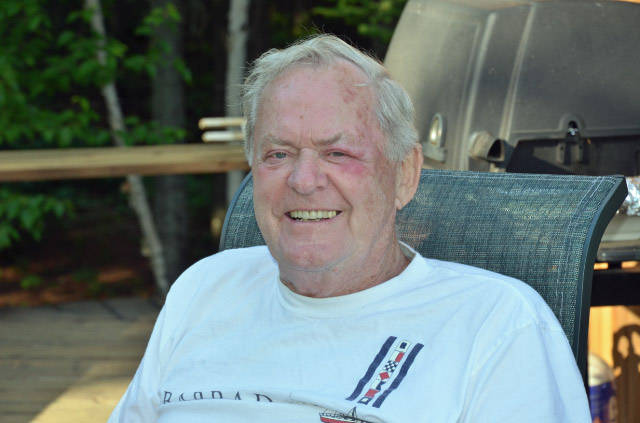 |
| Dr Bill Pellow at CHS Reunion 2012 |
Bill wrote:
""The site for cutting ice in Chapleau was on the Chapleau River west of the railroad tracks and half way between the Old Power house and the Chapleau Lumber mills. Very near where the Broomhead's farm property is located and where Dr. Frank docks his plane in the summer.
"A contract was drawn up and was let out for a horse and scoop to take the snow from the top of the ice and allow for a deep freeze . ' Blue ice" as it was called was preferable and was 'manufactured' in this manner.
"Ernie Rice was one of the perennial contractors for clearing ice, and with his team of horses for hauling the withdrawn cubed ice from the river to the CPR ice house opposite the Boston Cafe, Later another ice house was built at the east end of the CPR platform across the street from the homes of E. Lacroix and Bartley Kennan.
"Later, years later,horse drawn sleighs were replaced with trucks and snow plows. Once the ice depth was determined and measured to depth, a huge fowere ur foot circular saw cut a block pattern on the ice surface with lines running north and south and east and west and to a depth of about three feet. Heavy steel five foot chisels were used to break it clean from the mass.
"The blocks of ice were taken from the water by a gas driven endless belt and loaded onto the horse drawn sleighs for delivery. Raymond Sarto was put in charge of the ice saw. No one else wanted the job because it was a constant task to keep ice cut and to keep up to the sleighs on demand. There were few breaks in the work. Raymond went around all winter with his skin peeling from his face because of the severe frost bite he acquired behind that saw with the snow and ice chips constantly hammering his face. His entire body was covered in a thick film of 'ice dust'.
"Safety shields, saw guards and precautionary fencing to prevent drowning in the open frigid Chapleau River were not thought about then. If you happened to slip into the open water, you had to be retrieved within seconds or you were in for big problems with hypo thermia. Walking on blue ice next to the open watr was a constant concern. The splashed water froze instantly and it was always slippery.
" Imagine, diabolically opposite though. In those days no one spoke about wind chill factor. If it was fifty or sixty below on the thermometer it was just that cold outside and often we could talk about a chilling wind off the lake to boot. I have often listened to people from southern Ontario reiterate, 'But it was a dry cold'. Dry or wet it was damn cold. There was no protection from the cold and the wind on the lake. At least in town you had some protection from the building.
 |
| CHS Reunion 2012, Bill with friends from pioneer families |
"The sleighs filled with ice were drawn up to a loading ramp at the ice house. Each horse drawn sleigh could haul 20-24 blocks of ice as a full load. The ice house was a two storey wooden building painted CPR red, with tons of sawdust that was used within the walls for insulation and was shovelled on top of the ice to preserve it until needed for summer use to air condition the trains
"There were fifteen or twenty trains going through Chapleau every day. (in the summer) The regular trains were numbered from 1 to 8. The even numbers were headed east to Montreal and Toronto. The odd numbers were headed to Vancouver. There were sometimes four sections of a regular scheduled train . Passenger trains were always running on "block" i.e. at twenty minute intervals behind each other. Dangerous before block signal systems were installed.
"At the ice house loading platform the ice was tonged into a gas driven hoist that raised the huge blocks into the top levels of the ice house. A crew was inside the ice house and with ice tongs they wiggled the blocks across layers of frozen ice and snow to their finally resting place twelve or fifteen feet in each storey. When a section was completely filled the large thick insulated doors were shut and sealed. Ice is brittle and even with care and not much care was exhibited, there would be an accumulated pile of broken chipped ice around the hoist. This had to be kept clean and free from the mechanism.
"That was my regular job. It had its perks: when you got caught up and the hoist was clear you could slip across the street to the Boston Cafe and lean against the hot water radiators and let the heat jump inside your body for a short spell before you had to go out side and brave the elements and do it all over again. You could also see if the foreman was around and maybe looking for you. But the foremen were fathers as well as gang foremen and they had great compassion and understanding.
 |
| MJ Morris, Marg Fife, Bill, Vince Crichton |
"Saturday mornings freezing to death working on the ice gangs for the CPR made a body wonder about an inside job where you could "look out" and always be warm. It was a perpetual dream and the thought crossed my mind many a Saturday. Two pairs of pants, sometimes overalls three sweaters, Stanfield long underwear was standard apparel, flight boots and heavy woollen inserts over leather mitts, a beaver hat with lugs, ( my head at least was always sweating) and scarves just would not keep you warm.
"You couldn't put on more clothes even if you had them, because you had to navigate and work and there was a limit on wearing too much bulky clothing and being practical. Work was the salvation. So you constantly kept moving, and kicking your toes against something to remind you that your feet were down there and they were not turning to ice although it felt like that and maybe your feet could fall off if you didn't keep the circulation moving.
Moving prevented frost bite and severe chill. I am eighty years old and so often in winter the small of my back aches from what I must believe was a permanent chill in my back when I worked the ice gangs in my early teens. Ice gangs started at 7 a.m. and quit a 7 p.m. Dark starting to work and dark finishing. The pay was between 35- 50 cents an hour.
 |
| Bob Fife of CTV News with Bill |
You were warned that you were not to sit on the ice that you could get severe haemorrhoids. Truth or fiction, however most believed the story an it provided an incentive to stay on your feet and constantly keep moving. Maybe it was only a good bit of propaganda generated from the CPR to increase productivity and make the time motion studies practical. Now it is called work ethic and where have they gone?
Leo Ouimet of Peterborough wrote regarding Louis Fortin's memories from ice gang: "Thanks for this. Takes me back to the 60's when I worked in the dining cars one summer. I was on the spare board, so every trip was different; Thunder Bay, Halifax, etc. Some trips were spent peeling bushels of onions, others, washing dishes and scooping out pre-mixed mash potatoes. 18 hour days at $1.05 an hour. I still love trains."
Subscribe to:
Posts (Atom)
Michael J Morris

MJ with Buckwheat (1989-2009) Photo by Leo Ouimet
UNEEK LUXURY TOURS, ORLANDO FL

click on image
MEMORIES FROM CHILDHOOD

Following the American Dream from Chapleau. CLICK ON IMAGE
