MICHAEL's EMAIL

WELCOME TO THE MICHAEL J MORRIS REPORT!!!!

EMAIL mj.morris@live.ca

WRITE ME WITH COMMENTS, STORY IDEAS, SUGGESTIONS, INFORMATION REQUESTS. IF YOU CAN'T FIND A STORY, DO NOT HESITATE TO EMAIL ME

Showing posts with label Dr Bill Pellow. Show all posts

Wednesday, February 20, 2013

Engine 5433 a national treasure symbolizes Chapleau's railway heritage as one of only 48 preserved CPR steam engines

Brass replica of 5433. Courtesy Ian Macdonald

Engine 5433 located in Chapleau since 1964,  one of only 48 of the preserved 3257 Canadian Pacific Railway steam engines, perhaps more than anything else, symbolizes the community's railway heritage.
When I learned that Engine 5433 was one of only 48 CPR engines that have been preserved, and it is in Chapleau, its historical significance struck me, and during this Heritage Week in parts of Canada, including Ontario, I  have been "Googling" and contacting others who know much more about the history of the CPR than I do.

Well, let me digress for a moment with an anecdote about my display of CPR knowledge when I was taking Grade 13 history at Burnhamthorpe Collegiate Institute in Etobicoke.  Mr. Young, our rather excellent teacher was showing us the route of the CPR across Canada on one of those old red classroom wall maps.

I knew that he was showing us the route of the Canadian National Railway across northern Ontario but hesitated to tell him so. Gathering my courage, I raised my hand, and he said, "Yes, Morris." In those days teachers tended to call boys by their surnames.

Standing, I told him politely he was showing us the wrong route, followed by a dead silence in the classroom.

"How do you know Morris?", he asked, to which I replied, "Because I am from Chapleau, sir, and it is on the main CPR line." Mr. Young then invited me to come forward and outline the route. Gathering my courage again,  I did so and added that I knew the names of all the places between Chapleau and Fort William.  Mr. Young said, say them and I did: "Chapleau, Boucher, Esher, Pardee, Musk, Nicholson....and so on." He never held it against me but I sure had to know the history of the CPR as I was usually asked about it. Paybacks can be, well you know..!

How did I know them? Because my grandfather Harry Morris a CPR conductor gave me a timetable, and I learned them and when my mother   Muriel (Hunt) Morris and I were at their Elgin Street home for dinner waiting for him to come in off the road, I would tell them, 'ad nauseam', that  "Grandpa is now at Musk, now Pardee" etc.

Back to Engine 5433 and Chapleau. It arrived in 1964 because of the efforts of Arthur and Nettie Grout who were largely responsible for the creation of the entire Centennial Park. They contacted N.R. Crump, then the CPR president, who even came to Chapleau for the occasion.

Arthur Grout with N.R. Crump
How did they get it to the park after it arrived in Chapleau? I have the story from writings of Wilf Simpson and Dr. Bill Pellow.

Here is a summary. Engine 5433 is a testament to Chapleau's railroading past. The Iron Horse #5433, was proudly placed in the park in 1964, through the initiative and generosity of Arthur and Nettie Grout. This unit actually worked these tracks for many years west of Chapleau. It weighs 275 tons, measures 95 feet long, and hauled 1900 tons in its prime.

To place the engine on location meant building a special spur, or track, straight across from the roundhouse. A building had to be demolished to make way for the spur, which ran right up to the main line on the engine side, and continued on the other side of the main line. With a gang of trackmen, and everything timed to the minute, the spur was laid across the main line. The steam engine was then pushed across by a diesel. Within 30 minutes, the Iron Horse was in place, and the main line cleared again for service.

Also of historical interest is that J.M. "Bud" Park was the engineer on Engine 5433 for its trip from the roundhouse to the park while Earle Freeborn was the engineer on the yard engine diesel.

At the ceremony Samuel Chappise, a full blooded Cree who had come to Chapleau with his parents mostly by canoe from James Bay presented Mr. Crump with a rifle. Wilf Simpson related a story that Mr. Chappise had told him that for the first few weeks after they arrived along the CPR line near Nicholson, every time he heard a train whistle, he would race to the shelter of the forest.

Sam Chappise presentation to Mr Crump
In 1967, Mr. Chappise was invited to sound the 'O Canada' whistle opening the 1967 Centennial Caravan when it passed through Chapleau.

As I so often do, I turned to Ian Macdonald for his expertise on Engine 5433. Ian has a brass replica of this engine in his Winnipeg home. 

"Locomotives were the primary symbol of the railway. Occasionally we would digress ( as we did with the Canadian ) and use an image of an observation car or caboose but nothing really had the visual impact of a locomotive to define the railway. It was ( and is ) truly potent.  It is, therefore, the most logical symbol to use when you're trying to make a statement." Ian wrote in an email.

 "I remember when I first saw 5433 in (the park)  my first reaction was ' perfect'. Why perfect??? Dates generally become 'historic dates' when it can be reasonably said that the world was never the same after.  5433 to me, is important because it is symbolic of the end of the steam era in Chapleau in the same sense that the first GM diesel that went through Chapleau in December 1949 represented a new era which had an enormous impact on the community.

"In this sense, 5433 as an individual locomotive was not the important thing. It was everything required to operate it, maintain it and the infrastructure associated with supporting steam power."

For instance, Ian wrote, "try to envision the number of enginemen in Chapleau during steam power, their families, homes, and an economy generated to support them. Then think of everyone associated in some activity associated with maintenance and operation and interpolate this number into individual families etc. This was important in defining the specific culture of our community and who we were. Who we were is an important aspect of 'community'  and provides reference to who we are.

He explained that "The Mikado was the most dominant locomotive type on the Schreiber Division as the steam era ended and one which most people were familiar with. The era was important for me because the Mikado was designed and manufactured in Canada in direct response to the specific demands of Canadian operating conditions. I like that.

The GM diesel that went through Chapleau in 1949 was built in GM's plant at LaGrange Illiois and was typical of locomotives used everywhere else in North America. There was nothing particularly Canadian about it which didn't change when GM allowed them to be built under licence in Canada. Some people enjoy being reminded of that."

Until I started researching Engine 5433, I never fully realized the tourist attraction it is, and the potential it and all things railway in Chapleau has for the future. I discovered many references to it on web sites along with photos taken by people who had visited Chapleau. It may well be the most photographed site in Chapleau. 

While home for the CHS reunion in 2012, I was of course made aware that proposals have been made to enhance Chapleau's CPR heritage as a tourist attraction and ensure the care and maintenance of Engine 5433. Chapleau is home to a national treasure in having Engine 5433 there -- only one of 48 CPR steam engines that have been preserved. My email is mj.morris@live.ca

Thanks to Ian Macdonald, Dr Bill Pellow and Gerry Bowland director of the Crump Centre, Calgary


Saturday, September 22, 2012

Zoe Weber awarded $5,000 Dr. William R. Pellow Masonic Bursary at CHS graduation ceremony


Zoe Weber was the winner of the $5,000 Dr. William R. Pellow Masonic Bursary which was presented to her at the Chapleau High School graduation ceremony in June by Dr. Pellow on behalf of the Chapleau Masons.

Zoe is registered at the University of Ottawa for the 2012-13 acadamic year, full time, in the Honours Bachelor of Science program  with specialization in Human Kinetics. (Kinetics is the branch of physics that deals with the relation of force and changes of motion.)

Dr. Pellow extended congratulations to Zoe.  "Chapleau is so proud of your achievements and all look forward to more good news concerning your advancements."

 The Bursary award this year was increased from $3000 to $5000, to commemorate the 90th anniversary of the Chapleau High School.

The Masonic Bursary was established in 1987 by the Masons of Lorne Lodge 622, Chapleau, a registered charity which means that all donations are income tax deductible.  

 Keith McKnight , Arthur Broomhead and Yen Hong presented the first donation to establish this bursary on behalf of Lorne Lodge 622 at a banquet held in Chapleau to honour Dr. Pellow,  Grand Master of Ontario, then with a membership of 85,000.  Post-secondary education is constantly on the front burner and is  just one  of the active programs fostered by the Free Masons. 

 Lorne Lodge will be celebrating 100 years of existence in Chapleau in 2023. The thrust of Masonry is centered around charitable good works. Dr. Pellow is on a committee to establish a CHAIR at Brock University, (St. Catharines), in Masonic Studies within the department of History  and is active in funding the $6,000,000 project.

Saturday, July 21, 2012

ROBERT FIFE MEETS BISHOP TOM CORSTON 44 YEARS LATER AT CHAPLEAU HIGH SCHOOL REUNION


When Robert Fife was in Grade 9 at Chapleau High School in 1968-69, Tom Corston was in Grade 13 and president of the Students' Council. During the initiation a photographer captured Bob holding an umbrella over Tom, while also sneaking a smoke at the bottom of the hill at the new CHS.

Over the next 44 years they went their separate ways but they met at the 90th anniversary reunion festival of CHS, where Tom, now the Rt. Rev. Thomas A Corston, the Anglican bishop of the Diocese of Moosonee, invited Bob, now the Ottawa Bureau Chief of CTV NEWS, to participate in an ecumenical service.
Thomas A. "Tom" Corston, born and raised in Chapleau, Ontario, the son of Frances (Jardine) and the late Henry "Chicken" Corston, was elected the ninth Bishop of the Anglican Church Diocese of Moosonee at a synod in Timmins in July 2010..
He had been serving as an  archdeacon in the Anglican church and also Rector of the Church of the Epiphany, Sudbury, Ontario, in the Diocese of Algoma.

Growing up in Chapleau, Tom was active in St. John's Anglican Church, as AYPA president, which is a parish in the Diocese of Moosonee, he now leads.. Tom becomes the first Chapleau boy to have become an Anglican priest to have been elected a Bishop. Tom was also a president of the Students' Council at CHS.

He graduated from Lakehead University with the Bachelor of Arts degree and Wycliffe College with a Master of Divinity degree. He was ordained a deacon in the Anglican church in a service at St. John's Anglican Church, Chapleau, in 1974, and became a priest a year later.
He started his ministry in the Diocese of Moosonee and then served in several parishes in Atlantic Canada and Ontario.

Tom's grandparents John and Lydia (Swanson) Corston, came from James Bay in the Diocese of Moosonee to Chapleau in 1907 where his grandfather began work with the Canadian Pacific Railway. They established their family home on Grey Street.
Bob, who was born in Chapleau,  is the son of Margaret and the late Clyde Fife. Bob's grandfather George Fife was manager of the Chapleau Electric Light and Power Company and served as reeve of the Township of Chapleau from 1938 to 1942. Bob's father Clyde was later the manager and then of Chapleau Hydro.
After graduating from CHS. where like Tom,. he had served as president of the Students' Council, Bob attended the University of Toronto where he earned the Bachelor of Arts degree.
In 1978, Bob started his journalism career in the parliamentary bureau of NewsRadio and then he worked for United Press International.  He then became a senior political reporter for the Canadian Press and later spent 10 years as Ottawa Bureau Chief and political columnist for the Sun Media chain. At one point in the 1980s Maclean's magazine called Bob the best investigative reporter in Canada.


After the National Post was founded he joined it in 1998, and he became Ottawa Bureau Chief for CanWest News Services and the National Post in 2002.. He has won the Edward Dunlop Award for Spot News and two National Newspaper Citation of Merit for political reporting.
In 1991, Bob's first book, 'A Capital Scandal' which he wrote with John Warren came out. In 1993, Bob's second book, 'Kim Campbell: The Making of a Politician' was published. She became the first female prime minister of Canada. Both books remain a must read for a better understanding of politics in Canada. 
However, it has been since  Bob became Ottawa Bureau Chief of CTV News in 2005 that he has become a household name in Canada.

At the end of the service, a photo op was arranged where Bob and Tom would pose for a photo, although in so doing, I neglected to let them know that the 1968 photo would  play a role in this column. Thanks to Dr Bill Pellow for arranging for the photos to be taken. My email is mj.morris@live.ca.


Thanks to Dr. W.R. 'Bill' Pellow for arranging the photo shoot and providing the photos from the reunion.. Dr. Bill and Bob are surely discussing the major events of the day. Dr. Bill also attended CHS.

SEE STORY ON ROBERT FIFE: http://michaeljmorrisreports.blogspot.ca/2011/01/robert-fife-from-chapleau-winner-of.html

SEE STORY ON TOM CORSTON http://michaeljmorrisreports.blogspot.ca/2010/04/tom-corston-elected-ninth-anglican.html

Saturday, September 10, 2011

CHAPLEAU HIGH SCHOOL MASONIC BURSARY RAISED TO $5,000 IN 2012 TO MARK SCHOOL's 90th ANNIVERSARY

The Chapleau High School student who wins the Dr. William R. Pellow Masonic Bursary in 2012 will receive $5,000 to assist him or her with post secondary education, the bursary committee has announced.

To mark the 90th anniversary of the school in 2012, the committee will increase the bursary to $5,000 for one year only - from the $3,000 that is usually awarded. On June 27, 2005, the committee increased the annual bursary from $300 to $3,000.

"The Dr. William R. Pellow Masonic Bursary Committee raised the annual bursary award from $3,000 to $5,000 for one year only...", the committee announced in a news release, in recognition of the 90th anniversary of CHS.

It noted: "This is the largest bursary on record at Chapleau High School administered and registered bursary by any one Chapleau group or single individual".

The news release also said that all proceeds from Chapleau Trails, edited and published by Dr. William R. Pellow are directed to the Masonic Bursary Fund. The price for Chapleau Trails is $50.00. It is a great read about the life, times and people of Chapleau.

To purchase a copy of Chapleau Trails or make a donation to the bursary fund, please contact Dr. Bill Pellow at drpellow@rogers.com

Thursday, April 29, 2010

D.O. Payette 'catalyst' behind first Chapleau winter carnivals in 1930s was active in business, church and community life

As I was browsing through a wonderful pile of Chapleau material recently received from David McMillan, it intrigued me to discover one clipping noting that D.O. (Ovide) Payette would sing "the Mass of Angels" all in Latin at Sacred Heart Roman Catholic Church.

I was aware of Mr. Payette's very significant role in the history of Chapleau, but did not know that he had been a soloist and choir director at Sacred Heart church.

Lucien Bouillon, who would become a Roman Catholic priest and the first to be ordained to the priesthood in Sacred Heart Church in 1965, made the observation about Mr. Payette's singing in Latin in an article in The Chapleau Sentinel marking the 100th anniversary of the parish in 1986. Lucien was serving as an altar boy in the fifties when Mgr. Romeo Gascon was the pastor.

From the time Mr. Payette arrived in Chapleau just after the beginning of the 20th Century he was involved in the life of the community and his church. I visited that fantastic resource for Chapleau material, www.chapleau.com, created and maintained by Hugh Kuttner, and discovered photos showing that Mr. Payette was playing hockey on a Chapleau team by 1905-06. As there is a trophy in one photo, it looks like his team had won a championship.

Turning to Chapleau Trails, edited and published by Dr. William R. Pellow, I found that his daughter, Margaret Rose (Payette) Fortin wrote that her father, born in Pembroke, who taught school in Golden Lake, Ontario, came to Chapleau to work in the men's wear at Smith and Chapple Ltd. By around 1930, Mr. Payette and Arthur J. Grout bought the store and started to expand its departments. Mr. Payette became president of the company.

Margaret Rose noted that it was probably one of the first "shopping centres" in Ontario, and it likely was, living up to its reputation of providing "Everything for Everybody." For those of us who grew up shopping and working at Smith and Chapple, it is hard to believe that it closed its doors 23 years ago on April 30, 1987.

During the thirties plans to start a Chapleau winter carnival were made in Mr. Payette's office. He was described as the "catalyst' for starting the winter carnivals, and his business partner Mr. Grout became the chairman.

Mr. Payette was also very active in the Chapleau Town Band and by 1952 took over leadership of it and served in that capacity for 10 years until he retired. I can recall times when Mr. Payette, and three of his sons, John, Billy and George, would all be playing in the band for the July 1 celebration.

He also served as a volunteer firefighter and was Chapleau's fire chief for a number of years as well as being manager of the Chapleau Memorial Community Arena at one time and chairman of the Chapleau High School Board.

Very involved in all aspects of life in Chapleau, Mr. Payette was a member of the Rotary Club, the golf and curling clubs, and at Sacred Heart Church, he was a member of the Knights of Columbus and a Grand Knight. After his retirement from Smith and Chapple, Mr. Payette also served as a Justice of the Peace.

Margaret Rose wrote that music was a large part of the "growing up years" in the Payette family home with both her parents involved in the Sacred Heart church choir, and "as each of us became old enough to contribute, we were part of the choir." In fact, she revealed that her parents met at the church when Mr. Payette was the choir director, and her mother, (Marie Cahill) arrived in Chapleau to become the church organist. She adds, "the rest, as they say, is history. They were married in 1923."

Mr. Payette's contribution, in his church, in business and the wider community, played an important role in the life and times of Chapleau.

MAIL

Commenting on Chapleau Moments about 1976, Eugene Bouillon wrote: "omg, Michael, yes memories (of 1976). I graduated from College and of course worked with Terry (Bryson) helping plan the Celebrations. Also, travelled with Doreen (Collings) to Red Rock to pick up the Pickerel for the Fish Fry and stayed up all night working on the fire for the Beef BBQ. Yes memories."

Thursday, April 1, 2010

Dr. Bill Pellow recalls working winter weekends on CPR ice gangs in the 40s and heading to Boston Cafe to 'let heat jump inside body'

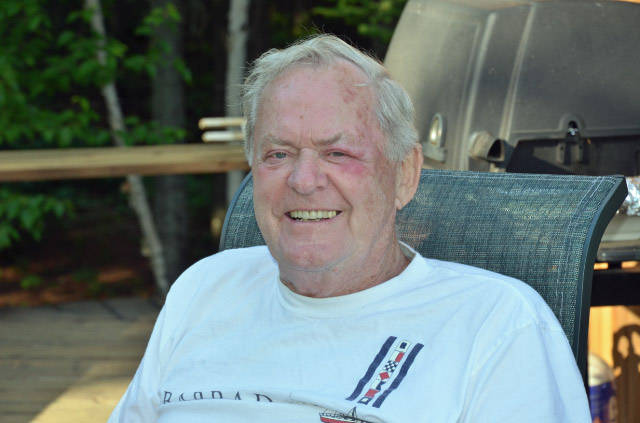
Dr Bill Pellow at CHS Reunion 2012
Dr. William R. 'Bill' Pellow agreed to share some of his memories of working on CPR ice gangs on weekends during the winter months when he was a high school student in Chapleau during the 1940s. Bill, who was born and raised in Chapleau, is the editor of 'Chapleau Trails.' Thanks Bill for bringing us some moments from a day long gone now in Chapleau's history.

Bill wrote:

""The site for cutting ice in Chapleau was on the Chapleau River west of the railroad tracks and half way between the Old Power house and the Chapleau Lumber mills. Very near where the Broomhead's farm property is located and where Dr. Frank docks his plane in the summer.

"A contract was drawn up and was let out for a horse and scoop to take the snow from the top of the ice and allow for a deep freeze . ' Blue ice" as it was called was preferable and was 'manufactured' in this manner.

"Ernie Rice was one of the perennial contractors for clearing ice, and with his team of horses for hauling the withdrawn cubed ice from the river to the CPR ice house opposite the Boston Cafe, Later another ice house was built at the east end of the CPR platform across the street from the homes of E. Lacroix and Bartley Kennan.

"Later, years later,horse drawn sleighs were replaced with trucks and snow plows. Once the ice depth was determined and measured to depth, a huge fowere ur foot circular saw cut a block pattern on the ice surface with lines running north and south and east and west and to a depth of about three feet. Heavy steel five foot chisels were used to break it clean from the mass.

"The blocks of ice were taken from the water by a gas driven endless belt and loaded onto the horse drawn sleighs for delivery. Raymond Sarto was put in charge of the ice saw. No one else wanted the job because it was a constant task to keep ice cut and to keep up to the sleighs on demand. There were few breaks in the work. Raymond went around all winter with his skin peeling from his face because of the severe frost bite he acquired behind that saw with the snow and ice chips constantly hammering his face. His entire body was covered in a thick film of 'ice dust'.

"Safety shields, saw guards and precautionary fencing to prevent drowning in the open frigid Chapleau River were not thought about then. If you happened to slip into the open water, you had to be retrieved within seconds or you were in for big problems with hypo thermia. Walking on blue ice next to the open watr was a constant concern. The splashed water froze instantly and it was always slippery.

" Imagine, diabolically opposite though. In those days no one spoke about wind chill factor. If it was fifty or sixty below on the thermometer it was just that cold outside and often we could talk about a chilling wind off the lake to boot. I have often listened to people from southern Ontario reiterate, 'But it was a dry cold'. Dry or wet it was damn cold. There was no protection from the cold and the wind on the lake. At least in town you had some protection from the building.

CHS Reunion 2012, Bill with friends from pioneer families
"Delmos Paquette was assigned as the foreman to ice cutting and storing. As young boys looking for week-end work we had to check in with Delmos and get "hired on" If you presented for work you were never turned away. Perhaps because we lived next door to the Paquettes all our lives in Chapleau, I was given one of the better jobs at the ice house up town. I never was sent to the lake.

"The sleighs filled with ice were drawn up to a loading ramp at the ice house. Each horse drawn sleigh could haul 20-24 blocks of ice as a full load. The ice house was a two storey wooden building painted CPR red, with tons of sawdust that was used within the walls for insulation and was shovelled on top of the ice to preserve it until needed for summer use to air condition the trains

"There were fifteen or twenty trains going through Chapleau every day. (in the summer) The regular trains were numbered from 1 to 8. The even numbers were headed east to Montreal and Toronto. The odd numbers were headed to Vancouver. There were sometimes four sections of a regular scheduled train . Passenger trains were always running on "block" i.e. at twenty minute intervals behind each other. Dangerous before block signal systems were installed.

"At the ice house loading platform the ice was tonged into a gas driven hoist that raised the huge blocks into the top levels of the ice house. A crew was inside the ice house and with ice tongs they wiggled the blocks across layers of frozen ice and snow to their finally resting place twelve or fifteen feet in each storey. When a section was completely filled the large thick insulated doors were shut and sealed. Ice is brittle and even with care and not much care was exhibited, there would be an accumulated pile of broken chipped ice around the hoist. This had to be kept clean and free from the mechanism.

"That was my regular job. It had its perks: when you got caught up and the hoist was clear you could slip across the street to the Boston Cafe and lean against the hot water radiators and let the heat jump inside your body for a short spell before you had to go out side and brave the elements and do it all over again. You could also see if the foreman was around and maybe looking for you. But the foremen were fathers as well as gang foremen and they had great compassion and understanding.

MJ Morris, Marg Fife, Bill, Vince Crichton
" I look back and admire men like Delmos Paquette, Jimmy Purich and Ed Swanson. If you kept moving and did some work you were never scolded and never turned down on a future Saturday.. Red flags of caution were placed on the overhead bridge to warn of horse and sleigh traffic at the bottom of the bridge where the ice was removed and stored.

"Saturday mornings freezing to death working on the ice gangs for the CPR made a body wonder about an inside job where you could "look out" and always be warm. It was a perpetual dream and the thought crossed my mind many a Saturday. Two pairs of pants, sometimes overalls three sweaters, Stanfield long underwear was standard apparel, flight boots and heavy woollen inserts over leather mitts, a beaver hat with lugs, ( my head at least was always sweating) and scarves just would not keep you warm.

"You couldn't put on more clothes even if you had them, because you had to navigate and work and there was a limit on wearing too much bulky clothing and being practical. Work was the salvation. So you constantly kept moving, and kicking your toes against something to remind you that your feet were down there and they were not turning to ice although it felt like that and maybe your feet could fall off if you didn't keep the circulation moving.

Moving prevented frost bite and severe chill. I am eighty years old and so often in winter the small of my back aches from what I must believe was a permanent chill in my back when I worked the ice gangs in my early teens. Ice gangs started at 7 a.m. and quit a 7 p.m. Dark starting to work and dark finishing. The pay was between 35- 50 cents an hour.

Bob Fife of CTV News with Bill
Tonging the blocks took a little skill and a little brawn.. There was no way to lift a block of ice this size, some three-four feet thick but with a side to side action they would "slide" across the loading ramp into the hoist and slide them into their final resting place inside the house.

You were warned that you were not to sit on the ice that you could get severe haemorrhoids. Truth or fiction, however most believed the story an it provided an incentive to stay on your feet and constantly keep moving. Maybe it was only a good bit of propaganda generated from the CPR to increase productivity and make the time motion studies practical. Now it is called work ethic and where have they gone?

MAIL

Leo Ouimet of Peterborough wrote regarding Louis Fortin's memories from ice gang: "Thanks for this. Takes me back to the 60's when I worked in the dining cars one summer. I was on the spare board, so every trip was different; Thunder Bay, Halifax, etc. Some trips were spent peeling bushels of onions, others, washing dishes and scooping out pre-mixed mash potatoes. 18 hour days at $1.05 an hour. I still love trains."

Michael J Morris

Michael J Morris
MJ with Buckwheat (1989-2009) Photo by Leo Ouimet

UNEEK LUXURY TOURS, ORLANDO FL

UNEEK LUXURY TOURS, ORLANDO FL
click on image

MEMORIES FROM CHILDHOOD

MEMORIES FROM CHILDHOOD
Following the American Dream from Chapleau. CLICK ON IMAGE