MICHAEL's EMAIL

WELCOME TO THE MICHAEL J MORRIS REPORT!!!!

EMAIL mj.morris@live.ca

WRITE ME WITH COMMENTS, STORY IDEAS, SUGGESTIONS, INFORMATION REQUESTS. IF YOU CAN'T FIND A STORY, DO NOT HESITATE TO EMAIL ME

Showing posts with label world war II. Show all posts

Sunday, July 15, 2018

Remembering Flying Officer Jim Morris: 'Every day is Remembrance Day' for 75 years

Rotary Park
By Michael J Morris

Rotary Park in the very heart of Cranbrook's downtown core has been one of my favourite places in the city ever since I arrived here 29 years ago just about now.

Over the years I have often stopped there to rest when on a walkabout of that part of the city, but this time I had a special reason for a visit. The cenotaph and Wall of Honour are located there, and for me it was the place to go and spend a few moments in quiet reflection on a long ago incident that affected me and my family and the lives we have led.


Seventy-five years ago, on July 16, 1943, a Wellington bomber took off from an air force base in England. It was to be a short height test flight around the airfield only.


The last entry in the pilot's log book written later by the squadron's wing commander was, "Aircraft exploded in air."

The usual telegram was sent by the war office, expressing regret that Flying Officer James E. Morris, my father,  was killed while on active service in the Royal Canadian Air Force, July 16,1943. Similar messages would have been sent to the families of my father's crew who were on the flight with him. The crew members were five Canadian boys, from Ontario, Alberta and Saskatchewan, brought together  because of Canada's participation in World War II.

Dad shortly before he was killed 1943

Upon arriving at Rotary Park, I stopped at the cenotaph located in about the exact middle of the park, and read the inscription: "To the honour and memory of OUR BOYS from Cranbrook district who gave themselves for liberty." Every one of those inscribed on the cenotaph, like me, had a family and friends, and I shared a moment with them.

I headed over to the Wall of Honour, a project spearheaded by the Cranbrook Firefighters and Branch Number 24 of the Royal Canadian Legion where the names of those who served their country in the Boer War, World War I, World War II and Korea are inscribed.

As I stood looking at the wall with the Canadian Ensign, Maple Leaf and Union Jack flags fluttering above me, I thought what a truly amazing project it was to have undertaken and to all those who made it a reality -- thank you.

On the other side of the Wall of Honour is  a mural entitled Valour Remembered and a plaque says it was done as a Millenneum Project from the time Cranbrook and district had people involved in the Boer war in 1900 to 2000. The mural was painted by the distinguished internationally acclaimed Canadian artist Joseph Cross, who lives in Cranbrook.

The latest addition to the site is a Garden of Remembrance opened in June 2011.

I sat down on a park bench for some reflection.

My Dad and Mom on Wedding day 1940

Although I didn't know it at the time, July 16, 1943, was destined to be the most significant turning point in my life, and I wasn't even two years old when my father's plane exploded in air and crashed over the English countryside during World War II. In fact, that date had a profound effect on my entire family. Nobody was ever quite the same again. Of course, in 1943, I wasn't really aware of what life was like for my mother, Muriel E. (Hunt) Morris, my grandparents Harry and Lil Morris and George and Edith Hunt, my father's sister Marion, and the close relationship they all had. 
Me with my Dad 1942 Only photo of us

My grandmother Hunt was in England at the time working as a war nurse and my father had visited her the weekend before he was killed. She attended his funeral and burial in Ripon Cemetery, Yorkshire, England. Grandpa Hunt was with us in Chapleau.
Jim Morris 

My father, like so many who joined Canada's armed forces during World War II was an ordinary Canadian from a small town, in his case, Chapleau, Ontario where he was born and raised, called upon to perform the exceptional. There was absolutely no doubt in their minds whatsoever that it was the right thing for them to do. I am sure there are many here in Cranbrook who felt the same way.

After his death, The Evening Telegram of Toronto reported that my father took to flying in his early teens and became associated with several of Canada's early bush pilots who were operating in the Chapleau area. Actually he was going down to the waterfront and getting rides and learning to fly planes, thinking that my grandmother didn't know what was going on. But she did. Mothers always know!  


In 1940 my father enlisted in the RCAF at Moncton, New Brunswick. He became a flying instructor and was posted to No. 10 Elementary Flying Training School at Mount Hope. He was among the first instructors in the Commonwealth Air Training Plan. In 1942 he went overseas. I was born on November 3, 1941.

On November 11, Remembrance Day, we pause for a moment, and for some of us, for much more than a moment, to remember all those who died in war. For those of us affected so profoundly by war, we live with a day of remembrance each day of our lives.

My mother who likely never missed a Remembrance Day service, once told me that "Every day is remembrance day."  I thought of my mother's words before I headed off to Rotary Park and knew it was the right thing to do.

Stephen Hayter, the executive director, of the Commonwealth Air Training Plan Museum in Brandon, Manitoba, has agreed to include my father's  RCAF material in a display there.

In an email to me, Mr. Hayter wrote: "It is your father's story that we wish to preserve for future generations...Your father's name is also listed in our memorial book They Shall Grow Not Old which also states that he was part of #432 Leaside Squadron (Saevitir Ad Lucem), and that his Wellington aircraft #JA 119 crashed one and one half miles west of Malton, Yorkshire."  
Me 2018. a Michael Pelzer photo

As I was leaving the park I noticed another plaque in memory of Soren Johnson, a horticulturist who was instrumental in tree selection for  Cranbrook Rotary Club in 1928 that created the beautiful urban forest in the downtown core.

What a beautiful place it is and what visionaries the members of the 1928 Rotary Club were to create it. And thanks to Cranbrook Firefighters, Branch Number 24 of the Royal Canadian Legion and all the rest who were involved in creating the Wall of Honour. 

They shall grow not old, not at all, for you will always remember yours as I remember mine. My email is mj.morris@live.ca


Tuesday, May 8, 2018

Making peace by overcoming ugliness with beauty, meanness with generosity, lies with truth, evil with good!

Let me share some thoughts expressed by Rev. Canon H.A. Sims, the Rector of St. John's Anglican Church in 1948. They seem as appropriate today on this Victory in Europe Day (V-E Day) in our troubled world as they were three years after the end of World War II.

In part, here is what Canon Sims. a World War I veteran,  said:

"There is not the slightest necessity for civilized men to destroy their civilization in warfare. Nothing is settled by warfare which could not be better settled in some more reasonable, humane and decent way.

"Warfare is caused by men  who have allowed the spirit of the devil rather than the spirit of God to determine their thinking.

"Peace does not come through wishing for it or through praying for it... peace comes only from those who make it; who work harder at making peace than men working at making war.

"We must make peace by working hard at overcoming ugliness with beauty; overcoming meanness with generosity; overcoming lies with truth and by overcoming evil with good."

I was at the church that night with my family because a memorial prayer desk was being dedicated in memory of my father, Flying Officer James E Morris, who was killed on active service in the Royal Canadian Air Force in 1943 during World War II. I was seven years old.

In his incredible book, 'The Ordeal of Total War', Gordon Wright tells us that Sir Winston Churchill once commented that the effects of World War II, will be felt by those affected by it for at least 100 years. Trust me, Churchill was right. I am just shy of 77 now , and have lived with that war every day of my life.

Every time I hear of the death of one of the member of our armed forces, or for that matter police officers, firefighters, and other first responders, my heart goes out to their family and friends. I know, I care  and I understand.  My email ias mj.morris@live.ca

Saturday, June 18, 2016

Maud Hands, first woman elected to Chapleau council, also served as only president of local branch of Red Cross Society in World War II

Mrs Hands front row centre Names not available
Mrs. Maud Hands was the only president of the Chapleau branch of the Canadian  Red Cross Society during World War II, according to an article in the Chapleau Post.

In November 1946, the executive of the Chapleau branch hosted an afternoon tea in the lodge room of the Town Hall, which was located on the second floor of the municipal building opened in 1914. Service badges and pins were presented at the meeting.

During World War I, she had served as a nurse in England. Her first husband Ambrose Evans, was serving with Lord Strathcona's Horse, (Royal Canadians), Royal Canadian Armoured Corps.  Michael McMullen and I note in 'The Chapleau Boys Go To War' that he was classified as missing and presumed dead, and is commemorated at the Vimy Memorial, Vimy, Pas-de-Calais, France. His name is also inscribed on the memorial plaque at St. John's Anglican Church, Chapleau.

After the war, she returned to Chapleau and in due course, married Fred Hands. She worked as a nurse at Lady Minto Hospital for many years, and had the distinction of being the first woman elected to Chapleau council in 1947. Mrs. Hands was also the long-time superintendent of St. John's Sunday School, and leader of the Junior WA of the church.
Branch members circa 1945


At the tea, certificates of merit were presented to the Catholic Women's League of Sacred Heart Roman Catholic Church, accepted by Mrs. Vezina; Trinity United Church Women's Auxiliary, accepted by Mrs. Hamlin, and St. John's Women's Auxiliary by Mrs. Card.

Freda Matters accepted the certificate on behalf of Chapleau High School while Betty Ann Payette and Pearl Marchesseault accepted on behalf of the separate school and public school respectively.

Thirty-two pins and and nine service badges were presented to members by Mrs. Hands, assisted by Mrs. A. Austin and Miss Foy.

The Chapleau Post reported that at the tea hour, Mrs. H. Sauve and Mrs. Vezina poured tea, "the long table covered with a beautiful lace cloth with a huge bouquet of yellow chrysanthemums in the centre. Four young girls from the high school waited on the aldies. They were Miss Betty Ann Payette, Miss Pearl Marchesseault, Miss Betty Edwards and Miss Gloria Warren."

During World War II, the Chapleau branch was actively involved in the Red Cross National Appeal. In 1944, Reg Thrush wrote "Campaign Notes" for the Chapleau Post.

He noted that the campaign had ended but the Chapleau branch had over $5,600 in cash on hand. Its goal had been $3,750, and donations were still coming in.

Mr. Thrush wrote: " The stories told by returning heroes who have seen Red Cross work in prison camps and on machine-gunned battlefields undoubtedly did much to encourage people to open their hearts and purses to a worthy cause."

Apparently babies played a prominent part in the Chapleau canvas. For example, he noted that the youngest boy of Charles W. Collins appeared on the donor list, "only to be topped by his sister".

"The baby daughters of another soldier father, (J.G. 'Jiggs' Goldstein, who was serving overseas in the Canadian Army) Anne and Dawn Goldstein also appear on the list."

"A mysterious group of young ladies described as the 'Sit and Chats', Bea, Babs, Ina, Irene, Kay, Myrtle and Vera, appear both collectively and individually," Mr. Thrush wrote. I think I know who all these ladies  were, but will not take a chance in making a mistake. If you know, my email is mj.morris@live.ca


Thanks to Anne (Zufelt) McGoldrick for providing names

Red Cross picture
                                                                                         Mrs. Card, Mrs. Shoup    
Back row`: Miss Holding,  Mrs. Boulard,  Mrs Nell Crichton,  Edna Crowhurst , Miss Foy (Separate School Principal),  Mrs. Ernie Holding, Mrs. Jardine, Mrs. Austin
 
Middle Row:   Mrs. Steed, Mrs. Edith Hunt, (our grandmother),Mrs. Deluce, Mrs. Cochrane, Mrs. Robinson, Mrs. Simpson, Mrs. Banks
 
Front Row:  Mrs. Delaney, Mrs. Strapp, Mrs. H. Gagnon,  unknown, Mrs. Sauve, Mrs. Hands,  unknown, unknown, Mrs. Jack McAdam

the top photo

  Mrs Austin                        mrs. Wilson,  unknown might be mrs barnes Edith Way-Waywhite , Terry Way-white wife
Mabel Westerman Murphy, Mrs. Laurie Westerman,   Mrs. Connie  I think  Way-White Carroll ,  Bea Chevalier Galy,   Vi  Nolan Selin                      Elsie Zufelt, Mrs. Byce, Vera Westerman Martin
 
Sonego,  unknown, Mrs. Hands, Mrs. H. Gagnon  unknown


Friday, June 12, 2015

'Chapleau Boys Go To War' presented to Cranbrook Public Library

Terry Burgess, Ron McFarland, MJM, Ursula Brigl, Bill Nightingale (Joel Vinge photo)
The Chapleau Boys Go To War now has a place in the Cranbrook Public Library following  presentation of a copy to chief librarian Ursula Brigl.

Accompanied by  Ron McFarland a World War II veteran who served in the Royal Canadian Navy,  and Bill Nightingale who served 33 years in the Royal Canadian Air Force,


I presented a copy to Ursula,on behalf of my co-author Michael K McMullen and myself,

To have Ron and Bill take time to attend the presentation, made it especially meaningful, even though they are not "Chapleau Boys", officially, they represented all of them, and all who have served Canada in our nation's armed forces. Thank you so much!

Terry Burgess, treasurer of the Friends of the Cranbrook Public Library, made the arrangements for the presentation, and Ursula Boy, president of friends of the library also attended. Thanks Terry and Ursula.
Bill, Ursula Boy, MJM, Ron, Terrry (Joel Vinge photo)

Thanks to Joel Vinge for being the official photographer.

On a personal note, I have lived in Cranbrook just on 26 years now, and am so delighted that the library agreed to add The Chapleau Boys Go To War to its collection. I often visit Rotary Park here and spend time looking at the names on the Wall of Honour and the Cenotaph from Cranbrook and area who served in the armed forces. Every time is a visit home to Chapleau too.

I am reminded that it is so important to focus on those things bringing us together in this nation, rather than those dividing us. Thanks Ron and Bill.

My email is mj.morris@live.ca


Saturday, May 30, 2015

'Chapleau Boys Go To War' story of significant contributions at home and abroad in World War 1 and World War 2

The Chapleau Boys Go To War is  the story of the contributions and sacrifices made during World War 1 and World War 2, at home and abroad by the people of Chapleau.

My cousin, Michael McMullen and I have been working on this project for several years, and the book has just been published. 

In the introduction we note that 2014 marked the 100th anniversary of the start of WW 1 and the 75th anniversary of the start of WW 2.

" Canadians volunteered to serve from all across their country for both conflicts, and small towns and villages, like Chapleau, made significant contributions to both war efforts. They went to war because they believed it was the right thing to do. They were representing their families, friends, neighbours, colleagues and all of Canada, and were willing to pay the Supreme Sacrifice."

Our research revealed that there were 283 enlistments in World War 1 with a Chapleau connection, and 416 in World War 2 -- an incredible number given the population of the community during both wars.

Some returned home but others did not not. There were 32 "Chapleau boys" who died while on active service in the first world war and 29 in the second. We pay special tribute to the fallen with a biographical sketch and photos of them where available.

We have included a list of the names of all those with a Chapleau connection who served in both wars.

We also provide a look into the founding of Chapleau in 1885 with the arrival of the Canadian Pacific Railway, as well as life on the home front In both wars with a fascinating look at the work of the Chapleau branch of the Canadian Red Cross Society and other projects.

We were able to obtain some letters  from Chapleau boys in both wars who were overseas providing a glimpse into their lives on the front lines, a number of them written home near Christmas.

After World War I, Chapleau's first reeve G.B. Nicholson and his wife, Charlotte, had St. John's Parish House built in memory of their son Lorne who was killed on active service, and his friends. It became the Legion Hall. The book also notes the contribution of Branch No. 5 (Ontario) of the Royal Canadian Legion, from its founding in 1926 on.

Michael K (left) and I have serious chat about Chapleau Boys Go To War
On June 25, 1978, the cenotaph was moved from its original location beside St. John's Anglican Church to the Legion property. In 2000, the Chapleau Cree First Nation established the Fox Lake War Veterans Memorial. In 2014, Donald White, Chapleau's oldest living World War II veteran attended the Remembrance Day service at the cenotaph.

Henry (Harry) Byce and his son, Charles Byce, were Chapleau boys. They enlisted and fought in WW 1 and WW 2, respectively. Both received exceptionally high honours for valour and bravery for their individual war exploits. They were among the highest decorated Aboriginal veterans. We tell their stories.

Four Chapleau boys, Willard Bolduc, Baisel Collings, Donald Freeborn and Lloyd McDonald were among the recipients of the Distinguished Flying Cross. We share their stories of bravery.

With thanks, particularly to former cadets, we were able to share highlights of 1181 Chapleau High School Cadet Corps.

Both Michael and I share some personal thoughts, and in my case, for the first time in my life, I share an anecdote involving Dr. Karl Hackstetter, John McClellan and me when I was in Grade 9 at Chapleau High School.

There is a chapter on cemeteries and monuments globally, compiled by Michael, some of which he has visited.It is a most valuable resource and also shows the high esteem in which our "Chapleau Boys" are held.


Michael McMullen explained that "fallen 'Chapleau Boys' are commemorated by name on the Chapleau cenotaph, and for WW I on a plaque at St. John’s Anglican Church. "
Michael added:
"We wanted to know more about them and for most of them, have been able to put together short resumes with pictures that include family information, occupation at enlistment, place of enlistment, some of their armed forces experience, date of death and cemetery or memorial information. This is our way of preserving their memories.
"We hope the information we have provided for foreign cemeteries and memorials will help to provide a context to where the Chapleau Boys were when they were killed or died due to war inflicted causes.
"We also hope our work will be used as a reference for family descendants to do research on their relatives that served in wars. It is important that photos of those who served and letters that they sent home are preserved with details of their service. If not, this material will be lost, if not already lost, with the passage of time.
"Ideally, our book will serve as a catalyst for families to search old shoeboxes for pictures and letters from those who served. Also, medals and awards should be documented for future family generations. It is important that this information not be lost. We owe this to all Chapleau Boys who have served in wars and conflicts."
I extend my most sincere personal thanks to Mario Lafreniere, publisher of the Chapleau Express, for inviting me to write Chapleau Moments almost six years ago. Had he not done so, I likely would not have begun my research into "Chapleau Boys Go to War". Our book is available now or please email me at mj.morris@live.ca for other purchasing options. 

Wednesday, October 30, 2013

Nicholson generosity left Chapleau with 'most elegant and distinctive of all Royal Canadian Legion properties in Canada'

Royal Canadian Legion hall Chapleau
Lt. Lorne Weller Nicholson was killed in action just one week before the armistice that ended World War I on November 11, 1918.

The Toronto Star of November 26, 1918, in his obituary said, "Lieut. Nicholson went overseas with the 227th Battalion, 'Men-of-The- North. He was transferred to the 4th C.M.Rs and went to France in 1917. 

The Star story continued: He was wounded with shrapnel in January of this year (1918), but recovered quickly, not leaving his battalion. He was wounded again in April, and was in a Canadian hospital in France when it was bombed and more than 300 lives lost.

"He was transferred to the Prince of Wales Hospital in London, where after three and a half months, he fully recovered, returning to his battalion on September 29. He was in the lines continually from that time until just one week before the armistice was signed when he made the supreme sacrifice".

Lorne Weller Nicholson was the only child of George Brecken and Charlotte (Weller) Nicholson On April 19, 1920, the St. John's Memorial Hall, first called Parish House, which his parents had built, was officially opened.

As George Evans once wrote "It is significant that the donors of the building did not put their names on the monumental inscription: they were content that the world remember them simply as the father and mother of Lt. Lorne W. Nicholson."  

It reads: "St. John's Parish House. In memory of Lt. Lorne W. Nicholson and all those who with him voluntarily gave their lives in the Great War. Erected by his father and mother A.D. 1919", and at the bottom of it, the words from the Gospel According to John, "Greater love hath no man than this, that a man lay down his life for his friends". (John 15:13)

Mr. Nicholson was the first reeve of Chapleau serving from 1901 to 1913, and at the time the hall was opened was the Member of Parliament for East Algoma , and Mrs. Nicholson had been one of the first school teachers in Chapleau.

Some of those participating in the memorial service at St. John's Anglican Church and official opening at the hall included  Rev. John Nelson Blodgett, Rector of St. John's Anglican Church; Rev. Dr. Robert John Renison, later Bishop of the Anglican Church diocese of Moosonee; Rt. Rev. John George Anderson, Bishop of Moosonee; Reeve Max Brunette, Township of Chapleau; Rev. George Prewer and Rev. White.

Lt. -Col. C. H. LeP. Jones , the commanding officer of 227th Battalion of the Canadian Expeditionary Force and Major D.M. Brodie also participated.

Ian Macdonald, retired head of the department of architecture and professor emeritus at the University of Manitoba, who has researched and written extensively on Chapleau buildings kindly agreed to let me share some of his thoughts about the building, now commonly referred to simply as "The Legion".

"A building as distinctive and prominent as the Nicholson Hall accurately reflected the public honour for war sacrifice, military service, veterans and the Union Jack that the World War I vets fought under. The Victorian gothic revival style of the building, which is closely associated with monarchism, reminds us of the significant cultural role of architecture and the British Dominion that we were at the time," Ian wrote.

"The Canadian Parliement buildings were also built in the same style to echo the architecture of Westminster and provide a permanent reminder of our British heritage."

"The Legion Hall is formally organized around a central axis, and the gothic revival windows, doors and details are what most individuals would associate with a religious building," Ian noted.

In fact, when I googled Chapleau Legion Hall recently, a photo popped up on a web site and whoever posted it, thought it was a church. A Chapleau person had posted a correction in the comments section.

Ian also speculated on what the Legion in Chapleau might have built, had it not been for the philanthropic act of Mr. and Mrs. Nicholson, albeit that it was first given to St. John's Anglican Church as a parish house.

"There are plenty of examples of other Legion facilities in small Canadian communities to provide an idea of what might have been", Ian wrote, adding that the Nicholson generosity "has left Chapleau with what is probably the most elegant and distinctive of all Royal Canadian Legion properties in Canada. It is clearly the most sophisticated building of its time in Chapleau."

By the 1930s and the onset of the Great Depression, St. John's was no longer able to maintain the hall, and it was subsequently closed and turned over to the municipality. Branch Number 5 of the Royal Canadian Legion rented it for some years until 1955 when B.W. "Bubs" Zufelt was reeve, the Legion took ownership of the building. Mr. Zufelt was made a life member of the branch for his efforts.

On November 11, Remembrance Day, Chapleau will once again "remember them" including Lt. Lorne Weller Nicholson and all those who gave their lives in World War I, World War II, Korea and NATO service.

My thanks to Ian Macdonald and Doug Greig for their assistance. My email is mj.morris@live.ca


Wednesday, November 7, 2012

Following the American Dream from Chapleau and reuniting with my 'seven sisters' in a lasting bond of over 70 years

After my father, Flying Officer James E. Morris was killed while on active service in the Royal Canadian Air Force on July 16, 1943 during World War II, my mother  Muriel (Hunt) Morris decided we would remain in Chapleau, but stay in  touch with some of my parents' close friends made when he was a Flying Instructor with the British Commonwealth Air Training Plan.
Iven and Arlene Nichol came to Canada from the United States after the war started in 1939,  and Iven joined the RCAF, then became, like my father, a flying instructor at Mount Hope near Hamilton.  Iven was one of hundreds of Americans who came to Canada to join our nation's armed forces before their country entered the war in 1941.

Jim and Muriel Morris
J.L. Granatstein, the former CEO of the Canadian War Museum and historian described the BCATP as "the major Canadian military contribution to the Allied (Second World) War effort." It was a program to train air crew members from the Royal Air Force, the Royal Australian Air Force and Royal New Zealand Air Force and RCAF in Canada. By the end of the war more than 130,000 air crew members had been trained and more than 100 aerodromes and landing fields built across Canada.

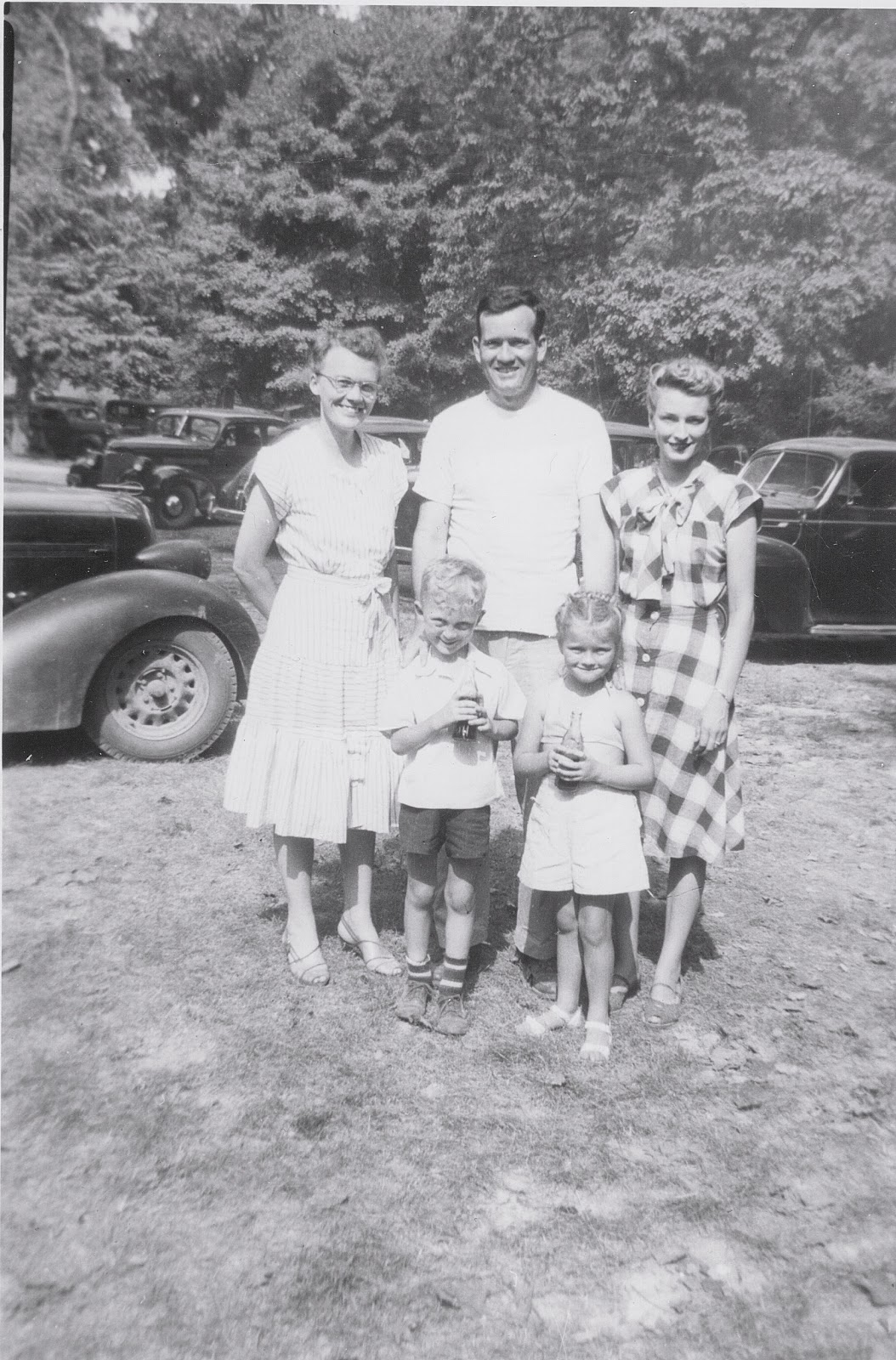
My parents met Iven and Arlene in Hamilton, and more than 70 years later, I am in contact with their children. In a real way, I have been able to follow the American Dream through their family, beginning shortly after the end of the war when Mom and I travelled by train from Chapleau to Illinois to pay our first visit.

In Illinois circa 1947 names below
It was on that trip that I visited Tom Sawyer's caves in Hannibal, Missouri in Mark Twain country and fell in love with marching bands when they took us to the Illinois State Fair.

As Iven moved up the corporate ladder, the ever growing family moved to Pittsburgh where we  visited often and I saw my first Major League baseball game.

But most importantly, I still recall Iven telling my mother that the next day he was going to take me and their oldest daughter Sandy for an airplane ride over Pittsburgh. My mother was not in favour, but Iven insisted that given how my father died, it was something that had to be done. Iven won and to this day I am grateful to him.

But, he wasn't done. We had arrived in Pittsburgh by train, but Iven arranged for us to fly back to Toronto on a commercial flight which was the first time my mother had flown.

We visited them In Stamford, Connecticut too and my mother made regular visits for many years. I had my first slice of pizza in Stamford.

In 1955, Iven, his father-in-law and a friend came to Chapleau on a fishing trip. I was in Grade Eight at Chapleau Public School and J.M. Shoup, the principal who had served in World War I and  World War II let me skip classes to go fishing with them one afternoon at Poulin Creek. To his great credit, Mr. Shoup understood how important it was for me to go fishing with one of my father's very best friends from World War II

In Chapleau 1955.. names below
After my mother died in 1989, I was going through her address book and found a number for them in Florida where they had moved to retire. I called and had one long last chat with Arlene. Iven had died a few years earlier.

But, how did I get back in touch with the Nichol children?  Actually they found me. In 2009, I wrote a story about watching the Stanley Cup finals between Pittsburgh Penguins and Detroit Redwings, mentioning that I was cheering for Pittsburgh because as a kid I visited Iven  and Arlene Nichol who had lived there. It appeared on the Internet.

Some time later there was a comment posted on it from Susan: "I am one of Iven and Arlene's daughters. They loved to entertain so I am not surprised that they showed you some American life." Needless to say, I was amazed.

Then I received an email from Janet, another daughter. There were eight daughters, seven of whom are still alive.

Janet explained: "My nephew was asking my sister Susan if his grandfather was on the internet.  She did a search and your blog came up from your report on the 2009 Stanley Cup where you reminisced about Pittsburgh and your visits with my family Iven and Arlene Nichol.  You can imagine my sister’s shock and my nephew’s joy to find that small paragraph so kindly penned about our parents/grandparents."

Laurie, in her first email wrote about my mother. "I too am a product of that American Dream! I am #7 of the 8 girls in the family and I fondly remember my Auntie MOO!  She was always my favorite visitor and covered me with love like I was the most special child. I know she had much love to give and she shared that love with so many! I miss her so much and I am blessed to have known her love!"

Just recently Laurie sent me a message that sums up so incredibly well the bond that was created during the war and continued to this day even when we have not seen in each other in years, and our parents are now gone. "I know that you and your mom were very important to my dad. He and your dad were like brothers and when he spoke of him, you and Auntie Moo, his heart would swell and his eyes would be moist with tears, he loved you all that much!"

The Nichol children called my mother Auntie Moo, my father's nickname for her, and Laurie also commented that she lived in a "a fairy tale land called Chapleau, Ontario."


Sandy, the eldest of the family shared that her father came to Canada as he was upset that the US was doing nothing to stop Hitler and he felt so stongly about it that he enlisted in the RCAF.


"Since you know him I'm sure that this makes perfect sense to you.  He held such strong convictions and felt that Hitler needed to be stopped.  He went to Canada and enlisted and I suppose it was pure happenstance that he was sent to Hamilton.  The real irony is that after all of that, he was never sent to Germany to bomb the Nazis, but was left behind to train others to do what he wanted to do himself."

He did tell of several scary experiences where he was nearly killed by his students. "I remember one story he told that when he gave final instructions to a student about to take his first solo flight  and as he climbed down from the cockpit his wedding ring got caught on a rivit on the wing and he was dragged down the runway as the student  was about to take off. Dad managed to free himself just in time, but from then on he never wore his wedding ring.  Mom didn't have a problem with that and was grateful that Dad was OK."
Me and Sandy, Illinois, circa 1947
"Another time he said he had his student 'buzz' the house just before the lesson was over so Mom would know to come and pick him up.  As she waited at the chain link fence for him to land the student crashed the plane and Dad was tossed free of the wreckage on the other side so Mom could not see him.  She was sure he was hurt or dead when he walked around from behind the wreckage and she could see he was fine.  He always told these stories with that rather 'dirty laugh'  that he had and usually went to get another scotch.'

Sandy concluded that it was nice to have a "brother" and that I had "seven sisters" in the United States.

As we mark Remembrance Day, I decided to share this very personal story about the lasting bond of over 70 years, begun at the beginning of World War II when a young Canadian couple, Jim and Muriel Morris met Iven and Arlene Nichol from the United States, became friends and the relationship continues to this day.

They shall grow not old!  My sincere thanks to Sandy, Pam, Jeanne and Janet, Lynne, Laurie, and Susan. Beth  passed away at a young age. My email is mj.morris@live.ca

Top photo: Iven, Arlene, children, my Mom at Greater Pittsburgh Airport circa 1952

Mom, Iven, Arlene, in front are me and Sandy in Illinois circa 1947

Party photo in Chapleau: from left Harold Kennedy, Jiggs Goldstein, Bubs Zufelt, Beth Goldstein, my Mom,  Paul Behrens, Marion Morris,  Iven Nichol, Elsie Zufelt, Harry Morris (my grandfather)

John Gillespie Magee was an American who joined the RCAF and was killed on active service in 1941.


High Flight

Oh! I have slipped the surly bonds of Earth
And danced the skies on laughter-silvered wings;
Sunward I've climbed, and joined the tumbling mirth
Of sun-split clouds, — and done a hundred things
You have not dreamed of — wheeled and soared and swung
High in the sunlit silence. Hov'ring there,
I've chased the shouting wind along, and flung
My eager craft through footless halls of air. . . .
Up, up the long, delirious burning blue
I've topped the wind-swept heights with easy grace
Where never lark, or ever eagle flew —
And, while with silent, lifting mind I've trod
The high untrespassed sanctity of space,
Put out my hand, and touched the face of God.
— John Gillespie Magee, Jr

Michael J Morris

Michael J Morris
MJ with Buckwheat (1989-2009) Photo by Leo Ouimet

UNEEK LUXURY TOURS, ORLANDO FL

UNEEK LUXURY TOURS, ORLANDO FL
click on image

MEMORIES FROM CHILDHOOD

MEMORIES FROM CHILDHOOD
Following the American Dream from Chapleau. CLICK ON IMAGE