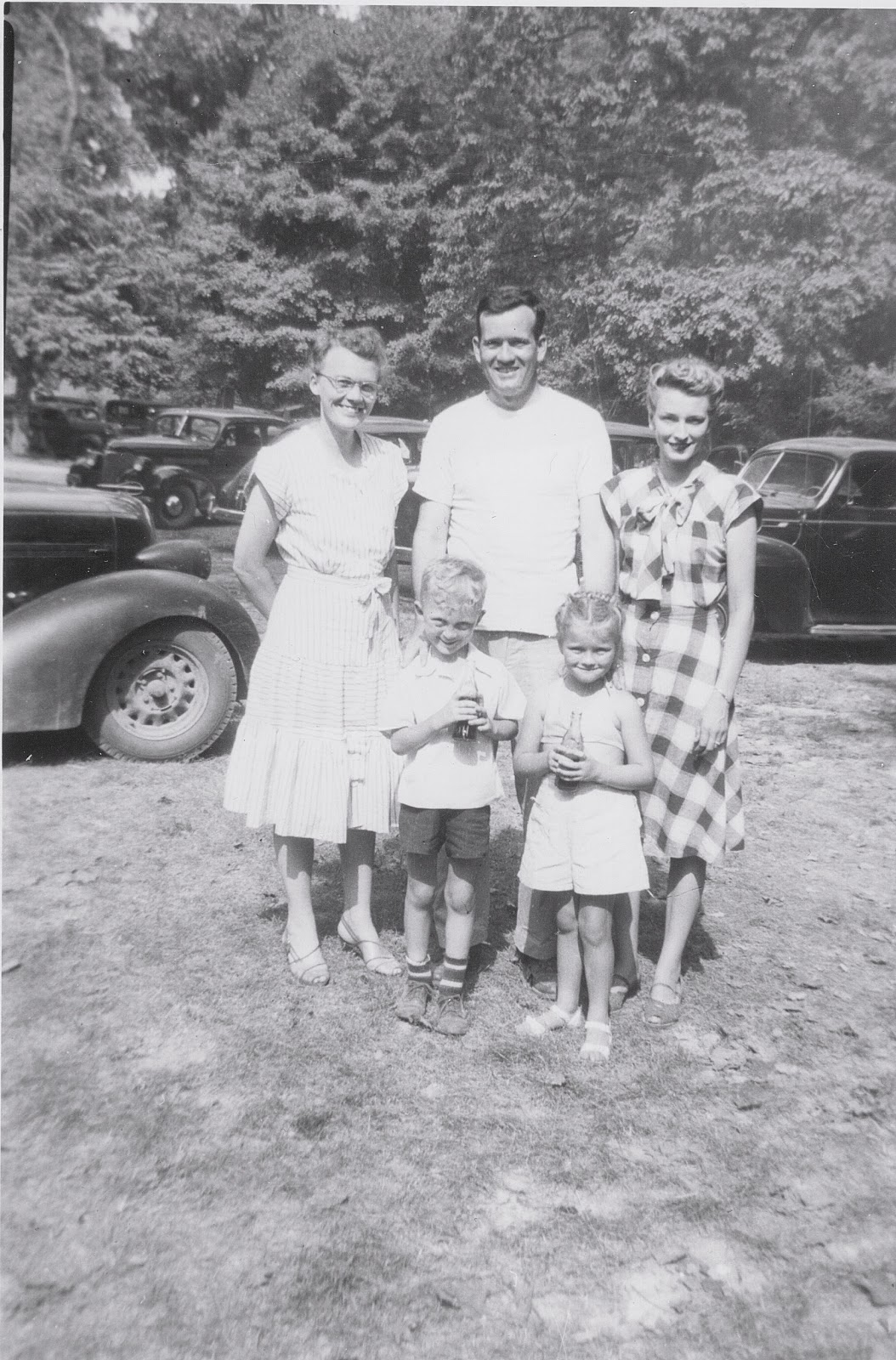
MICHAEL's EMAIL

WELCOME TO THE MICHAEL J MORRIS REPORT!!!!

EMAIL mj.morris@live.ca

WRITE ME WITH COMMENTS, STORY IDEAS, SUGGESTIONS, INFORMATION REQUESTS. IF YOU CAN'T FIND A STORY, DO NOT HESITATE TO EMAIL ME

Monday, November 19, 2012

Moment of childhood ecstasy for Neil Morris riding in steam engine cab with his Uncle Nick as engineer

IAN TELLS ABOUT ENGINES BELOW!!!!!!!
When Neil Morris was 11-years-old, he took his first ride on steam engine with his uncle F.A. 'Nick' Card, a Canadian Pacific Railway engineer in Chapleau.

Years later, Neil, no relation to me, a reporter at The London Free Press, wrote 'Moment of Childhood Ecstasy' after his uncle had retired from the CPR in 1978. It appeared in the Chapleau Sentinel, and is a wonderful heartwarming story about a child's trips in the cab of steam and diesel engines with his Uncle Nick as the engineer.

Neil wrote that his uncle to him as "a giant of a man."

"His engineer's cap shoved shoved back on his prematurely balding head he'd toss that enormous plumber's tool box that was really his next 24 hour's meals onto to the steel doorway. Then he was up the ladder and through the doorway."

Then it was time for Neil to join him.

"Up you come fella," his uncle would say "with a grin, arms reaching down to me when what I really needed wasn't a help up the ladder but something to hold a kid's pounding heart from exploding."

Nick Card was born in Lady Minto Hospital in Chapleau in 1914, and served the community as a councillor and reeve as well as being active in other community organizations throughout his life. He attended Chapleau Public School and graduated from Chapleau High School in 1934. His father, William Card, also had served on Chapleau council.

Neil continues: "Inside the warm cabin with its throbbing steam guages, his fireman smiled my way while swinging huge shovelfuls of coal into the gaping firebox.

"The engine lurched as my uncle's gloved hand eased the throttle lever open. Steam blasted from the cylinders behind the cowcatchers. We were moving."

Neil explained that for an 11-year-old it was a moment never to be forgotten, "a thrill relived every time I see a huge steam locomotive on display for a new generation of children to stand in awe over, albeit never to ride."

I contacted Ian Macdonald, now professor emeritus and retired head of the department of architecture at the University of Manitoba and a great railway buff to ask if he knew the type of engines being used by the CPR when Nick was an engineer. Ian also worked on the CPR and received training on both steam and diesel engines.

As always, Ian was back to me quickly: "Steam engine 5433 was actually a Winnipeg locomotive but this locomotive type was the dominant locomotive type on the Schreiber Division during the time Nick was on the road.  This is what makes it the  most appropriate locomotive to preserve. Kudos to Art Grout."

Steam engine 5433 has been on display in Chapleau Centennial Park since 1964 when Mr. Grout, the president of Smith and Chapple Ltd.,  arranged to get it from the CPR. N.R. Crump, then CPR president, was on hand for the ceremony.

As a matter of historical interest, when 5433 was being moved to the site on a temporary track, J.M. 'Bud' Park was the engineer and Earle Freeborn was engineer on the yard engine.

Back to Neil's story. Although he wasn't there  when that "giant of an uncle" retired, others were, nephews like himself who had "enjoyed their moment of glory in one of his engines in their childhood. Each in his turn had climbed that ladder first of steam engines then later of those diesels with their strangely different sounds and smells."

He explained that the diesels were never like the steamers with their familiar pant, hissing jets of steam and huge clouds of smoke billowing upward as they strained to tug a long freight" out of Chapleau.

Referring to his uncle's retirement:
"Gone are the days when an engineer's heart was in his mouth as his own headlight reflected back at him of a snow-covered evergreen on a curve  - his moment of  terror that he was meeting another engine head on.

"Gone are the days when he climbed back into an engine, his coveralls ice coated after a water tender spout took a crazy turn and drenched him in freezing  January weather.

"And gone are the nights of the 'call boy' shouting at the front door that he was called for this train and that.

His Uncle Nick would be home for Christmas when Neil wrote his article and would not have to leave when his 'call' arrived just as the aroma of turkey was starting to emerge from the oven.

"And then he would be gone into the snow without a grumble - just a grinning wish for a happy Christmas for all"

Neil noted this was the railroad life and his uncle loved it adding he hoped other uncles or dads would continue to slip a son or daughter, a nephew or niece onto one of those big diesels for Their "moment of childhood ecstasy."  I don't know if it would be possible today but Neil's story sure brings back memories of train travel.

Neil concluded: "To me, my uncle was a close kin to Santa Claus. Perhaps, in away, he was the spirit of what Santa Claus is all about. And not too surprisingly his name just happens to be Nick."

F.A. 'Nick' Card died in 1986.

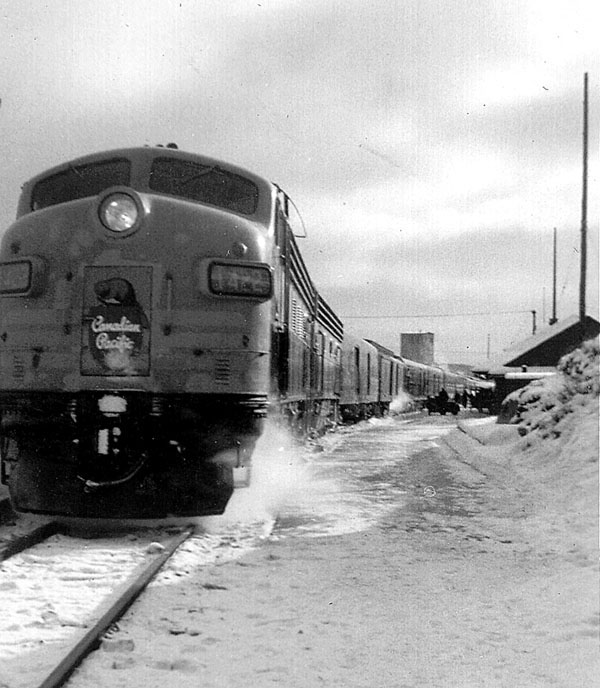
Ian sent me other photos and explained: "There are two types of Alco locomotives.  Both were of the earliest type used on the CPR in the 1950's and 60's.  The two road engine consist is pulling a freight train over the trestle into Chapleau. The other more typical locomotive onsist is sitting outside the Chapleau shops.

"2841 is a classic Hudson locomotive was used mainly on the transcontinental trains before they were replaced by diesels. 2841 was relegated to freight service in the late 1950's before being scrapped.

"I include an image of the GM demonstrator locomotives which were the first through Chapleau in 1949.  I include the image because it shows the complete train including the dynamometer car immediately behind the locomotives that monitored locomotive performance. I attach another image of the same GM type in CP paint sitting outside the Chapleau shops."

Thanks Ian as always for your assistance. I received the Neil Morris story from the late David McMillan, who gave it to me when he came to visit me in Cranbrook.  My email is mj.morris@live.ca

Wednesday, November 14, 2012

Santa Claus Parade was coming to Chapleau in December 1948 sponsored by Branch No. 5 of the Royal Canadian Legion following successful play presentation

Toddy Collinson, George Collinson, John Rose
Ted Soucie was telling his Chapleau Post readers that before reading his column, leave it aside and go to Major's Cleaners and get tickets for the play being sponsored by Harry Searle Branch No. 5 of the Royal Canadian Legion.
 Ted added: "Now that you're back, I hope that you got good seats. Let me remind you that it is a full program and you had better be there early. We're starting on the button -- but if you happen to get in a little early, you'll be entertained by some good music."
 It was Chapleau, December, 1948. Having returned from World War II, the new Chapleau Legion branch members joined the World War I veterans, in becoming a central focus in Chapleau life.
 For example, the play 'Cousin Jill from Junction Hill' was sponsored by the branch and was being directed by J.M 'Jack' Shoup, a veteran of both World Wars I and II, Legion Branch president at the time, principal of Chapleau Public school and member of Chapleau township council -- in fact Mr. Shoup holds the record for the longest serving council member with 16 one year terms in the community's history.
J.M. Jack Shoup
 Major's Cleaners was operated by D.T. 'Toddy' Collinson, a World War II veteran, who in 1976 on the occasion of the 50th anniversary of the Chapleau Legion participated in honouring George Collinson, on being a member of the branch for 50 years. His father was a World War I veteran, Chapleau's postmaster and fire chief for many years, and always active in community affairs.
 Ted moved on to sharing news about the "new room" in the Legion hall, revealing that Henry Therriault had shown it to him and had "every reason to feel proud." A successful redecoration project had been undertaken. In 1948 the branch was in the same building it is today but it was not until 1955 when B.W. 'Bubs' Zufelt was reeve that it took over ownership from the municipality.
 Henry had also dropped in to see him and requested that he "plug" a Stag and Spaghetti feed scheduled for December. "It is going to be one of our old-fashioned stags and guess who is going to make the sauce? None other than George Bucciarelli himself! Nuff said." Mr. Bucciarelli who owned a grocery store on Lorne Street south and after whom Bucciarelli's Beach is named, perhaps needless to say, was famous for his spaghetti sauce.
 In 1948, Henry Therriault, after returning home from active service in World War II, had become First vice president of the branch. Always active in the Legion and other community affairs, he served 12 terms as branch president.
 SANTA CLAUS COMING TO TOWN
 Ted noted that he had received a letter from Santa who advised that Chapleau children were "swamping' him with letters which was just fine and all would receive their card before he arrived for the Santa Claus Parade on December 11. I have some of those letters written way back in 1948 and will share them in a later column.
 The parade, another activity sponsored by the Legion, under the guidance of Wilf Simpson, World War II veteran, , was being planned although some more volunteers were needed for Santa's Military Guard of Honour. The Legion was accepting donations for the Santa Fund to help the less fortunate at Christmas.
 Wilf and his orchestra were also playing for Saturday night dances in the hall. Admission was 50 cents.
 As I wrote in my 1984 book, 'Sons of Thunder ... Apostles of Love' the World War II veterans returned home, resumed their employment, married and started to raise their families.
All of them, from World War I and World War II having experienced the bitterness of war and having lived through the Great Depression were determined to build a better community for their children.
 They became involved in local organizations, sat on the municipal council and school boards, and were active in their church. As Mr. Shoup so often said, "They had a duty to serve." And they did, in time of war and peace. This is just a glimpse of one month in the life of Harry Searle Branch No. 5 (Ontario) of the Royal Canadian Legion. My email is mj.morris@live.ca

Wednesday, November 7, 2012

Following the American Dream from Chapleau and reuniting with my 'seven sisters' in a lasting bond of over 70 years

After my father, Flying Officer James E. Morris was killed while on active service in the Royal Canadian Air Force on July 16, 1943 during World War II, my mother  Muriel (Hunt) Morris decided we would remain in Chapleau, but stay in  touch with some of my parents' close friends made when he was a Flying Instructor with the British Commonwealth Air Training Plan.
Iven and Arlene Nichol came to Canada from the United States after the war started in 1939,  and Iven joined the RCAF, then became, like my father, a flying instructor at Mount Hope near Hamilton.  Iven was one of hundreds of Americans who came to Canada to join our nation's armed forces before their country entered the war in 1941.

Jim and Muriel Morris
J.L. Granatstein, the former CEO of the Canadian War Museum and historian described the BCATP as "the major Canadian military contribution to the Allied (Second World) War effort." It was a program to train air crew members from the Royal Air Force, the Royal Australian Air Force and Royal New Zealand Air Force and RCAF in Canada. By the end of the war more than 130,000 air crew members had been trained and more than 100 aerodromes and landing fields built across Canada.

My parents met Iven and Arlene in Hamilton, and more than 70 years later, I am in contact with their children. In a real way, I have been able to follow the American Dream through their family, beginning shortly after the end of the war when Mom and I travelled by train from Chapleau to Illinois to pay our first visit.

In Illinois circa 1947 names below
It was on that trip that I visited Tom Sawyer's caves in Hannibal, Missouri in Mark Twain country and fell in love with marching bands when they took us to the Illinois State Fair.

As Iven moved up the corporate ladder, the ever growing family moved to Pittsburgh where we  visited often and I saw my first Major League baseball game.

But most importantly, I still recall Iven telling my mother that the next day he was going to take me and their oldest daughter Sandy for an airplane ride over Pittsburgh. My mother was not in favour, but Iven insisted that given how my father died, it was something that had to be done. Iven won and to this day I am grateful to him.

But, he wasn't done. We had arrived in Pittsburgh by train, but Iven arranged for us to fly back to Toronto on a commercial flight which was the first time my mother had flown.

We visited them In Stamford, Connecticut too and my mother made regular visits for many years. I had my first slice of pizza in Stamford.

In 1955, Iven, his father-in-law and a friend came to Chapleau on a fishing trip. I was in Grade Eight at Chapleau Public School and J.M. Shoup, the principal who had served in World War I and  World War II let me skip classes to go fishing with them one afternoon at Poulin Creek. To his great credit, Mr. Shoup understood how important it was for me to go fishing with one of my father's very best friends from World War II

In Chapleau 1955.. names below
After my mother died in 1989, I was going through her address book and found a number for them in Florida where they had moved to retire. I called and had one long last chat with Arlene. Iven had died a few years earlier.

But, how did I get back in touch with the Nichol children?  Actually they found me. In 2009, I wrote a story about watching the Stanley Cup finals between Pittsburgh Penguins and Detroit Redwings, mentioning that I was cheering for Pittsburgh because as a kid I visited Iven  and Arlene Nichol who had lived there. It appeared on the Internet.

Some time later there was a comment posted on it from Susan: "I am one of Iven and Arlene's daughters. They loved to entertain so I am not surprised that they showed you some American life." Needless to say, I was amazed.

Then I received an email from Janet, another daughter. There were eight daughters, seven of whom are still alive.

Janet explained: "My nephew was asking my sister Susan if his grandfather was on the internet.  She did a search and your blog came up from your report on the 2009 Stanley Cup where you reminisced about Pittsburgh and your visits with my family Iven and Arlene Nichol.  You can imagine my sister’s shock and my nephew’s joy to find that small paragraph so kindly penned about our parents/grandparents."

Laurie, in her first email wrote about my mother. "I too am a product of that American Dream! I am #7 of the 8 girls in the family and I fondly remember my Auntie MOO!  She was always my favorite visitor and covered me with love like I was the most special child. I know she had much love to give and she shared that love with so many! I miss her so much and I am blessed to have known her love!"

Just recently Laurie sent me a message that sums up so incredibly well the bond that was created during the war and continued to this day even when we have not seen in each other in years, and our parents are now gone. "I know that you and your mom were very important to my dad. He and your dad were like brothers and when he spoke of him, you and Auntie Moo, his heart would swell and his eyes would be moist with tears, he loved you all that much!"

The Nichol children called my mother Auntie Moo, my father's nickname for her, and Laurie also commented that she lived in a "a fairy tale land called Chapleau, Ontario."


Sandy, the eldest of the family shared that her father came to Canada as he was upset that the US was doing nothing to stop Hitler and he felt so stongly about it that he enlisted in the RCAF.


"Since you know him I'm sure that this makes perfect sense to you.  He held such strong convictions and felt that Hitler needed to be stopped.  He went to Canada and enlisted and I suppose it was pure happenstance that he was sent to Hamilton.  The real irony is that after all of that, he was never sent to Germany to bomb the Nazis, but was left behind to train others to do what he wanted to do himself."

He did tell of several scary experiences where he was nearly killed by his students. "I remember one story he told that when he gave final instructions to a student about to take his first solo flight  and as he climbed down from the cockpit his wedding ring got caught on a rivit on the wing and he was dragged down the runway as the student  was about to take off. Dad managed to free himself just in time, but from then on he never wore his wedding ring.  Mom didn't have a problem with that and was grateful that Dad was OK."
Me and Sandy, Illinois, circa 1947
"Another time he said he had his student 'buzz' the house just before the lesson was over so Mom would know to come and pick him up.  As she waited at the chain link fence for him to land the student crashed the plane and Dad was tossed free of the wreckage on the other side so Mom could not see him.  She was sure he was hurt or dead when he walked around from behind the wreckage and she could see he was fine.  He always told these stories with that rather 'dirty laugh'  that he had and usually went to get another scotch.'

Sandy concluded that it was nice to have a "brother" and that I had "seven sisters" in the United States.

As we mark Remembrance Day, I decided to share this very personal story about the lasting bond of over 70 years, begun at the beginning of World War II when a young Canadian couple, Jim and Muriel Morris met Iven and Arlene Nichol from the United States, became friends and the relationship continues to this day.

They shall grow not old!  My sincere thanks to Sandy, Pam, Jeanne and Janet, Lynne, Laurie, and Susan. Beth  passed away at a young age. My email is mj.morris@live.ca

Top photo: Iven, Arlene, children, my Mom at Greater Pittsburgh Airport circa 1952

Mom, Iven, Arlene, in front are me and Sandy in Illinois circa 1947

Party photo in Chapleau: from left Harold Kennedy, Jiggs Goldstein, Bubs Zufelt, Beth Goldstein, my Mom,  Paul Behrens, Marion Morris,  Iven Nichol, Elsie Zufelt, Harry Morris (my grandfather)

John Gillespie Magee was an American who joined the RCAF and was killed on active service in 1941.


High Flight

Oh! I have slipped the surly bonds of Earth
And danced the skies on laughter-silvered wings;
Sunward I've climbed, and joined the tumbling mirth
Of sun-split clouds, — and done a hundred things
You have not dreamed of — wheeled and soared and swung
High in the sunlit silence. Hov'ring there,
I've chased the shouting wind along, and flung
My eager craft through footless halls of air. . . .
Up, up the long, delirious burning blue
I've topped the wind-swept heights with easy grace
Where never lark, or ever eagle flew —
And, while with silent, lifting mind I've trod
The high untrespassed sanctity of space,
Put out my hand, and touched the face of God.
— John Gillespie Magee, Jr

Michael J Morris

Michael J Morris
MJ with Buckwheat (1989-2009) Photo by Leo Ouimet

UNEEK LUXURY TOURS, ORLANDO FL

UNEEK LUXURY TOURS, ORLANDO FL
click on image

MEMORIES FROM CHILDHOOD

MEMORIES FROM CHILDHOOD
Following the American Dream from Chapleau. CLICK ON IMAGE